
Manchester United’s 2–1 Premier League defeat by Leeds United at Old Trafford on Monday night highlighted a clear lack of strength in depth in Michael Carrick’s squad. Injuries, suspensions and a few tactical calls forced the United manager into more changes than at any point this season.
No Harry Maguire. No Kobbie Mainoo. No Diogo Dalot. No Bryan Mbeumo. No victory.
It was a timely reminder that this squad needs a full audit ahead of a pivotal summer transfer window.
To that end, we’ve produced position-by-position ratings that reveal weaknesses the hierarchy simply can’t afford to ignore. After assessing the defensive half of the squad in part one, we now turn to the roles that determine whether United can influence matches at the sharp end of the pitch.
As before, each position’s starter and back-up is rated out of five, giving a combined maximum score of ten. Lower numbers indicate a greater need to replace or strengthen the position. Youth players full of potential but unproven in the first team automatically receive a two.
So here we go….
Midfield (No. 8) – 5.5 out of 10
Kobbie Mainoo (3.5 out of 5): Out of favor under Ruben Amorim, the England international was straight back into the team under Michael Carrick and has started every game as United have climbed to third in the Premier League. He essentially missed half the season and is still working his way back to full speed, but his quality is obvious. Mainoo’s ability to receive under pressure and play through the lines gives United a calmer, more controlled platform.
Toby Collyer (2 out of 5): As with midfield partner Casemiro, there is no real back-up for Mainoo — academy graduate Toby Collyer is the closest. The 22-year-old has made 13 senior appearances but is yet to make a genuine breakthrough. He spent an injury-hit 2025/26 season on loan at Championship sides West Bromwich Albion and Hull City. Collyer’s potential is there, but relying on him as the primary alternative to Mainoo next season would be a gamble for a team expecting Champions League football.
Midfield (No. 10) – 7.5 out of 10
Bruno Fernandes (5 out of 5): United’s creative heartbeat could walk into any side in Europe, and it is sobering to think where The Red Devils might be without him. The Portuguese international rarely misses a game and his ability to decide matches with a pass or a shot makes him close to irreplaceable.
Under Carrick, his role has looked more structured, with clearer pressing triggers and better options around him. The issue in the No.10 slot isn’t the starter; it’s what happens when Bruno doesn’t play.
Mason Mount (2.5 out of 5): A favourite of multiple managers for club and country, Mount has endured an injury nightmare since moving to United. His profile — intelligent movement between the lines, the capacity to press aggressively and the technique to combine quickly in tight areas — is an ideal fit, but he has too rarely been available. He has featured in just 67 games in all competitions across three seasons at Old Trafford.
Right Forward – 7.5 out of 10
Bryan Mbeumo (4 out of 5): United’s best signing of a successful summer window. Mbeumo is explosive in transition, strong carrying the ball over distance, and scores important goals cutting in from the flank. His performances have dipped slightly since returning from the African Cup of Nations, although he has also been used as the main centre-forward during that period. He remains a constant threat, while also doing the unglamorous work off the ball.
Amad Diallo (3.5 out of 5): Technically gifted, brave enough to take defenders on in the final third and capable of creating chances in crowded situations. Amad also gives Carrick tactical flexibility: he can hold the width, drift inside, or operate as a secondary striker. His spell as a wing-back under Amorim has improved his defensive output, but at 23 he is still searching for consistency over a full season.
Left Forward – 7.5 out of 10
Matheus Cunha (4 out of 5): Cunha brings a different kind of threat to United’s left side: less chalk-on-the-boots wing play and more of a hybrid forward who can carry the ball, link with the striker and arrive in the box to finish moves. He’s aggressive, difficult to play against, and provides a powerful dribbling ability that can move United up the pitch even when the build-up is messy.
Patrick Dorgu (3.5 out of 5): Dorgu’s switch further forward from wing-back or full-back has given United pace and power down the left. He stretches defences, attacks space with real intent and offers an outlet when United want to play faster. The next step is end product and decision-making in the final third — turning promising carries into consistent chances. More of a natural winger than Cunha, he provides a useful tactical alternative, but we still do not know his true level in the role after injury curtailed his run just two games into the change under Carrick.
Centre-Forward – 5.5 out of 10
Benjamin Šeško (3.5 out of 5): Described as a ‘proper No. 9’, the Slovenian has a rare profile in the modern game: pace, power and genuine goal threat in behind, with the physical presence to occupy centre-backs. Šeško gives United something they often lack against high lines. The 22-year-old made a slow start after his summer move from RB Leipzig but has scored seven goals in his last 10 games. He has thrived under Carrick — initially from the bench — and has now secured a starting spot.
Joshua Zirkzee (2 out of 5): The Dutch international has suffered from being a ‘No. 9.5’ — not quite a typical No. 9 and not quite a typical No. 10. He links play smoothly, brings others into attacks and is comfortable dropping between the lines to create overloads, but he isn’t a direct replacement for any one role. He is also one of the players expected to leave this summer.
The Weak Links
Based on the ratings, United’s attack is in a healthier place than the defensive situation outlined earlier in the week — but there are still clear risk areas.
The No. 8 role is light behind Mainoo, while the long-term sustainability of the No. 10 position depends heavily on Bruno Fernandes. Out wide, the options look strong. Up front, Šeško’s potential is huge, yet the squad is still short of a dependable supply of goals, with no recognised centre-forward to back up the young Slovenian.
No Margin for Error
United are in a position to build from a top-three platform — but only if recruitment is targeted and coherent. The next step is turning these audits into a shortlist of realistic targets: players who fit Carrick’s (or United’s) style and raise the quality immediately.
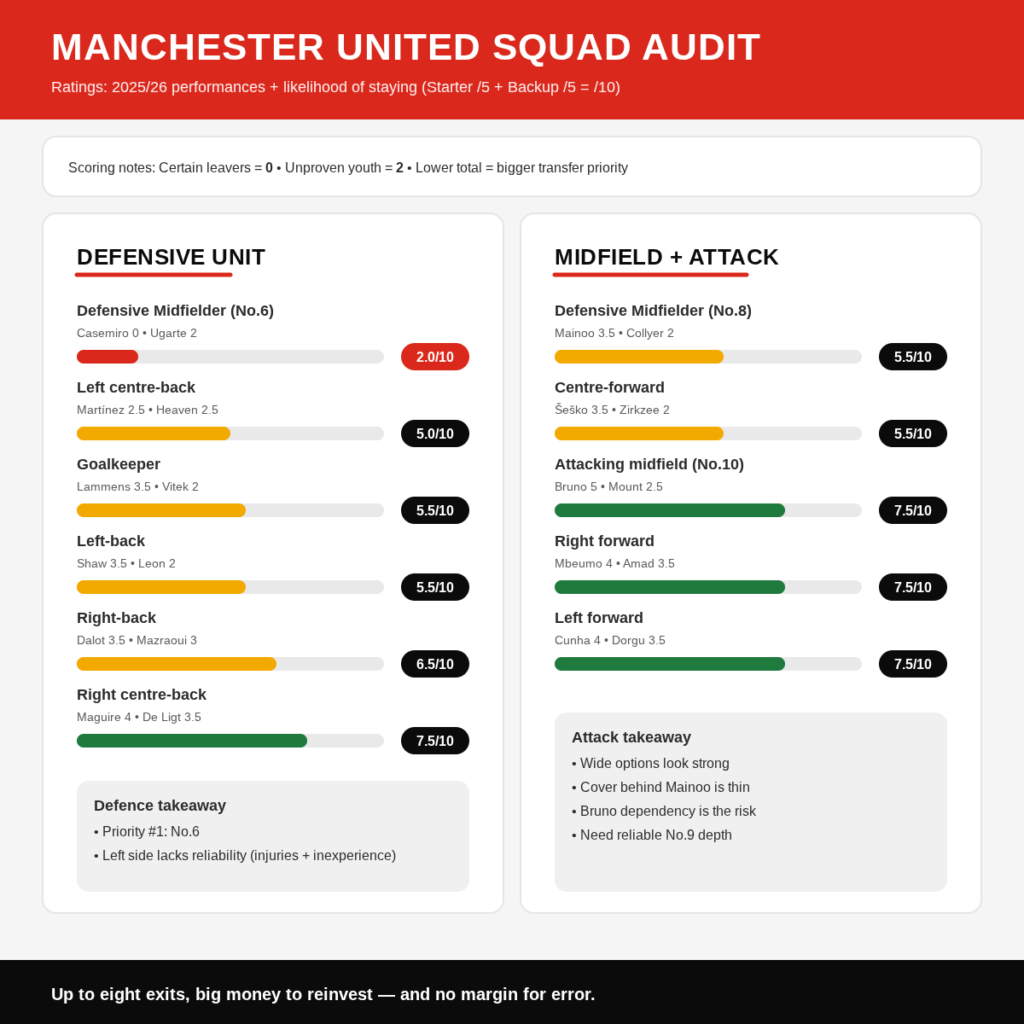
The Ratings at a Glance
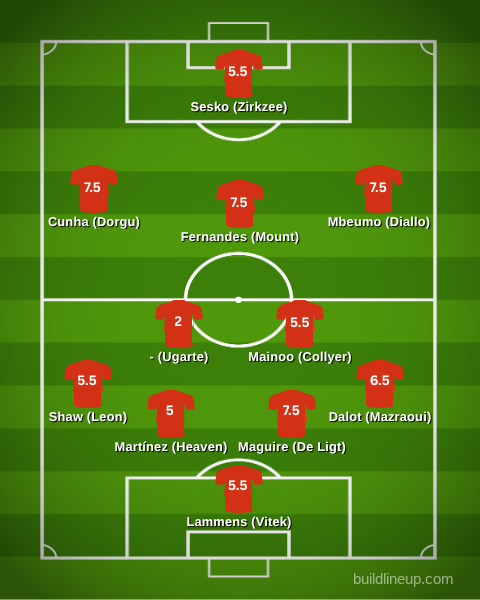
This XI-style graphic brings together the overall ratings from both parts of our audit. The numbers (out of 10, combining starter and back-up) make the priorities clear at a glance.
The biggest red flag is defensive midfield: with Casemiro leaving and Ugarte expected to be sold, United are effectively starting from scratch in the most important “control” position on the pitch. Elsewhere, the left side of the defence still looks fragile because of fitness and inexperience, while centre-forward remains short of proven depth behind Šeško.
The encouraging news for Carrick is that the attacking line rates relatively strongly — Fernandes, Mbeumo and Cunha give United a match-winning core — but the Leeds defeat underlined how quickly standards drop when two or three of those pillars are missing.
Read more – Part 1: Defensive Positions To Address This Transfer Window