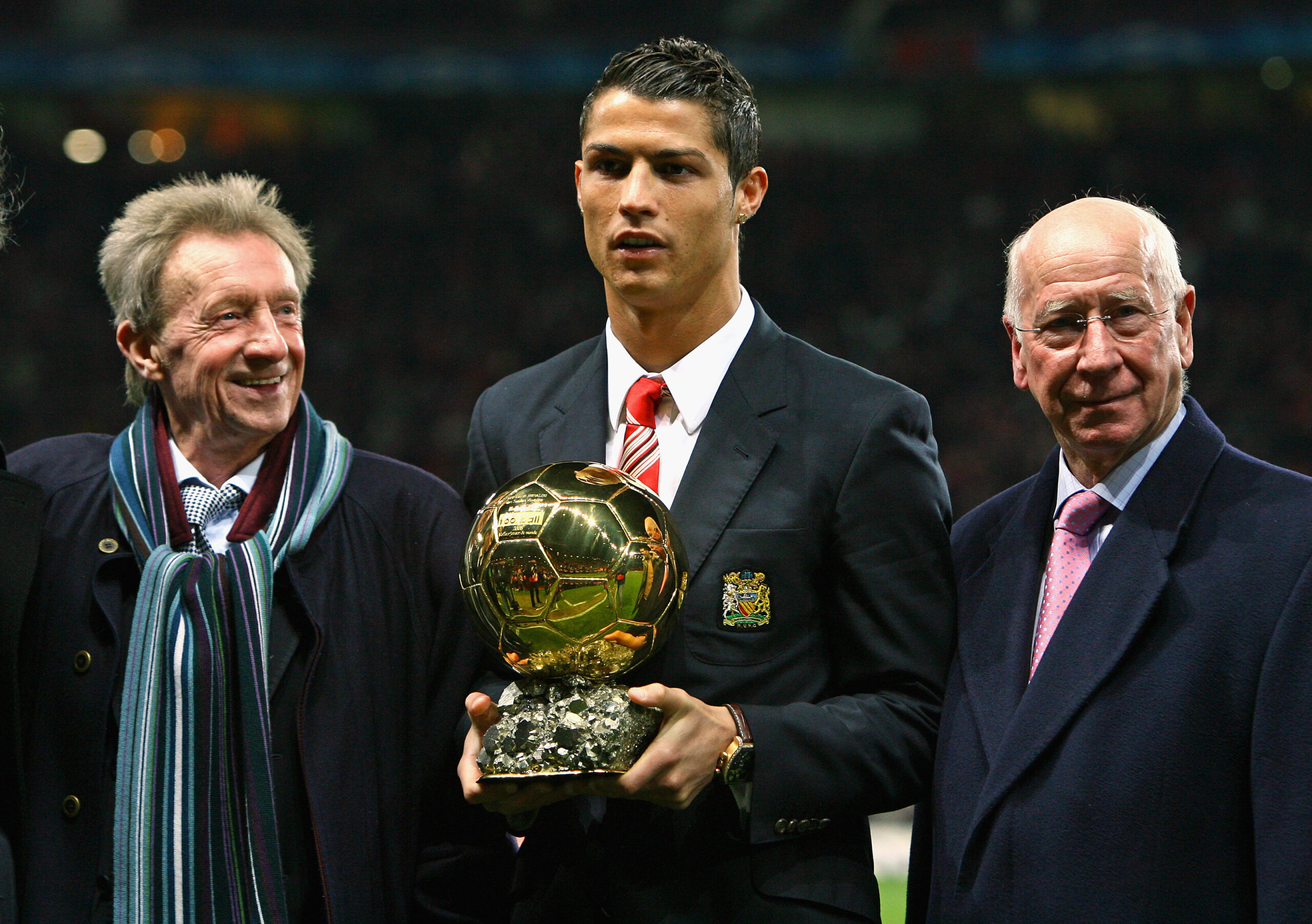

Football no longer seems content with choosing the best player of the year, crowning a world champion and celebrating its greatest legends. Now, it also needs new categories, additional awards and fresh ways to generate conversation around its biggest stars. France Football’s new Ballon d’Or All Time is the latest example of a trend that threatens to turn the sport’s most prestigious honors into another part of a commercial machine that never seems to have enough.
Cristiano Ronaldo leads the voting for the newly create award with 62% of the votes, according to the figures shared so far. His 2008 Ballon d’Or is the fans’ favorite, comfortably ahead of Lionel Messi’s 2012 edition, which has received 13%, and his 2023 award, with 9%.
The rankings continue with Ronaldo’s 2017 Ballon d’Or at 7% and his 2016 edition at 2%. Beyond the rivalry between Ronaldo and Messi, the results raise a bigger question: was another award really necessary to recognize the greatest footballers of all time?
The Ballon d’Or Needs to Reinvent Itself, Too
France Football introduced the Ballon d’Or All Time as an initiative allowing fans to vote for the greatest editions of the award in history. The selection includes ten legendary figures who have won the Ballon d’Or at least twice: Cristiano Ronaldo, Lionel Messi, Ronaldo Nazário, Marco van Basten, Michel Platini, Karl-Heinz Rummenigge, Kevin Keegan, Alfredo Di Stéfano, Johan Cruyff and Franz Beckenbauer.
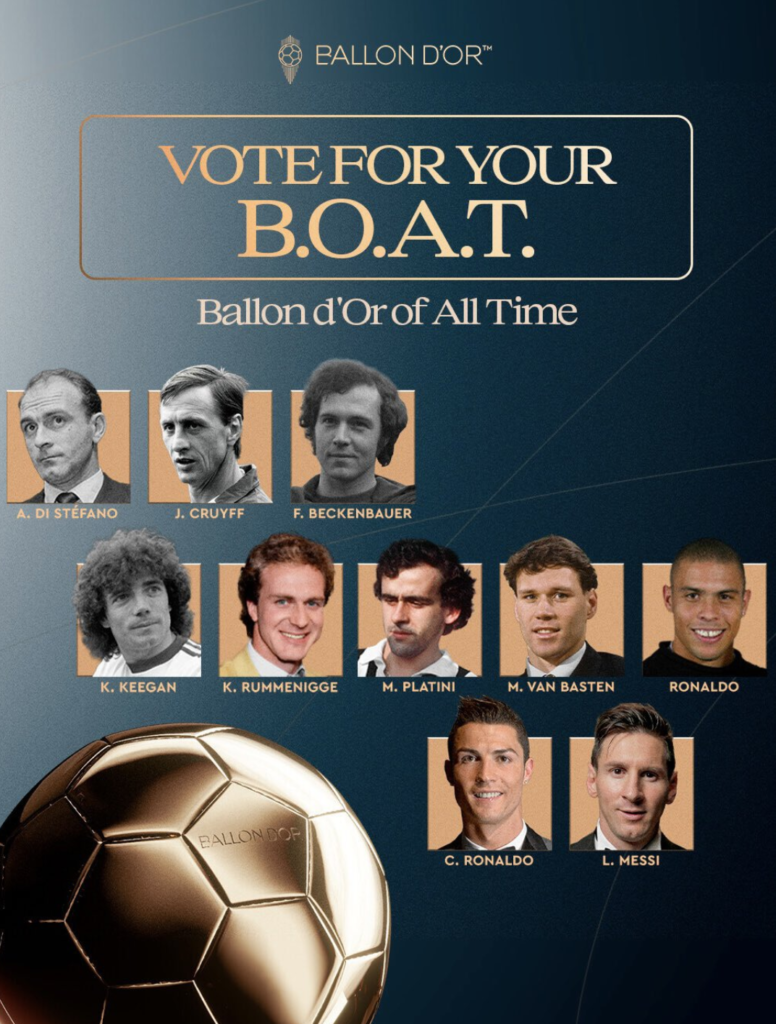
The list brings together different eras of football. From Di Stéfano’s influence on the Real Madrid side that dominated Europe in the 1950s to Cruyff’s footballing revolution, Beckenbauer’s elegance, Ronaldo Nazário’s devastating finishing and the rivalry between Messi and Ronaldo that defined more than a decade.
Every player has a case for being part of the conversation. The problem is not celebrating their achievements or debating who was the best. The question arises when a distinction that has represented individual excellence for decades needs to multiply into new versions to maintain public attention.
First awarded in 1956, the Ballon d’Or has become one of the most prestigious individual honors in football. Its value lies precisely in its ability to capture a year of performances, trophies, statistics and unforgettable moments in a single decision.
Messi has won eight Ballons d’Or, while Ronaldo has claimed five. Their names are already written into the award’s history. They do not need another trophy to prove their place among the greatest, even if revisiting their best seasons can be entertaining for fans.
The risk is that the conversation stops being about what winning the Ballon d’Or represents and starts revolving around how many additional awards can be built around it.
FIFA and an Expansion That Never Seems to End
What is happening around the Ballon d’Or mirrors a broader trend at FIFA, which has spent recent years expanding its competitions and developing new commercial opportunities.
The 2025 FIFA Club World Cup expanded to 32 teams, while the 2026 World Cup grew from 32 to 48 national teams. Expansion gives more clubs and countries access to the biggest international stages, but it also increases the number of matches, broadcasting rights, sponsorship opportunities and potential revenue streams.
The problem is not that every expansion is necessarily negative. Giving more national teams the chance to compete can benefit the sport. The real question is how far the calendar can grow without exhausting players, compromising the quality of the spectacle or turning every available space into another commercial opportunity.
FIFA has also explored a business initiative that went beyond expanding its tournaments. Its FIFA Forward Enterprise proposal contemplated selling a minority stake in its commercial business, including World Cup-related rights, to private investors. The initiative was ultimately abandoned following criticism and opposition from figures in international football.
The proposal left an important question on the table: to what extent should the organization governing world football treat its most valuable commercial assets as an opportunity to attract private capital?
Business has always been part of football. But its influence is becoming increasingly difficult to ignore.
A “Peace” Prize That Sparked Controversy
The relationship between football and political spectacle became particularly visible when FIFA president Gianni Infantino presented Donald Trump with the inaugural FIFA Peace Prize in December 2025, ahead of the 2026 World Cup.
The decision sparked questions about FIFA’s creation of such an award and its choice of recipient. The controversy went beyond Trump himself. It also highlighted Infantino’s relationship with political leaders and the way FIFA uses its ceremonies to project messages that extend far beyond the pitch.
FIFA can argue that football has the power to bring people together and promote peace. However, when a sports organization creates an extraordinary distinction and awards it to a politically influential figure, questions naturally arise about the criteria behind the decision and the role that public relations plays in shaping the organization’s image.
In a sport where the World Cup should be the main attraction, even awards connected to universal values can become part of a broader discussion about power, politics and public relations.
Winning No Longer Seems to Be Enough
There was a time when the Ballon d’Or represented a goal that accompanied the best players throughout their careers. Winning it meant reaching the summit of individual footballing achievement. Lifting the World Cup was the ultimate dream for many: becoming part of a national team capable of conquering the biggest tournament on the planet.
Those ambitions still exist. The difference is that they now coexist with an industry that constantly needs new content, products, competitions and awards to keep audiences engaged.
Every expansion promises more football. Every new award promises another debate. Another ceremony offers another opportunity to attract viewers, sponsors and social media attention.
But more does not always mean better
Football does not need to stop evolving or abandon its commercial potential. Clubs are businesses, players are professionals and competitions require resources to survive. The question is whether economic growth should become the main criterion behind every new decision.
The Ballon d’Or All Time can be an entertaining way to debate the greatest seasons of Cristiano Ronaldo, Messi and other legends. It can also remind fans of different eras and bring forgotten stories back into the spotlight. But its arrival is part of a trend that invites a bigger question: does every element of the sport need to become another product?
If everything requires a new edition, category or award to generate interest, there is a risk that these honors will lose some of what made them special in the first place.
The Ballon d’Or does not need to compete with FIFA in a race to multiply its products. Its history, its winners and the prestige it has accumulated over nearly seven decades are already enough to keep it among the sport’s most important individual honors.
Football will always have room for new ideas, but it should never forget what made it a global phenomenon in the first place: the emotion of competition, the pride of representing a team and the possibility of achieving glory on the biggest stages.
Not everything needs a trophy. Not everything needs a new competition. And not everything that can be turned into a business necessarily makes football better.

Alejandro Orellana is an accomplished sports journalist based in Mexico City, known for his incisive coverage of Club América and the Mexican National Team. A graduate of Journalism from Escuela de Periodismo Carlos Septien García, Alejandro brings a deep understanding of sports media to his work. His expertise extends to SEO and content creation, allowing him to produce engaging and discoverable sports narratives. He has contributed as a freelance writer for Goal.com, where he notably conducted interviews with MLS players, further showcasing his comprehensive interviewing skills. Prior to this, Alejandro dedicated five years to ESPN’s production department, contributing to renowned shows including SportsCenter, Futbol Picante, and NFL Live. His insightful articles can be found on platforms such as Deportrece and Hooligan Soccer. Connect with Alejandro on @soyalexorellana and Tik Tok to stay updated with his latest work. His commitment to journalistic integrity ensures every piece offers valuable and trustworthy insights for sports enthusiasts.