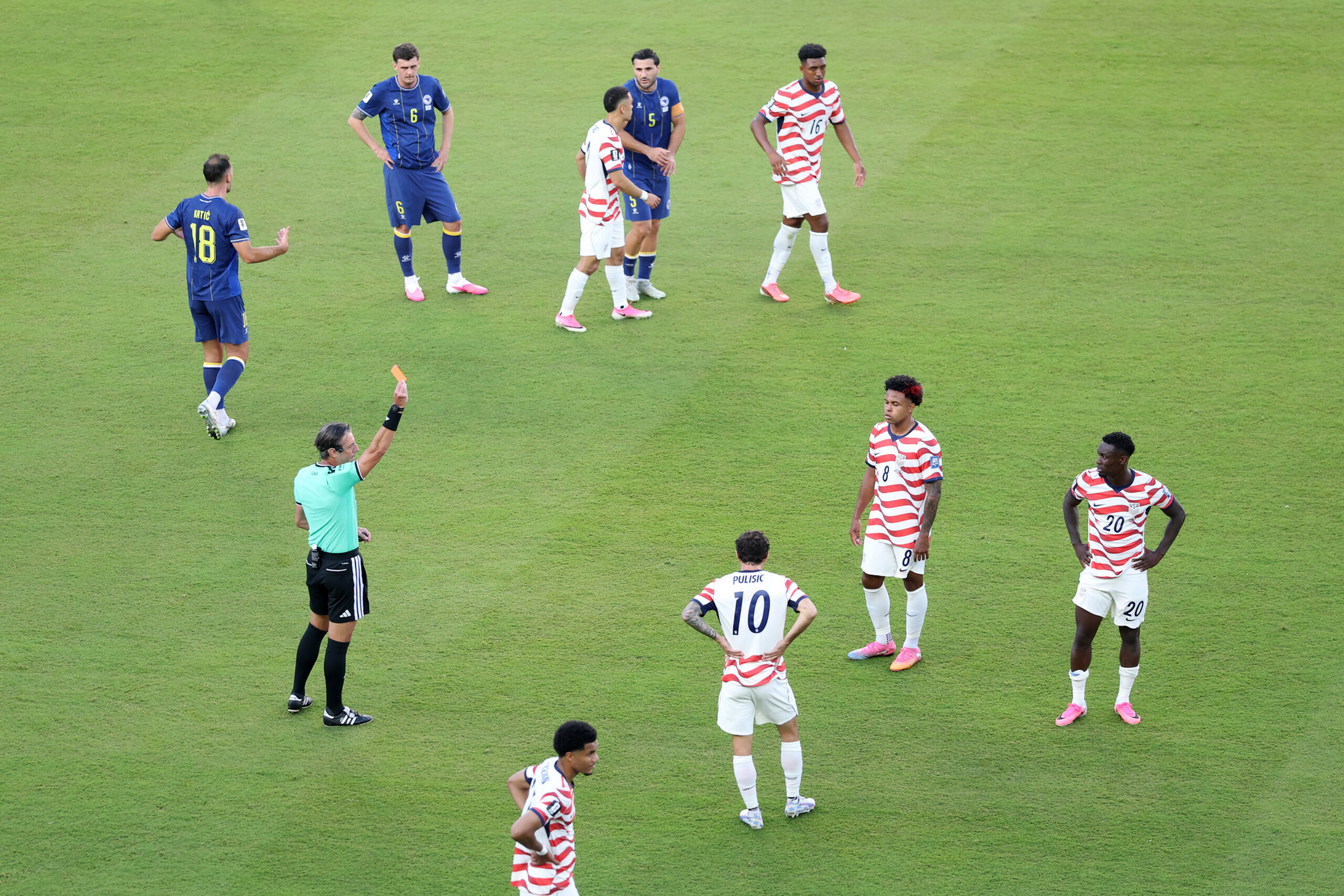

The big World Cup news today didn’t involve any of the teams playing in the Round of 16. Rather, it concerned Folarin Balogun, the USMNT striker. His one game suspension from a red card received in the match against Bosnia has been suspended, and he is eligible for tomorrow’s match against Belgium.
Normally, red card suspensions for the following game are unappealable. However, the FIFA Disciplinary Code contains Article 27.
What is Article 27?
Article 27 of the FIFA Disciplinary Code is titled: Suspension of Implementation of Disciplinary Measures. Unsurprisingly, it exists as a mechanism to address or modify previously issued disciplinary decisions.
This is the exact text, lifted from the document which can be downloaded for free here:
- The judicial body may decide to fully or partially suspend the implementation of a disciplinary measure.
- By suspending the implementation of the sanction, the judicial body subjects the person sanctioned to a probationary period of one to four years.
- If the person benefiting from a suspended sanction commits another infringement of a similar nature and gravity during the probationary period, the suspension shall be revoked by the judicial body and the sanction enforced without prejudice to any additional sanction imposed for the new infringement.
- Disciplinary measures relating to match manipulation cannot be suspended
Has Article 27 Ever Been Used Before?
Yes, and recently. Back on Nov. 13, 2025, down 2-0 to the Republic of Ireland, Portugal’s Cristiano Ronaldo elbowed defender Dara O’Shea in the face. The initial on-field yellow card was reviewed by VAR and upgraded to a direct red. Given the violent nature of the incident, he was given a three-game suspension.
This also meant Ronaldo would be suspended for the first two games of the World Cup.
Awkward.
But in the first publicly disclosed use of Article 27, FIFA announced that Ronaldo would serve a one-game suspension, then enter a one-year probationary period.
This decision was a travesty. It was clearly driven by Ronaldo’s status as one of the sport’s biggest (and most marketable) global stars, and not because of some “injustice” in the severity of the punishment. He deliberately and willfully elbowed a player in the face.
Balogun’s Suspension is also a Travesty
I want to be clear, I did not think his infraction against Tarik Muharemović warranted a red card. I believed Balogun’s step on the Bosnian’s ankle was a natural part of the play and a yellow card was sufficient. The red card was harsh, particularly as referee Raphael Claus had waved off the initial action.
But why FIFA’s decision is wrong.
First, there’s Article 66.4 of the same FIFA Disciplinary Code. This states:
- A sending-off automatically incurs suspension from the subsequent match. The FIFA judicial bodies may impose additional match suspensions and other disciplinary measures.
Crystal clear, right? The only alterations it specifically allows is INCREASING the duration of a suspension.
Ronaldo served a one-game suspension before Article 27 was invoked. Balogun did not. FIFA is deliberately altering its own rulebook in this one case. I wonder why?
The Stink of Political Pressure
Reporter and sometime Hooligan Soccer contributor Ben Jacobs posted this morning:
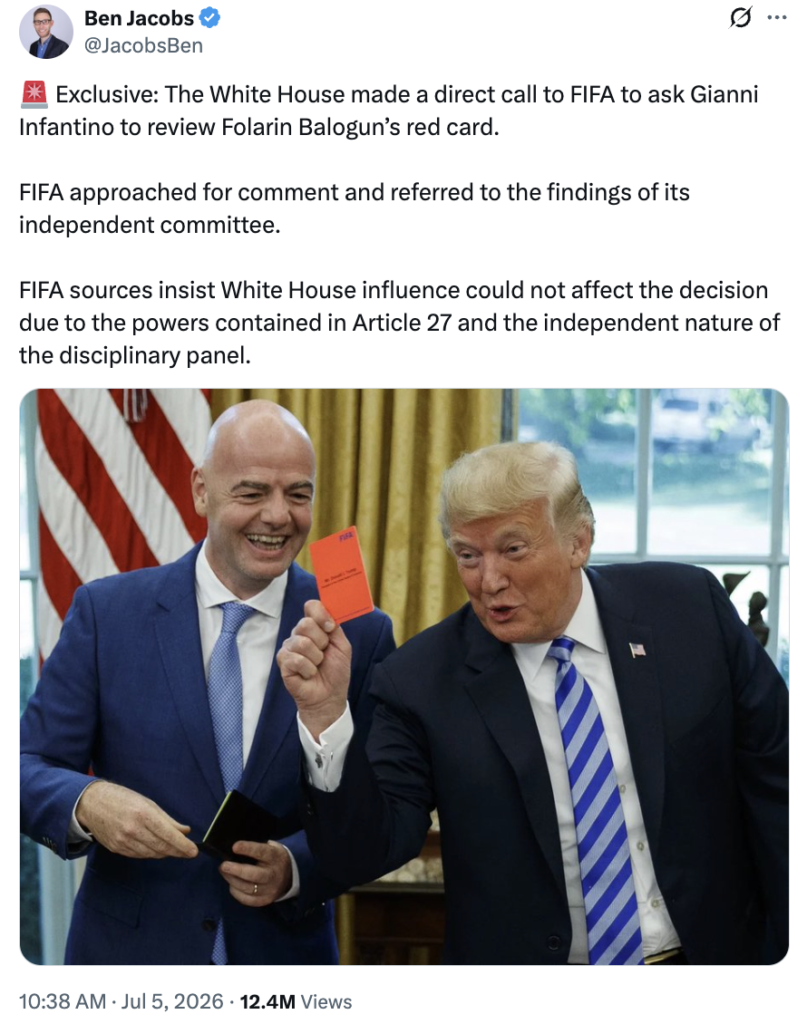
Does anyone seriously think Trump’s pal “Johnny” doesn’t have influence over the disciplinary panel? Come on.
Just the idea that a host nation’s government (or any government for that matter) can apply that kind of pressure is 100% wrong. Period.
Belgium’s Response
It goes without saying that Belgium is pissed. In addition to the arguments listed above, they included more provisions from other FIFA highlighting the exceptional and unprecedented decision. Manager Rudi Garcia, in a press conference, likened FIFA’s decision (apparently made on July 4th, American Independence Day) to another unofficial holiday: April Fool’s Day.
Read the Belgian Federation’s statement here.
Final Thoughts
I don’t think Balogun deserved a red card. But he got it. I wanted Balogun to play. But not like this. FIFA’s decision to alter its own disciplinary code, whether under outside pressure or not, is a dangerous slippery slope.
Expect to see many more appeals to Article 27 in the future, as all federations now know that FIFA won’t stick to its own rule. When it suits them.

The Qooligan is an alias of Hooligan Soccer founder Q Williams. Q is a 20+ year veteran of numerous technology and media companies, including MTV, Gracenote, Watchwith and Crunchyroll. He has a master’s degree in European History from Columbia University. Q is also a respected Sports Journalist with extensive experience in Soccer, particularly the Premier League, Champions League, MLS and USL. The Qooligan provides analysis and valuable insights based on years of professional practice. Connect with The Qooligan on X and Bluesky. He is committed to delivering accurate, trustworthy content that reflects expertise, experience and no shortage of attitude.