

The 2026 FIFA World Cup is finally upon us, and for the first time ever, the tournament will be split between three host nations. Unlike Mexico and the USA, Canada will be holding its maiden men’s World Cup and becoming the 19th different nation to host the tournament. But just what can we expect from Canada this summer?
How They Qualified
Unlike the other 45 nations, Canada, along with the Mexico and USA, automatically qualified for the 2026 FIFA World Cup on June 13, 2018. 15 months after officially unveiling the ‘United 2026 FIFA World Cup’ bid, the North American trio were announced as the hosts in Moscow, Russia, claiming 134 votes to Morocco’s 65.
Key Players
Alphonso Davies has emerged as the poster boy for this young, enticing Canadian generation, having already won 16 trophies with Bayern Munich (including one Champions League). But he has been mired in injury purgatory for the past few years, and it remains to be seen whether his body will hold up over the course of the tournament.
If Davies can’t return in time from his hamstring issue, there are several players capable of stepping up, none more prominent than Jonathan David. David is already Canada’s all-time leading scorer with 39 goals and 20 assists in 70 matches, and he will be looking to rebound from a disappointing debut season at Juventus by spurring the hosts to glory.
Breakout Star
One man’s trash is another man’s treasure, just ask Ismaël Koné. After a turbulent spell in France that saw Marseille manager Roberto De Zerbi banish him from training, Koné has rediscovered his scintillating form under Fabio Grosso at Sassuolo. Two years after guiding Canada to the Copa América semifinals, we’re expecting Koné to deliver another fantastic display and form a strong duo with Stephen Eustáquio in midfield.
World Cup History
Canada struggled in their first-ever World Cup in 1986, losing 1-0 to France in León, Mexico before falling to 2-0 defeats to Hungary and the Soviet Union. And while they returned in 2022, they once again finished with zero points and a -5 goal differential. After losing 1-0 to reigning bronze medalists Belgium in Qatar, Canada would proceed to lose 4-1 to Croatia and 2-1 to Morocco. Curiously, those two would end up meeting in the bronze medal match.
Coach Profile: Jesse Marsch
Jesse Marsch has already proven his mettle in club football across Europe and North America, but now, he’s making his mark in the international game. Despite taking charge a few weeks before their maiden Copa América, Marsch led Canada within inches of the bronze medal. With 14 wins, 13 draws, and 5 losses thus far, Marsch is proving to be a shrewd appointment for The Canucks, and it’s why Canada renewed his contract through 2030 on the eve of the tournament.
Canada Fun Facts
Canada boasts the largest moose population in the world, with estimates in excess of 1 million, whilst they also have a number of other diverse wildlife. In fact,, Churchill, Manitoba, had such trouble handling its ursine community that it launched the Polar Bear Holding Facility in 1982, which holds up to 28 bears at a time. Neither, however, are the national animal of Canada: that would be the beaver.
Natural beauty is certainly not lacking in Canada, which features the longest coastline in the world and accounts for over half of the planet’s natural lakes and 9% of the world’s forests. It also has the oldest known rock on Earth, Acasta Gneiss, and the oldest pool of water, found in Kidd Creek Mine.
Lastly, Canada, specifically the Hudson Bay region, experiences a measurable gravity anomaly where the pull of gravity is lower than in the rest of the world. If you stood in this region, you would weigh roughly 0.005% less than you would elsewhere.
Scientists have attributed this phenomenon to the last ice age, where the massive Laurentide Ice Sheet pushed down on the Earth’s crust, displacing mass to the sides. Even though the ice has been gone for thousands of years, the land is still slowly springing back (about 12 mm per year).
Fan Culture
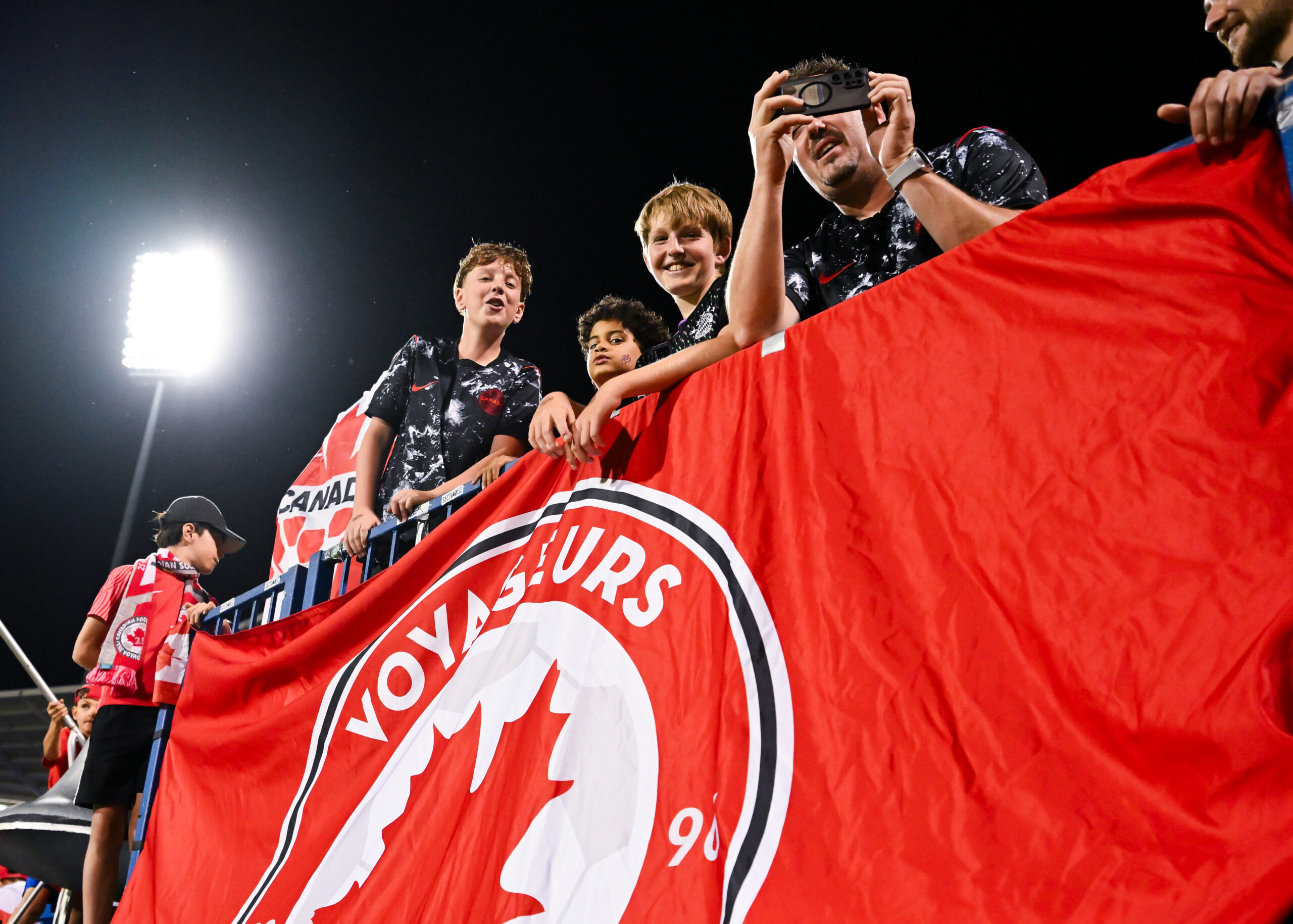
Named in honor of the historical French-Canadian fur traders who traversed the continent by canoe, reflecting the pioneering spirit of early Canadian soccer supporters, The Voyageurs are Canada’s oldest and biggest soccer supporter group. And ever since 2002, they have funded the prestigious Voyageurs Cup, awarded to the best men’s club in the country.
Founded in 1996 by a couple of fans in Edmonton, the Voyageurs first made headlines by organizing a petition for Owen Hargreaves to play for Canada — he would end up representing England — before mailing an annual Christmas card to Canada players from 1998 on. Born out of early internet message boards, the group has helped to establish a patriotic sentiment at games previously dominated by away fans, and it remains the beating heart of Canadian soccer culture.
Group Stage Fixtures
Canada vs. Bosnia and Herzegovina
June 12, 3 pm ET / 12 pm PT
Canada vs. Qatar
June 18, 6 pm ET / 3 pm PT
Switzerland vs. Canada
June 24, 3 pm ET / 12 pm PT