It was thought to be on the verge of extinction; a relic of a previous era. But eagle-eyed witnesses began spotting brief flashes of it in Wolverhampton. Reports followed that it was regaining a foothold in the Manchester United ecosystem, and then, at Old Trafford, we saw it: a back four.
Was it a 4-4-2, a 4-3-3, or even a 4-2-4? Experts are still debating the precise genus of this lesser-spotted back four, but concrete proof of its existence now abounds.
“Not on my watch”
Manchester United manager Ruben Amorim had previously stated that not even The Pope could persuade him to change his contentious 3-4-2-1 wing-back formation. And while the Portuguese did intimate he might be willing to alter his system eventually, it would only be on his terms and when he felt the time was right.
It would appear that time is now. Perhaps this tactical evolution has been prompted by the departure of three key players to the African Cup of Nations. Perhaps it was spurred by injuries, as centre-backs Matthijs de Ligt and Harry Maguire are sidelined and striker Benjamin Šeško just returning. Or perhaps a series of disappointing draws forced his hand? Or maybe, just maybe, it has always been in the pipeline.
Whatever the catalyst, in the thrilling 4-4 draw against Bournemouth at Old Trafford on Monday night, a back four was evident during large phases of the game.
Reports prior to the Premier League clash claimed Amorim told his players that a change was coming, and that United had been training in a 4-3-3 system for a “significant amount of time” last week, according to The Athletic’s Laurie Whitwell.
A “false-five”
However, when the team sheet emerged with the same familiar names that usually feature in Amorim’s favoured back five, it cast doubts on the purported evolution. Yet, a closer look revealed unexpected positional changes designed to facilitate the back four.
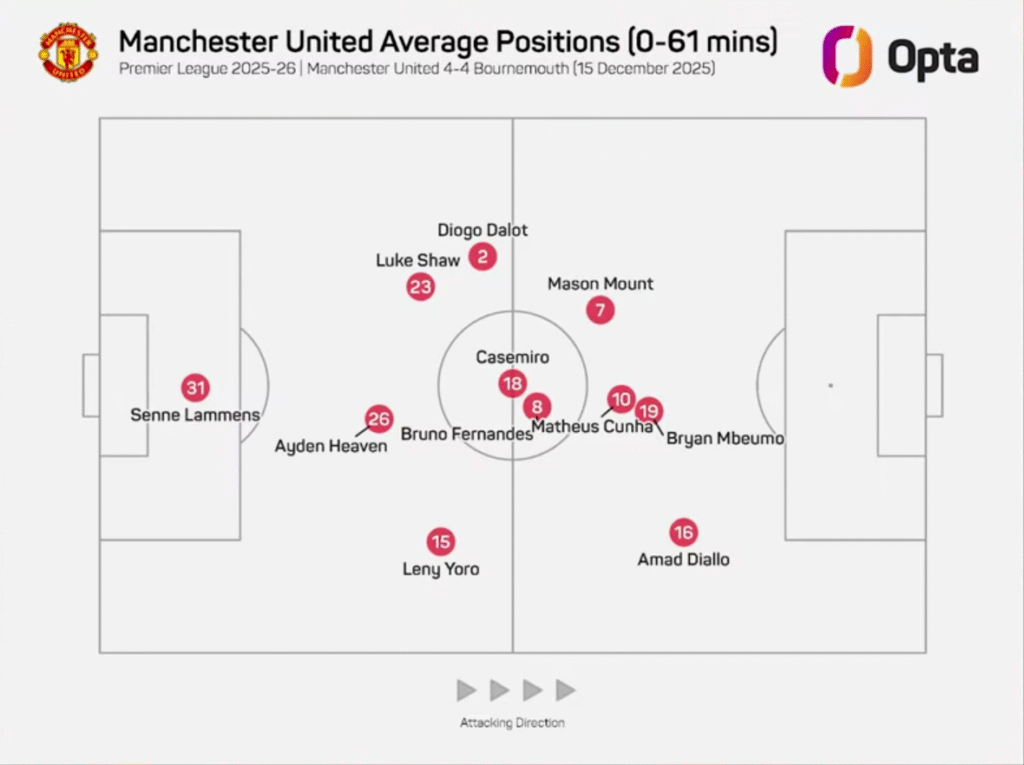
Centre-back Lenny Yoro featured at right-back, erstwhile left-back Luke Shaw remained in his centre-back role alongside youngster Ayden Heaven, and Diogo Dalot (who prefers to play on the right but has been operating as a left wing-back) dropped into left-back. Right wing-back Amad Diallo was pushed further forward, playing mainly as a winger – scoring the opening goal and generally terrorising the Bournemouth defence.
While the lineup might have seemed familiar, the positional shifts were crucial, as an average position chart from Opta (based on when United were in possession) clearly illustrates.
Why the switch is big news
The move to a back four is significant because Amorim’s critics have been calling for a change almost since his arrival. Every bad result (and there have been plenty) added fuel to the fire.
But the wider point, and the most important for many fans, was that watching the Red Devils play Amorim’s 3-4-2-1 / 5-2-2-1 had become somewhat boring, predictable, and distinctly ‘un-United’.
The eight-goal thriller against Bournemouth was the antithesis of that. United even adopted a 4-2-4 formation towards the end as they chased the game, looking for an equaliser and then what looked like a late winner from Matheus Cunha, only for Eli Kroupi to score an 84th-minute leveller for the visitors.
The first half of the match was arguably the best and most exhilarating performance by Manchester United under Amorim’s stewardship. The team produced 17 first-half shots – the most by any Premier League team in the first 45 minutes of a game this season. The only disappointment was that they only led 2-1 at the break. More than that, the swashbuckling nature of the performance felt like it had the DNA of a true Manchester United side, a sentiment reflected in the electric atmosphere inside Old Trafford.
Will Amorim stick with four at the back?
Although United only drew with Bournemouth, it was still one of the team’s most exhilarating performances of the season. It would surely be counter-intuitive to revert to the old system for the next match against Aston Villa.
There will, however, be some necessary changes. Bryan Mbeumo, who featured alongside Cunha in the front two, has now departed for AFCON. It is likely Šeško, returning from injury and food poisoning, will slot in as a striker. Amad has also left for AFCON, and Amorim doesn’t really have another player who can operate as a traditional chalk-on-your-boots winger. This suggests he may favour the 4-3-3 system and opt for a more narrow midfield.
Such a shift could mean more playing time for fan-favourite Kobbie Mainoo, who had a loan move request rejected earlier this season after becoming frustrated due to a lack of minutes, or a deeper role for Mason Mount.
Whatever the specific configuration, the sight of a back four at Old Trafford felt less like an anomaly and more like a long-awaited rebirth.