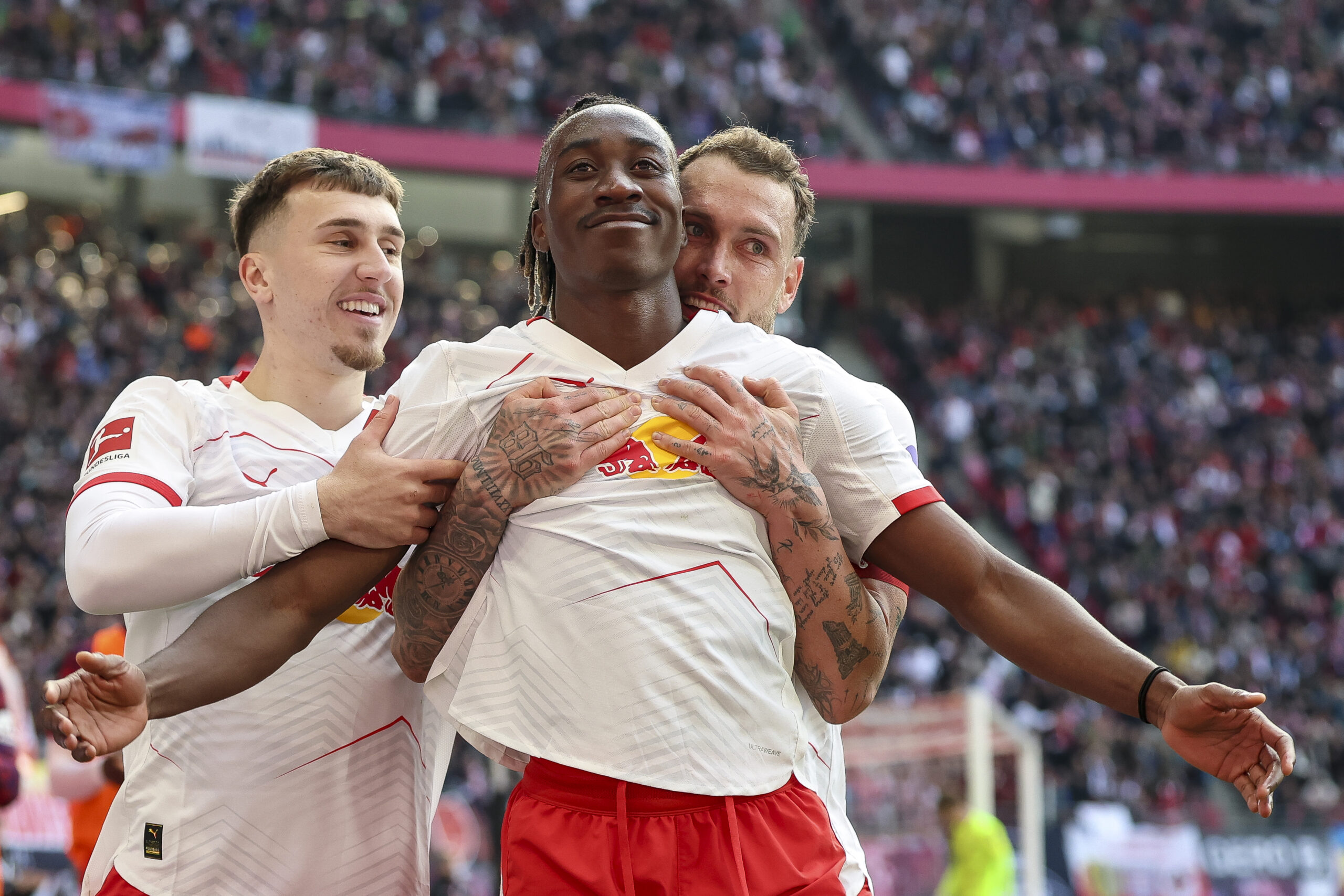

Leipzig are engaged in an intense battle to secure a UEFA Champions League spot in the Bundesliga. They are tied for 4th place on 56 points with five games remaining. But one of the most overlooked statistics of their campaign is their effectiveness in the attacking third. They rank among the top 10 teams across Europe’s five major leagues in terms of penalty box entries per match.
Most of these Top 10 teams are either strong title contenders in their respective leagues or directly involved in the race at the top. It is not particularly surprising to see these clubs operating at an elite level when it comes to accessing the penalty area.
What makes Leipzig especially intriguing begins right at this point. Despite being part of such an exclusive group, they are not the outright favorites in their domestic title race. For that reason, I found it more meaningful to examine the structures and recurring attacking behaviours through which they generate these penalty box entries.
In this piece, I attempt to break down Leipzig’s penalty area entry strategies through 12 distinct patterns.
1) Left-Side Triangle
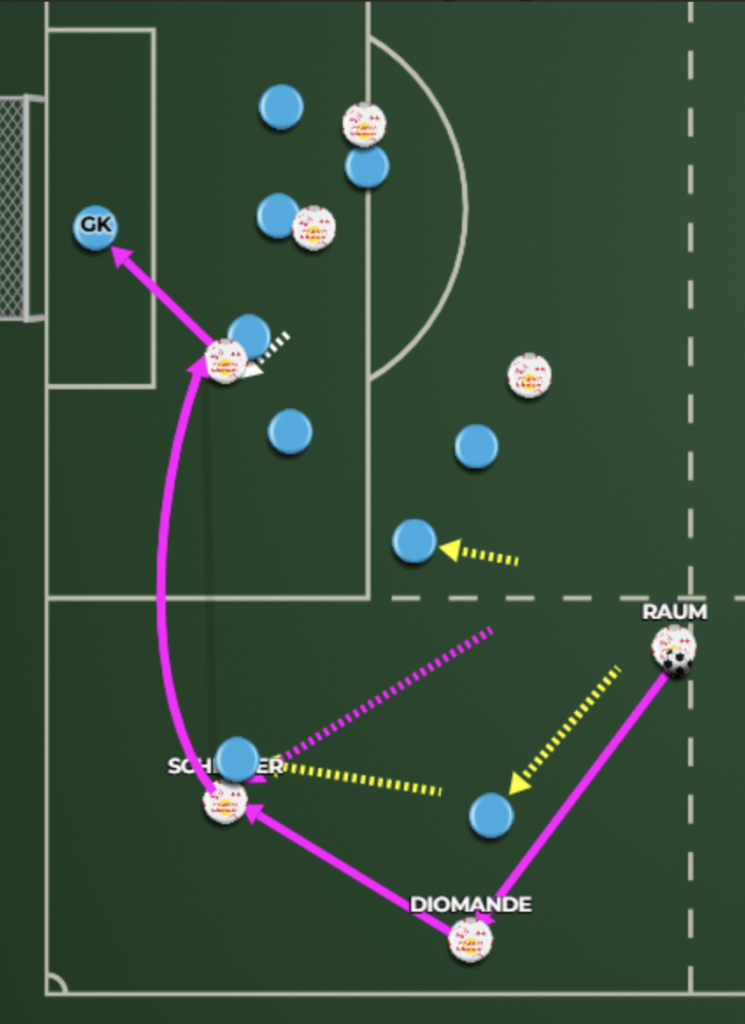
The left-back (Raum), the midfielder (Schlager), and the left winger (Diomande) form a passing triangle on the left wing. The three players are not positioned especially close to one another, but the opposition are not close enough to them either, which gives them sufficient space to combine and make supporting runs.
Schlager receives the ball and delivers a cross. The centre-forward (Romulo) drops from a deeper position and gets across the front of his marker to produce an excellent first-time finish, but the shot goes straight at the goalkeeper.
2) Space Attack
In an attack developing down the right wing, the right-back (Baku) plays the ball into Gruda, who has been used in some matches as a right winger and in others as an attacking midfielder. Recognizing that the opposition’s defensive structure is disorganized, Schlager makes a run into the space inside the penalty area.
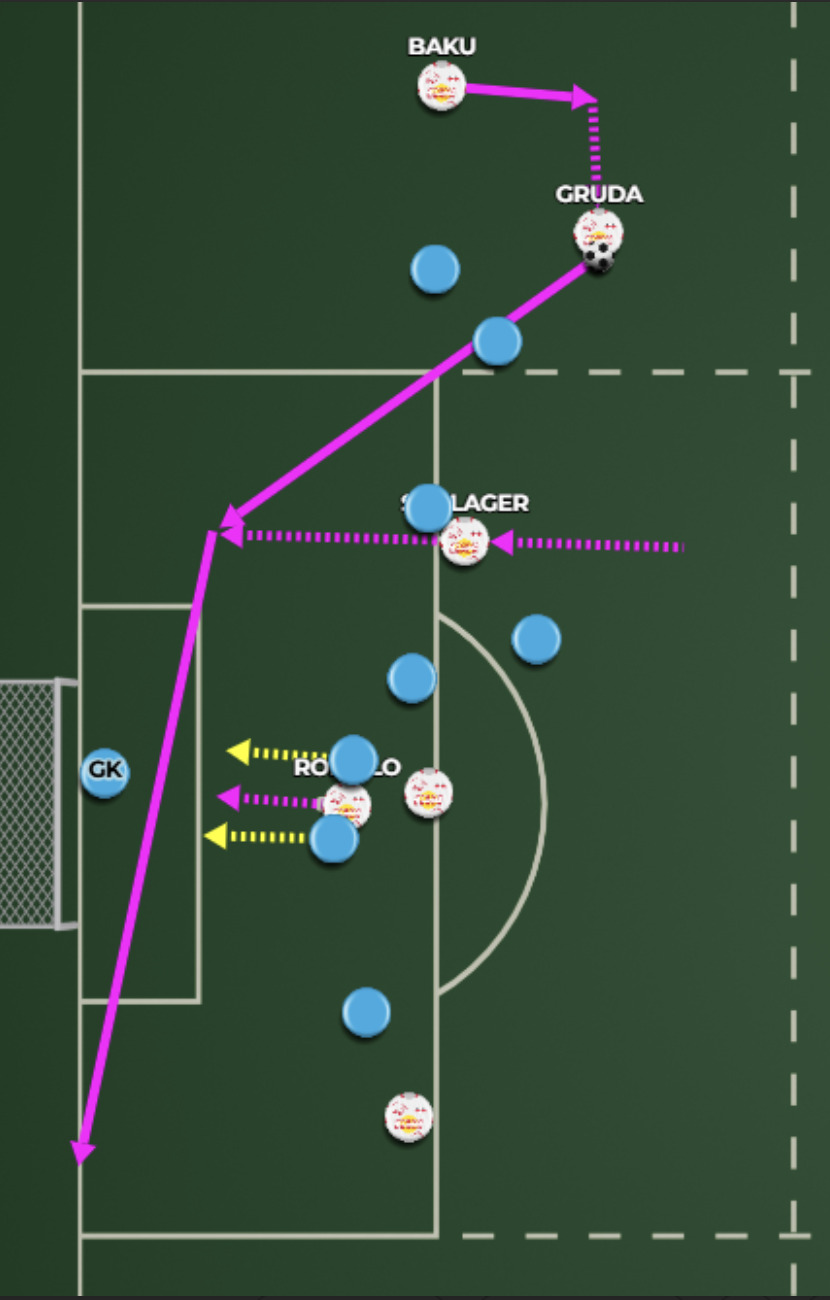
He meets Gruda’s through ball and delivers a cross, but no one is able to apply the finishing touch. The opposition player positioned furthest forward in that zone spots the run, yet the defensive line cannot prevent it because they fail to communicate and adjust collectively.
3) Loose Control
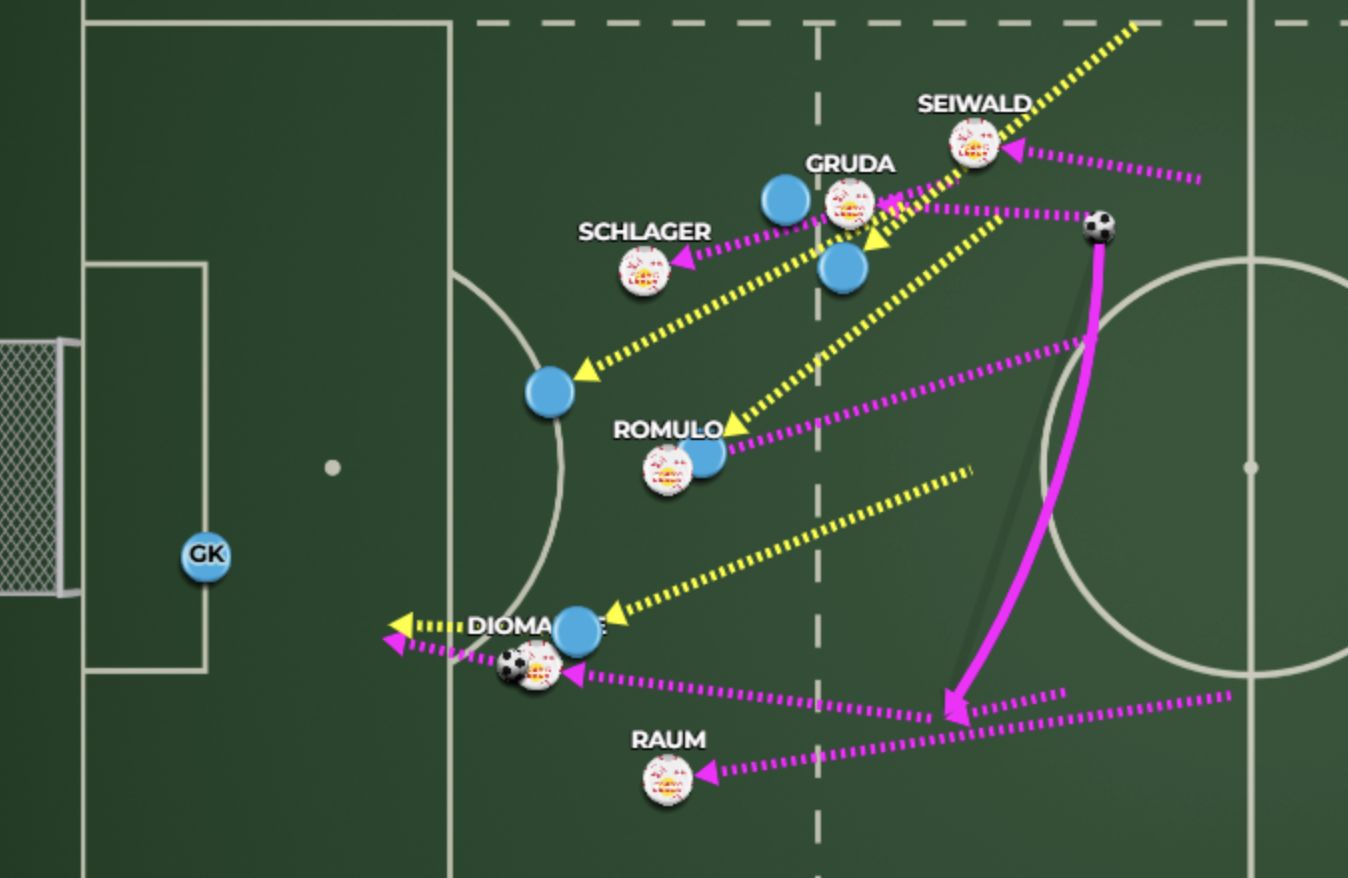
The opposition make both a passing error and a poor first touch after Leipzig’s long ball.
Gruda reacts quickly, steps in, and wins possession. Just before Gruda releases the pass, Diomande moves away from his defender, reducing the opponent’s chance of making an immediate intervention.
However, after creating that separation, he then carries the ball back towards the defender instead of improving his shooting angle, and the move breaks down. Had he continued on the same line or recognized Raum’s supporting run from the left and played the ball into him, the situation could have ended in a goal.
4) Quick Combination
After preventing the opposition defender from receiving the pass, Diomande wins the ball and drives towards the penalty area. The midfielder (Baumgartner) is in a free position inside the box, and Diomande plays the ball into him.
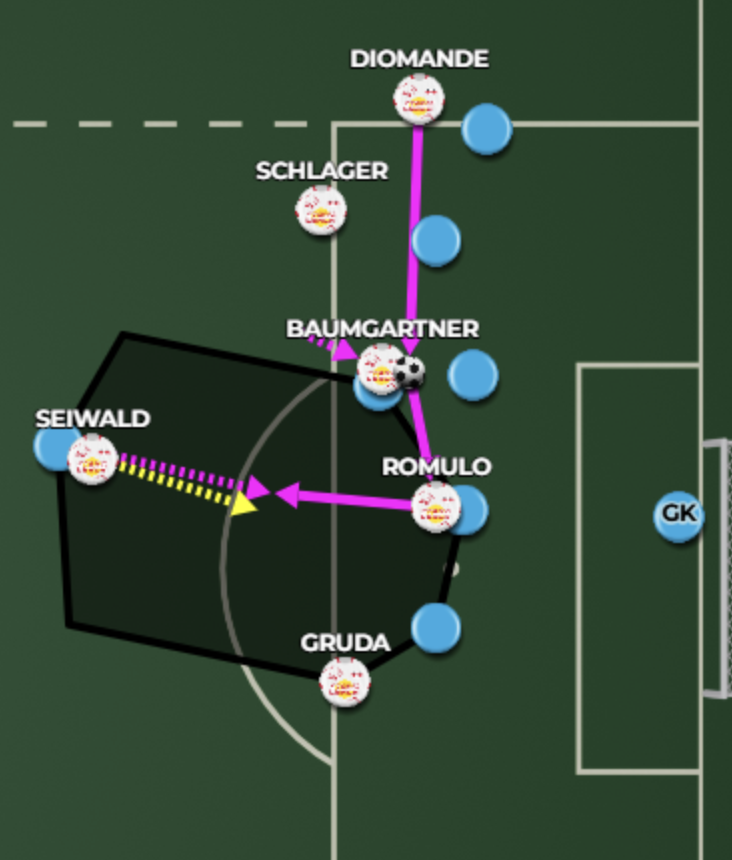
Romulo then acts as the wall player. Baumgartner lays the ball into Romulo, receives it back, but with the defender denying him any shooting window, he is forced to return the ball to Diomande. Seiwald would actually have been the better option, but Romulo cannot find him because Seiwald is unable to break free from his marker.
5) Inside Support
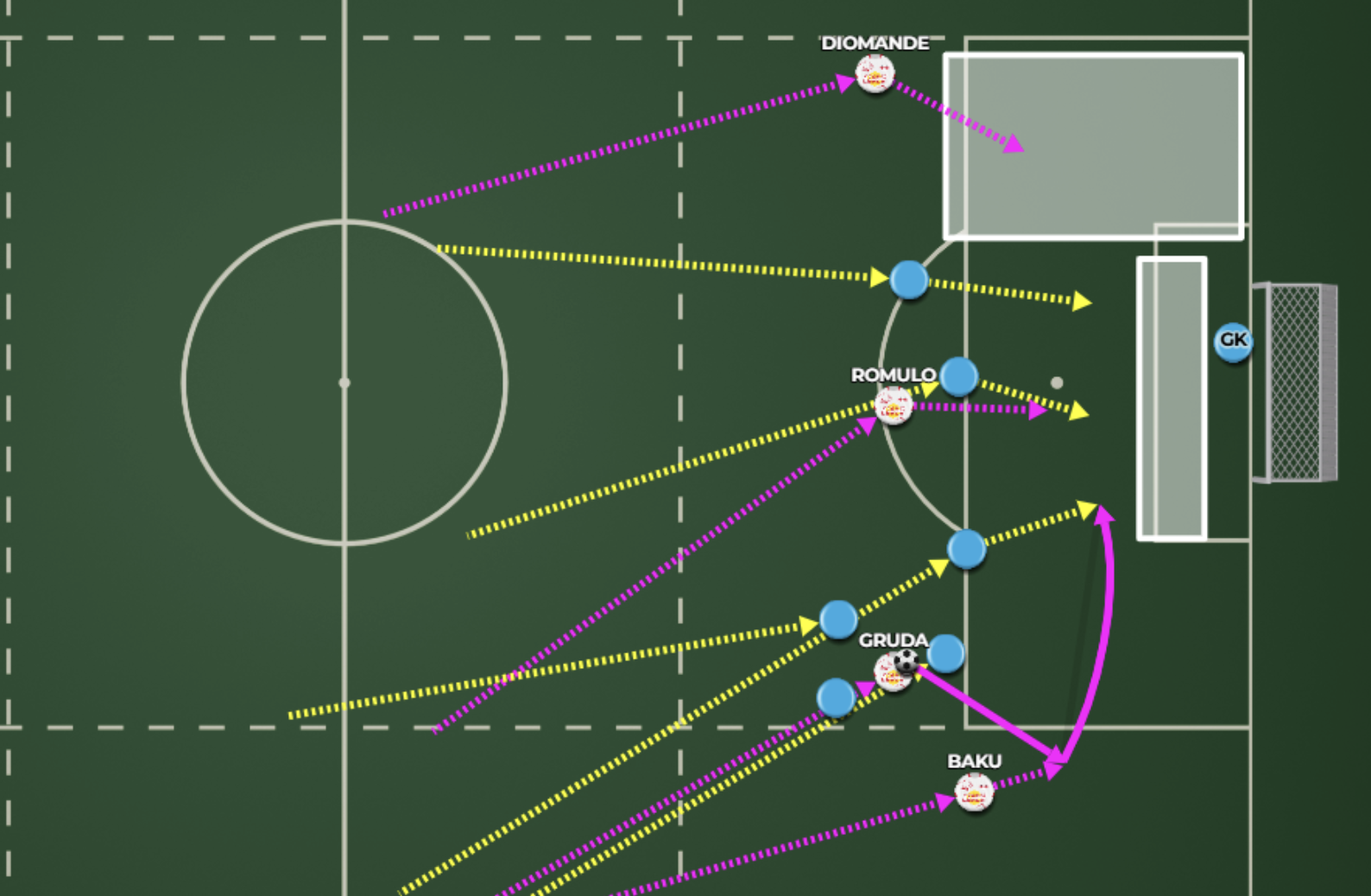
When Gruda plays on the wing, Baku is able to join the attack more aggressively.
Because Gruda is left-footed and naturally an attacking midfielder, he often carries the ball diagonally towards the edge of the box. The opposing left-back is aware of this tendency and therefore shifts more towards his own right side.
As a result, Baku is able to receive the ball more frequently inside the penalty area. By the time the ball reaches him, Romulo, Gruda, and Diomande are already positioned in the box. However, the opposition still have a clear numerical advantage in that zone. For that reason, a driven cut-back towards the area behind Diomande or a low ball flashed across the face of goal would have been the better option.
6) Diagonal Carrying
When Nusa is on the pitch, Diomande moves over to the right wing, but his effectiveness does not drop at all. If Leipzig are able to generate this many penalty-box entries, Diomande deserves a major share of the credit.
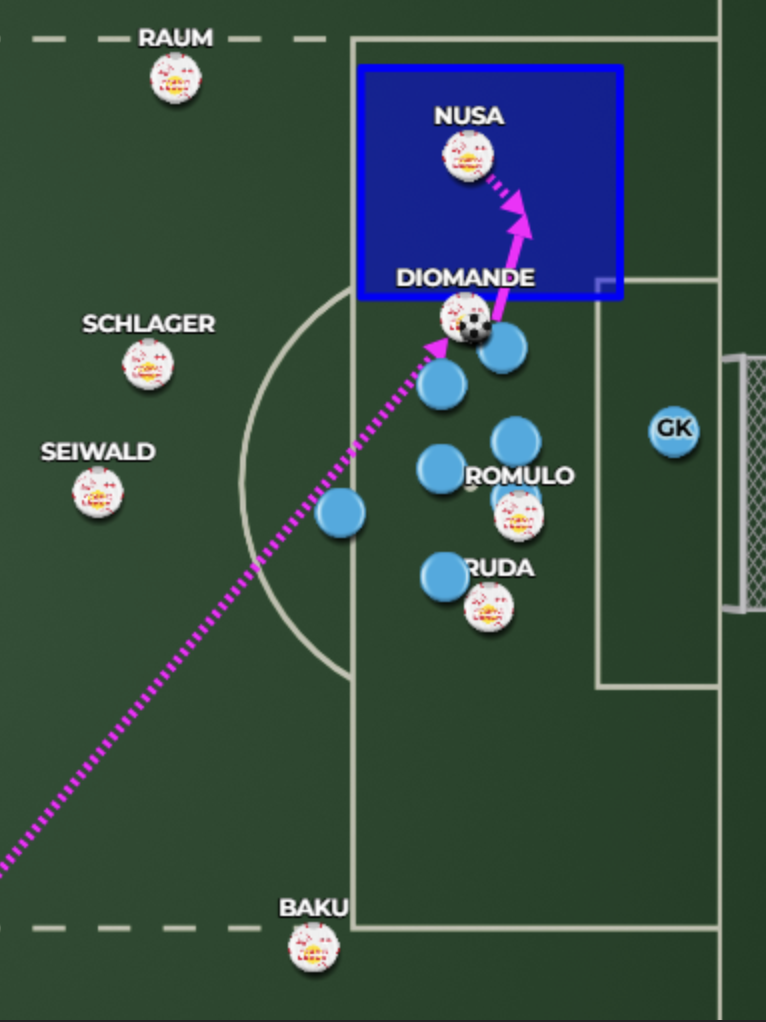
Receiving the ball near the start of the final third on the right side, he drives diagonally into the box through a series of dribbles.
He is clearly looking for the right moment to shoot. However, from the moment he reaches the front of the area, Nusa is completely free, and the pass comes too late. Nusa eventually gets the shot away, but with too many defenders in front of him, the effort takes a deflection and goes out for a corner-kick.
7) A Clever Free-Kick Organization
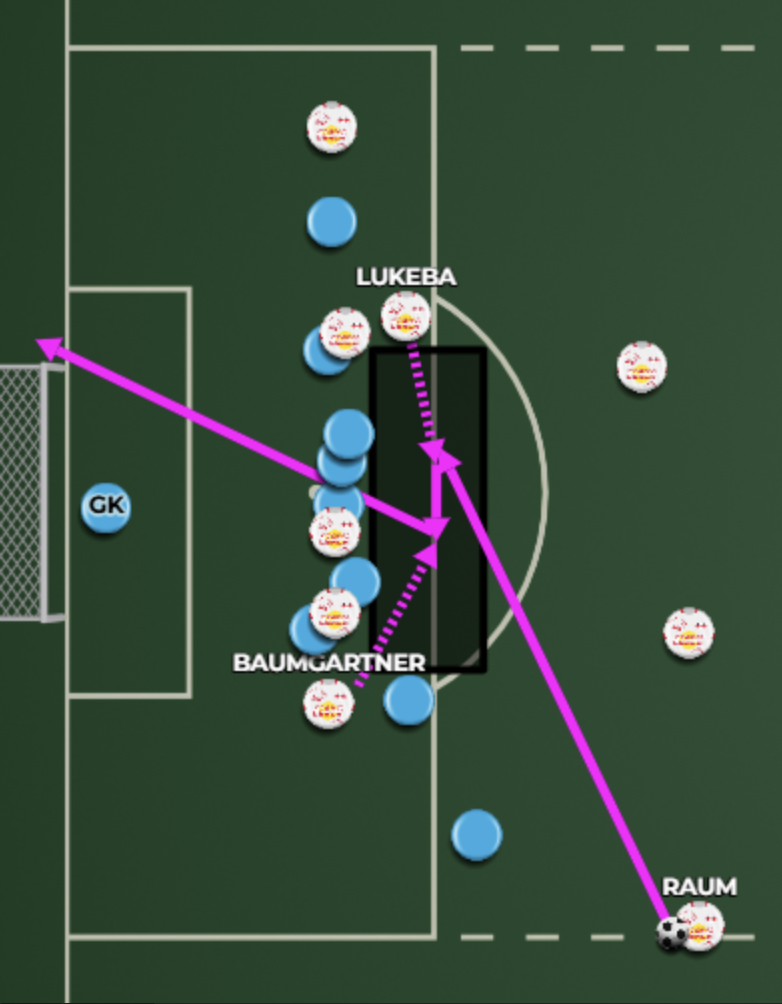
I did not want to include any examples from free-kicks or corner-kicks in any part of this piece, because set plays naturally create penalty-box entries anyway. However, I really liked the organisation inside the box in this particular free-kick, even without relying on aerial duels.
While everyone is expecting a cross into the area, the centre-back (Lukeba) moves towards the edge of the box. Baumgartner, who is positioned deepest, then makes a movement towards him. Lukeba plays the ball into Baumgartner, who gets his shot away, but the effort goes narrowly wide.
8) Delayed Delivery
The centre-back (Orban) stops the opposition counter-attack, releases the ball to Gruda on the wing, and then continues his run into the penalty area. Gruda moves laterally across the edge of the box before playing the ball into Nusa.
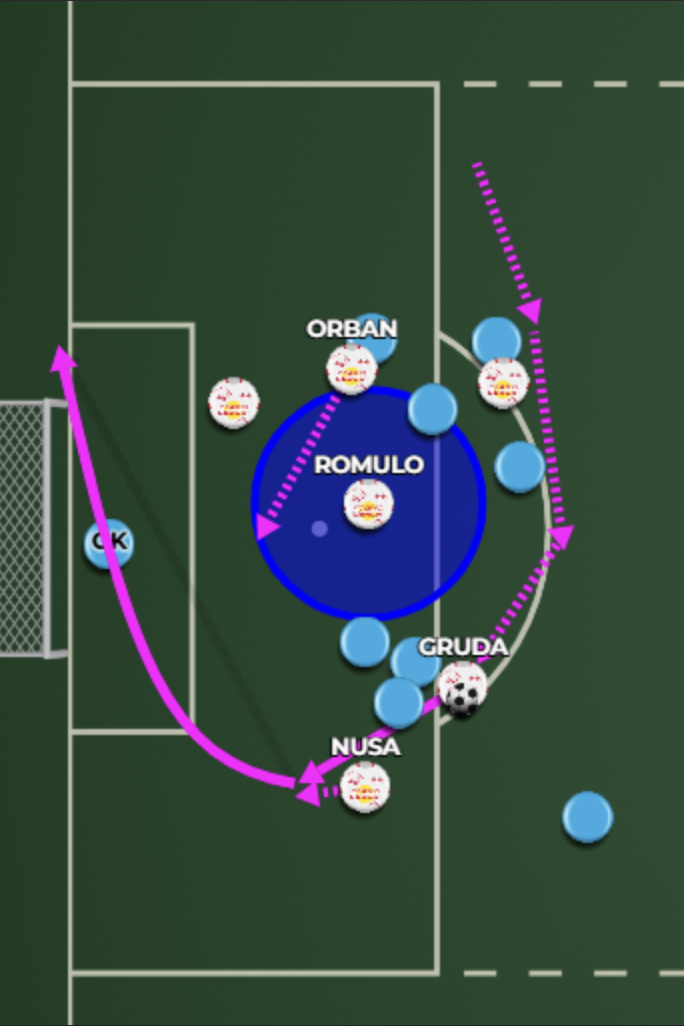
The speed of the pass is high, and Nusa does not control it at the right moment, which delays the cross. Additionally, both Diomande and Orban failed to recover from the offside line. In fact, even if Nusa had delivered the cross earlier, the move still would have ended in an offside situation. In this sequence, they also fail to spot Romulo, who waits intelligently in a better position.
9) Deceptive Run
Raum deceives his marker. He signals for Lukeba to move closer towards the left side, while he himself drifts slightly wider and holds the width alongside Nusa on the left touchline.
As the opposition player in front of Raum shifts in that direction, Raum suddenly changes his running line and attacks the penalty area.
Lukeba then plays an excellent through ball, and Raum receives it inside the box. Although he cannot control it cleanly at first, the ball returns to him a couple of seconds later. However, because it falls onto his weaker foot, he can only produce a weak finish.
10) Pressing Regain
Leipzig won the ball as a result of their intense high press. Baumgartner anticipates the opposition’s backward pass, steps in, and regains possession. Gruda is to his right, while Romulo is to his left. Because Gruda is left-footed, he moves towards the penalty spot area.
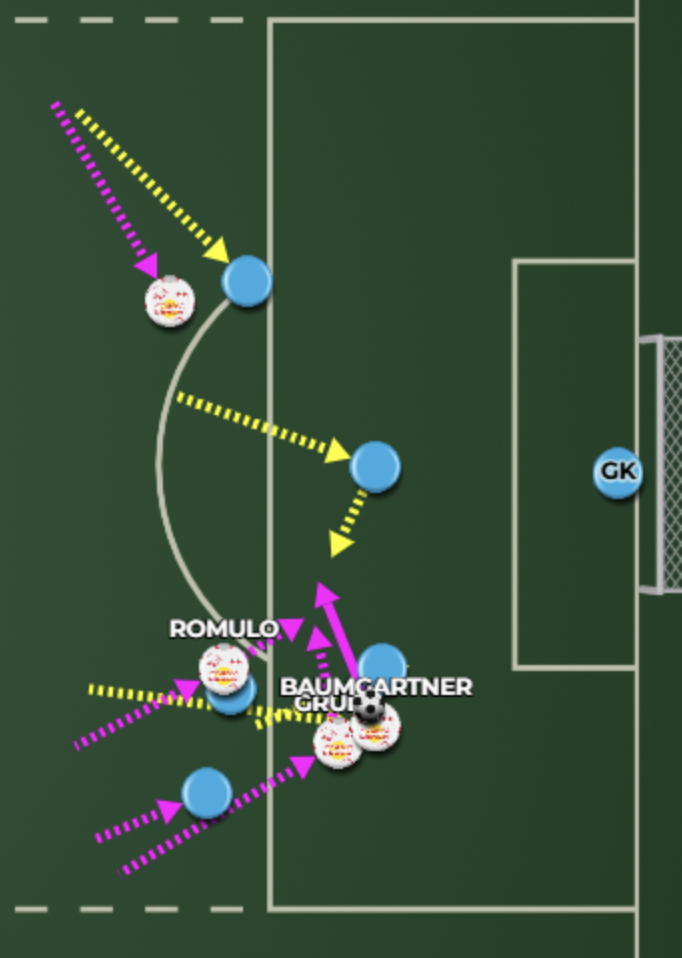
In doing so, he closes Romulo’s lane, even though continuing on the right side would have been the better option. Even so, he receives the ball and quickly lays it off to Romulo, but the opposition defence recovers in time and blocks the shot.
11) Support Positioning
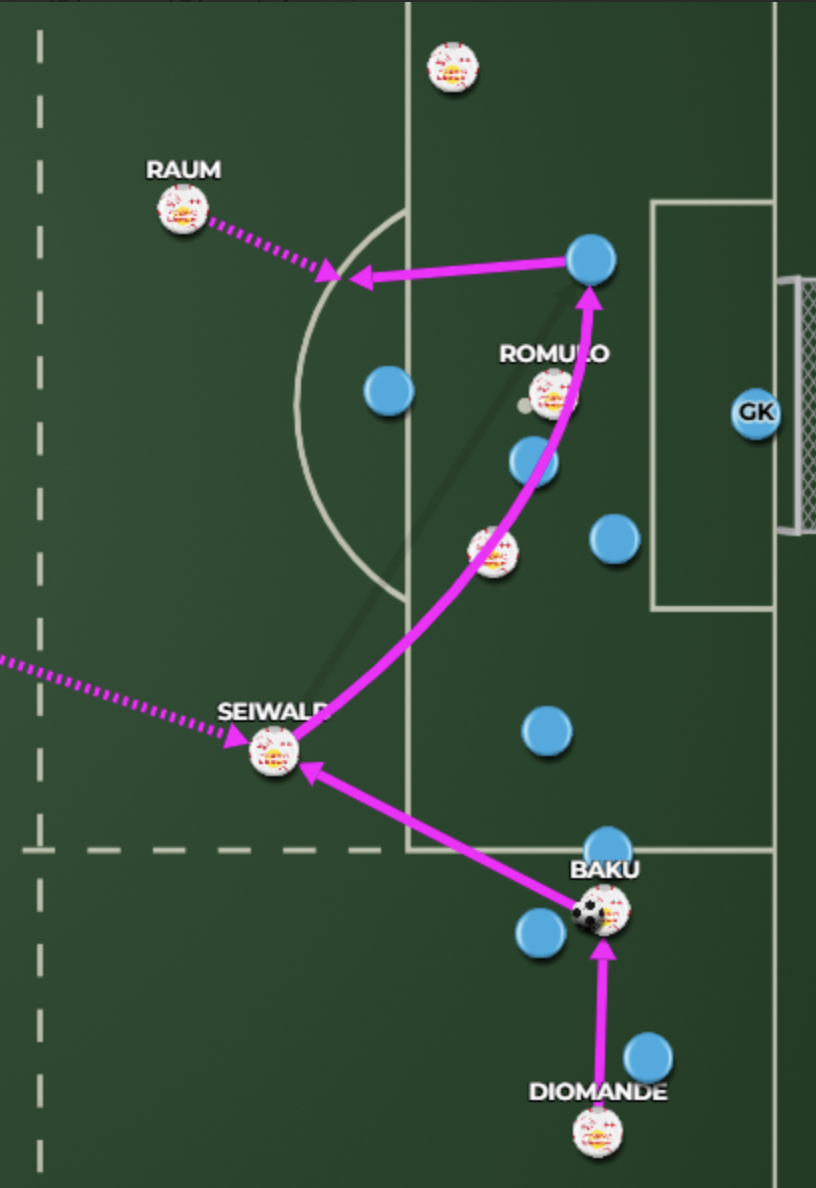
Unlike Baumgartner and Schlager, Seiwald is not a midfielder who naturally stands out with his attacking contribution.
However, when both the right-back and the right winger move into the final third, he also pushes forward in order to prevent the distances between players from becoming too large. When the ball reaches him, he is unable to deliver an effective cross. Even so, his presence in advanced areas is still valuable, as it allows Raum and Diomande to collect second balls and sustain the attack.
12) Cut-Back Vision
Bakayoko is a different type of winger compared to the others. In my view, his vision for the final pass is at a higher level. He breaks through between four opposition players on his own, reaches the byline, and unlike the others, delivers a grounded cut-back towards the deeper area. However, the defender manages to clear the ball away from the penalty area.
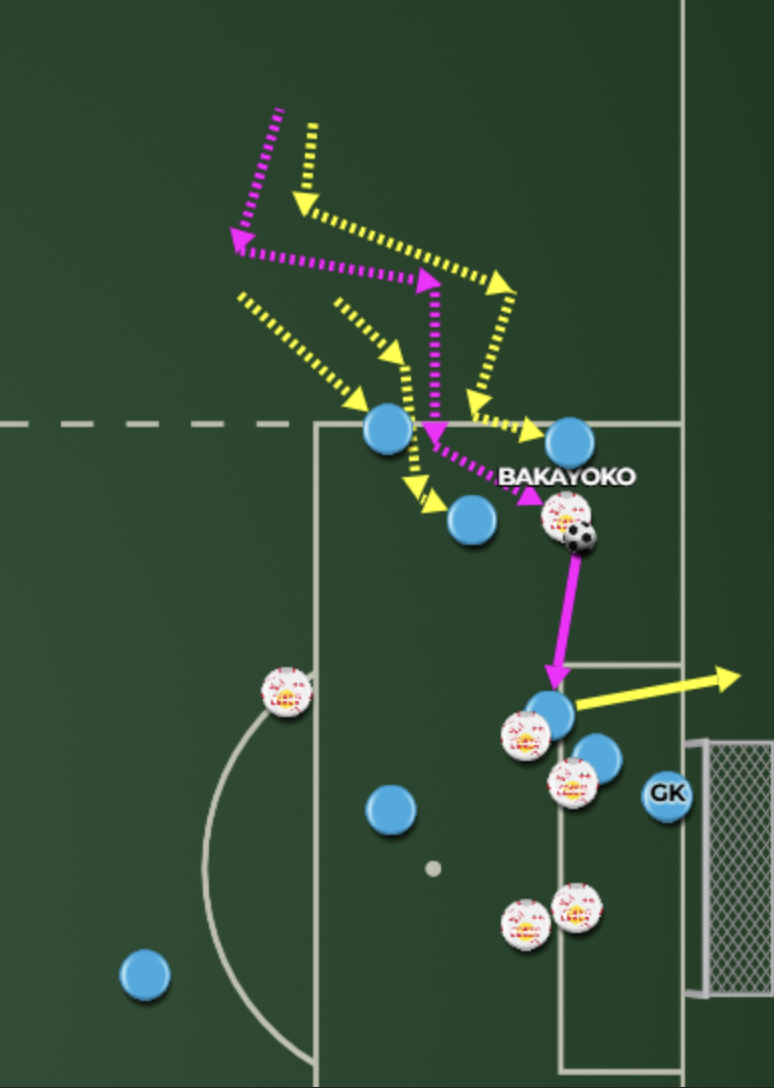
This also reflects the main reason why Leipzig, despite entering the box so frequently, struggle to convert these situations into goals. They are often able to reach the penalty area, sometimes even through individual actions, but they either fail to release the pass at the right moment or struggle to recognise the best-positioned teammate inside the box.