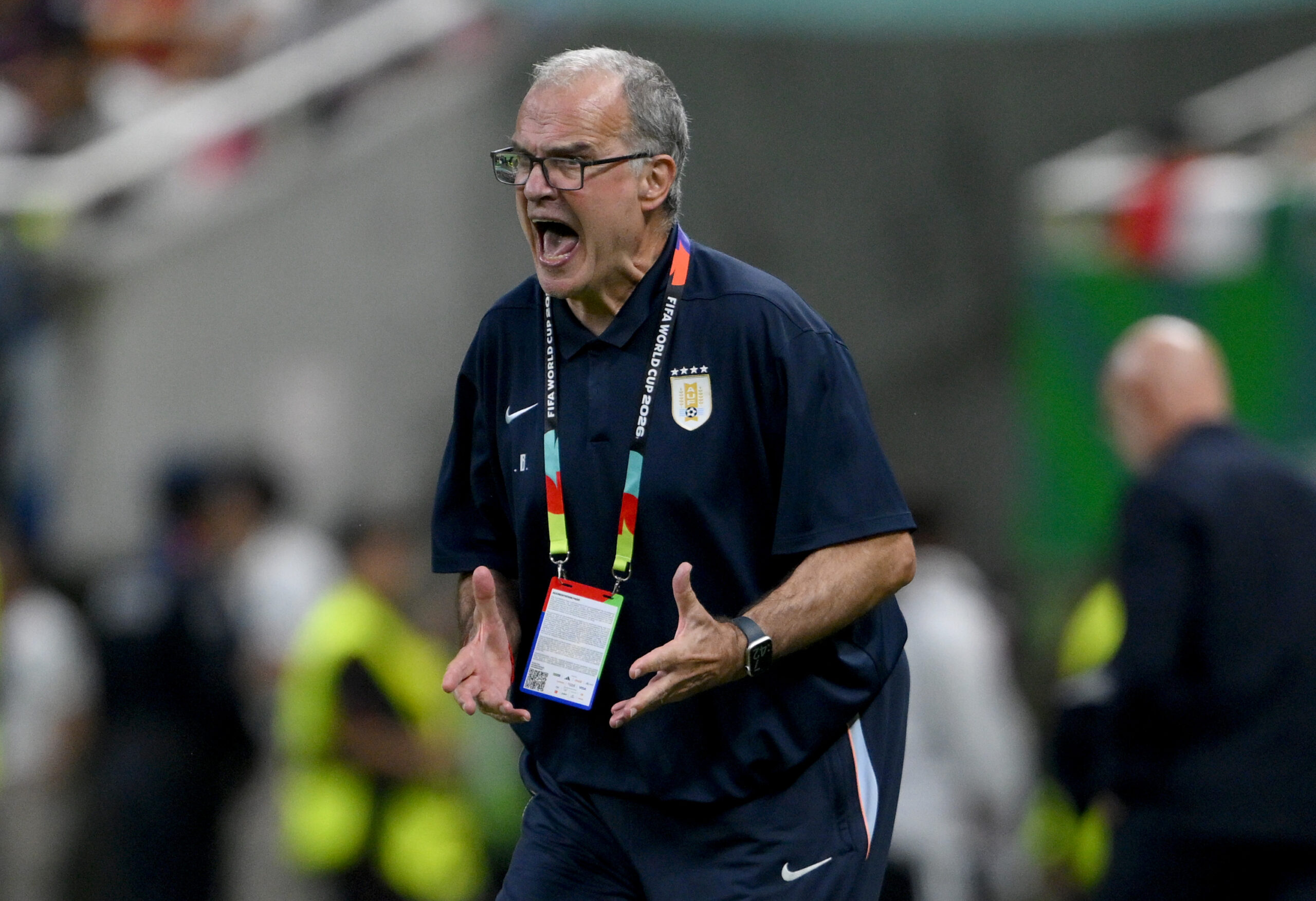

Marcelo Bielsa. They call him El Loco. The Madman.
A managerial career spanning more than four decades. Three FIFA World Cups managed. Countless trophies and an influence on modern soccer that is felt across continents.
When Marcelo Bielsa took charge of the Uruguayan national team in 2023, the reception polarized fans. Uruguay’s historic garra charrúa (their way of playing with defensive resilience) was now gonna clash with Bielsa’s relentless, high-octane attacking soccer.
For a while, it worked brilliantly. Uruguay impressed throughout World Cup qualifying, beat both Brazil and Argentina, and finished third at the Copa América. Yet, at the expanded 2026 FIFA World Cup, where eight of the 12 third-place teams advanced to the knockout rounds, Marcelo Bielsa somehow failed to make Uruguay advance.
What exactly went wrong for Marcelo Bielsa and Uruguay?
The Illusion of Group H
Uruguay’s placement in Group H alongside Spain, Saudi Arabia, and Cape Verde was widely viewed as one of the most favorable draws of the tournament. Most expected Spain and Uruguay to comfortably battle for first place while Saudi Arabia and World Cup debutants Cape Verde competed for third. But that wasn’t to be.
Saudi Arabia and Cape Verde
Their opening match against Saudi Arabia in Miami ended in a frustrating 1-1 draw.
The warning signs were already there when Uruguay were thoroughly outplayed during the opening 45 minutes. They conceded first and looked unusually sluggish and disorganized. Bielsa’s halftime adjustments improved the performance enough for Uruguay to rescue a point, but it was hardly convincing.
Five days later, they faced Cape Verde.
Fresh off their historic draw against Spain, this time, Uruguay allowed Cape Verde to score two goals on their head, securing yet another point for the Blue Sharks. Los Celestes had now played two back to back draws and missed out on four valuable points. Across both matches, Bielsa’s trademark 4-1-2-3 system simply failed to function the way it had throughout qualifying.
Heading into the final group match against Spain in Guadalajara, Uruguay had collected just two points and suddenly needed a result against one of the tournament favorites simply to survive.
Spain
Against Spain, Marcelo Bielsa had no answers. Luis de la Fuente expertly manipulated Uruguay’s aggressive man-to-man pressing structure, dragging players out of position and opening enormous passing lanes throughout midfield. Despite desperately needing victory, Uruguay failed to register a single shot on target until the 83rd minute.
A moment of horror arrived in the 41st minute.
Forty-year-old goalkeeper Fernando Muslera, appearing at his fifth World Cup, committed a terrible error that gifted Álex Baena the only goal of the match. Muslera never returned for the second half. He was replaced by Sergio Rochet. While rumors said that Bielsa was pissed off at Muslera, Bielsa later claimed the decision was made by the player instead who requested to come off.
After the first half, the frustration only grew.
Real Madrid midfielder Federico Valverde was surprisingly substituted in the 56th minute for striker Federico Viñas. Television cameras caught Valverde walking straight past Bielsa without acknowledging him before taking his seat on the bench. The cracks were starting to show now.
As elimination drew closer, Uruguay completely lost its composure.
The tackles became increasingly reckless. Yeremy Pino and Nico Williams both required treatment after heavy challenges from frustrated Uruguayan defenders. Uruguay collected four yellow cards during the second half before Agustín Canobbio received a straight red card deep into stoppage time.
When the final whistle blew, Uruguay’s World Cup was over.
Where Did Marcelo Bielsa Go Wrong?
The Goalkeeper Situation
Perhaps Bielsa’s most baffling decision involved the goalkeeping position.
Sergio Rochet had been Uruguay’s unquestioned first-choice goalkeeper since 2022. Yet, just before the World Cup, Bielsa controversially reinstated 40-year-old Fernando Muslera, citing the veteran’s tournament experience.
That one fatal miscalculation destablized the entire defence. Muslera is a traditional, line-bound shot-stopper. He is deeply uncomfortable acting as a sweeper-keeper. Rochet is much younger, agile and less error-prone and has been a mainstay of this squad for years now.
Muslera has a history of errors, especially in the World Cup. The blunder against Spain was just one of many, both in the current tournament and the four prior.
As La Gazzetta dello Sport summarized:
“His debut against Saudi Arabia featured an error leading to Al-Amri’s goal. Against Cape Verde there was indecision and an absurd, suicidal rush out of his area. Against Spain came his deeply disappointing final dance. It ended with his request to be substituted and an inglorious end to a remarkable career.”
The Midfield Problem for Marcelo Bielsa
The midfield engine room of any Bielsa team requires perfect spatial awareness and relies on other midfielders to protect that position. In his 4-1-2-3, the lone defensive midfielder (the “pivot”) is very vulnerable. For Uruguay, that was Manuel Ugarte.
Bielsa instructed his two central midfielders (Federico Valverde and Rodrigo Bentancur) to push and press aggressively high close to the forward line in an attempt to win turnovers. So when Spain, and even Cabo Verde, bypassed Uruguay’s initial line of pressure, Ugarte was left completely isolated covering 40 yards of horizontal space.
Spain’s midfield trio of Rodri, Pedri, and Mikel Merino exploited this ruthlessly. They formed passing triangles around Ugarte, pulling him out of position and driving straight at the heart of Uruguay’s center-backs.
Bielsa failed to update his system over the three games to rectify this issue and it ultimately cost him.
The Lack of Firepower
While Luis Suárez publicly apologized to Marcelo Bielsa after their previous disagreements and even expressed his willingness to return from international retirement, Bielsa paid him no attention.
Instead, Uruguay traveled to the World Cup with only three recognized center forwards. ONLY THREE.
- Darwin Núñez.
- Federico Viñas.
- Rodrigo Aguirre.
That was it.
Bielsa’s system relies heavily on wide forwards stretching defenses to create isolation opportunities. But because Uruguay’s midfield rarely gained stable control of matches, the strikers barely ever received possession in dangerous situations.
- Darwin Núñez was substituted at halftime against Saudi Arabia and did not start against Cape Verde.
- Federico Viñas failed to make an impact with the chances he was given.
- Rodrigo Aguirre barely influenced the tournament.
When Plan A failed, there was no Plan B.
By limiting his attacking options so severely, Bielsa boxed himself into a corner from which Uruguay never escaped. In all the three positions on the pitch, Bielsa continued to make blunder after blunder.
Marcelo Bielsa Retirement Next?
Marcelo Bielsa failed at the 2026 World Cup because he refused to compromise his philosophy. The beautiful game has changed a lot when he started managing back in 1987, and Bielsa doesn’t seem to come to that acceptance. Bielsa remained stubbornly committed to the same principles regardless of the opponent, the climate, the form of his players, or the demands of the tournament itself.
For me, Uruguay were dark horses of the tournament. But unfortunately, Marcelo Bielsa and Uruguay seem to be only heading into darkness.
Abhik Deb is an accomplished sports journalist and content creator, renowned for his innovative approach to digital storytelling within the football world. With a Master’s degree in Sports Journalism and Communications from Universidad Europea de Madrid, Abhik brings a sophisticated understanding of both traditional journalistic tenets and contemporary digital media strategies to his work. His professional journey includes a significant tenure as a multimedia journalist at Real Madrid C.F., where his contributions spanned video editing, scriptwriting, and on-camera presenting. Notably, Abhik made history as the first Indian to record a live stand-up from the hallowed Santiago Bernabéu pitch for Real Madrid TV, underscoring his pioneering spirit and influential presence. A specialist in La Liga and Spanish football, Abhik excels at captivating audiences through viral football content and insightful documentary-style videos. His natural ability to blend rigorous journalism with creative digital storytelling is evident in his independent fan channel, ‘LaLigaVic,’ where he cultivates a growing audience through engaging, original coverage of Spanish football culture. Abhik’s proficiency extends to social media strategy and audience engagement, crucial skills in today’s digital landscape. You can explore more of Abhik’s work on Hooligan Soccer and Muckrack. Connect with Abhik on Instagram, LinkedIn, and YouTube to follow his continuous dedication to delivering high-quality, authoritative sports content.