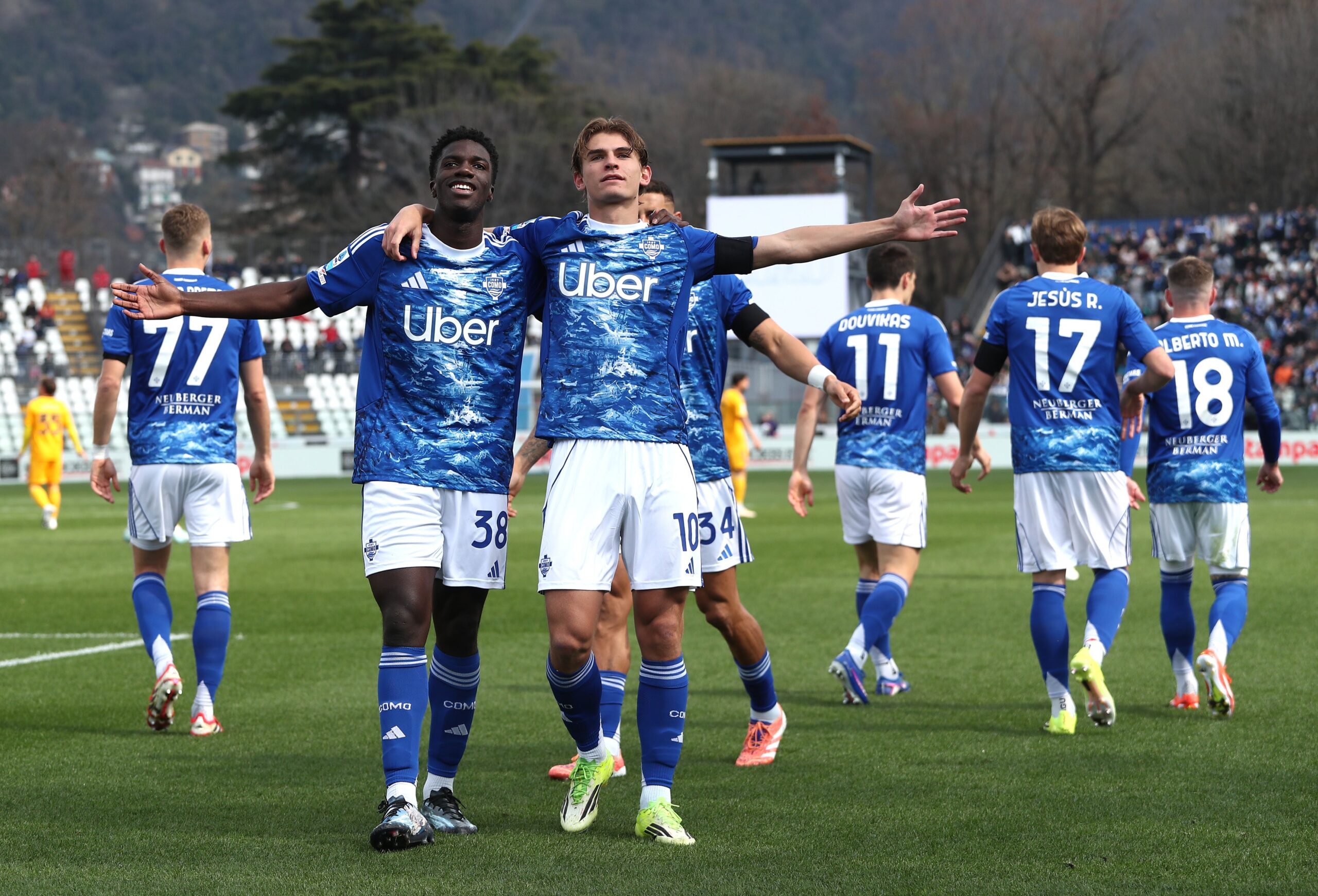
Como 1907 is a most surprising success story in Italian soccer. In 2017 they emerged from bankruptcy and re-entered Italy’s Serie D. Two years ago they were playing in Serie B. Last season, they finished tenth in Serie A. This season, with eight weeks still left before the end of the campaign, they are sitting in fourth place. It seems entirely possible that they will compete for that Champions League spot right until the final match against established rivals such as Juventus, Roma, and Atalanta.
One of the first details that stands out when you watch Como is their patience in possession. They rarely force the game, even if the opponent is not applying pressure. They do not speed up possession unnecessarily; nor do they pass simply for the sake of passing. When opposing players do not close down the player on the ball aggressively enough, Como still waits for the right moment without disrupting their existing structure. For them, attacking does not finish with the final action; it begins with being able to establish the right connections in every area of the pitch.
This piece focuses on one of Como’s most distinctive game elements behind that approach: their passing patterns.
1) Wide 1v1 Creation
As Paz moves toward the midfielder in possession, Caqueret pushes onto the opposition’s left centre-back. Paz then receives by stepping across the opposing left winger’s line.
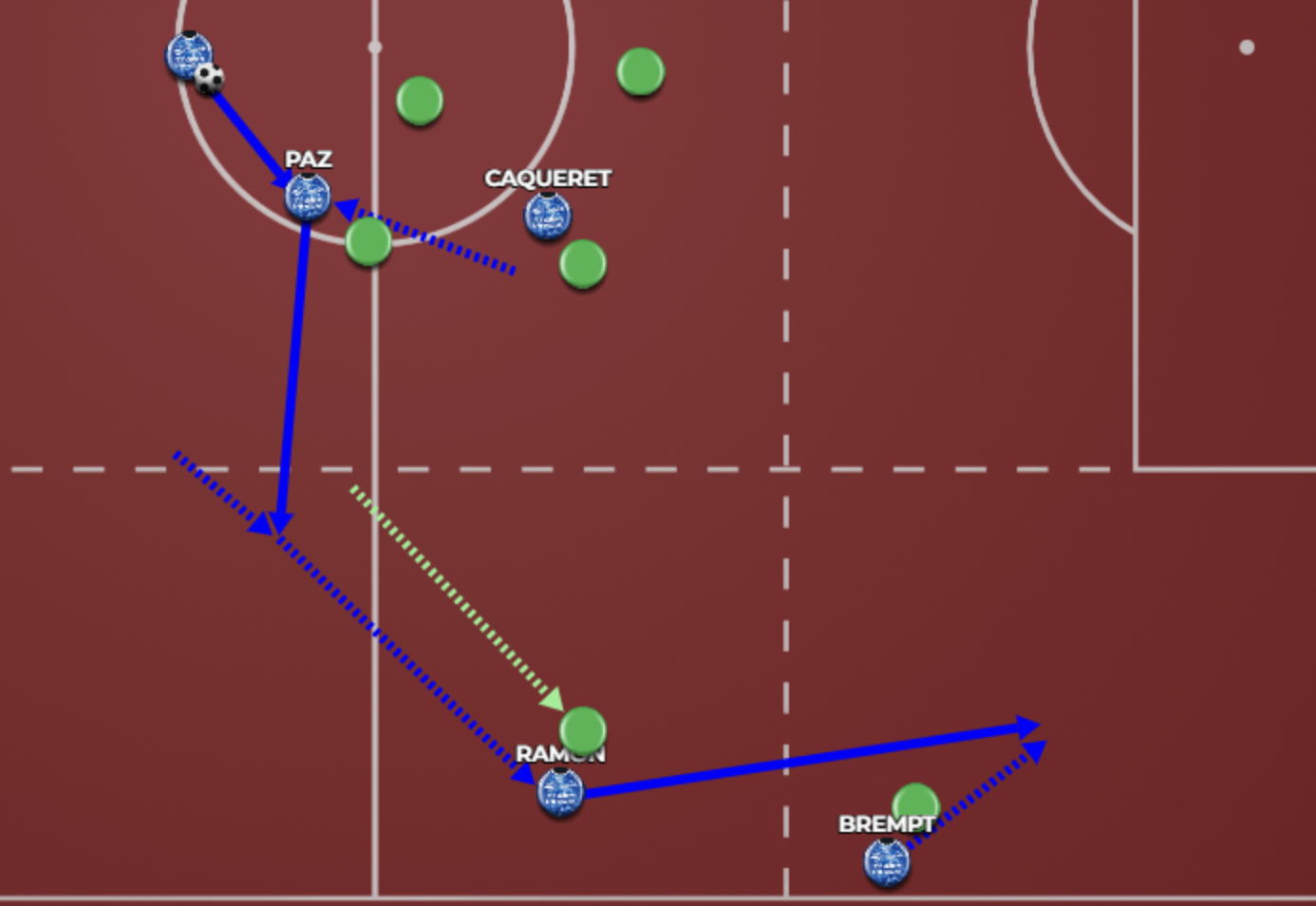
That creates an isolated 1v1 for Van der Brempt against the opposition’s left wing-back on their left side. The right centre-back, Ramon, takes the ball and plays into Van der Brempt’s run. Van der Brempt then draws both himself and his defender toward the touchline, before the next pass is played back inside with the intention of breaking into the penalty area.
2) Blindside Access
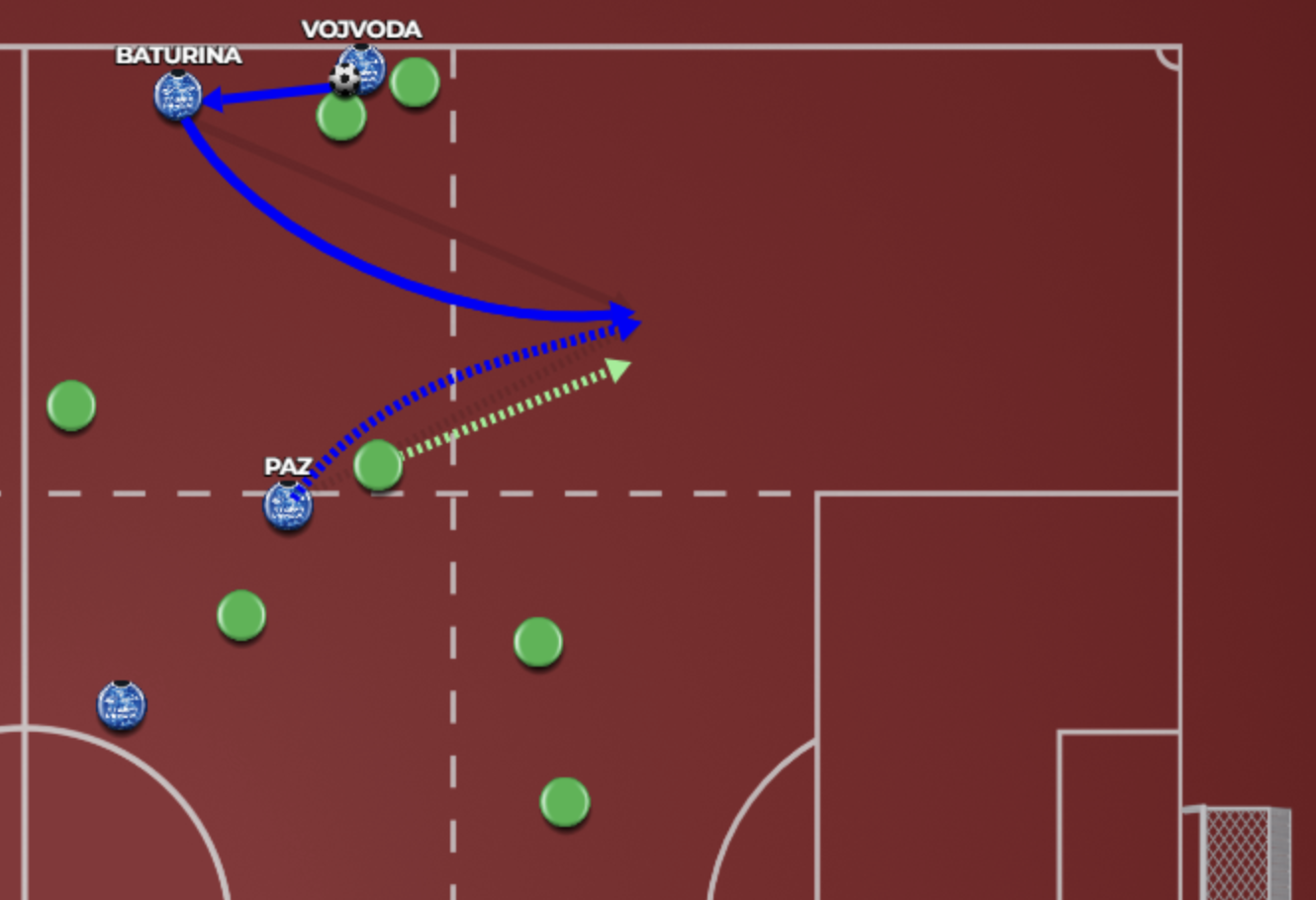
Vojvoda and Baturina combined with a few short exchanges on the left side of midfield.
Through this circulation, they draw the opposition’s right winger and right-back into focusing on the ball and away from the space behind them. At that moment, Nico Paz begins his run into that zone. The pattern would have been even more effective if Paz had started the run without being noticed by the opposing midfielder.
3) Layoff to Depth
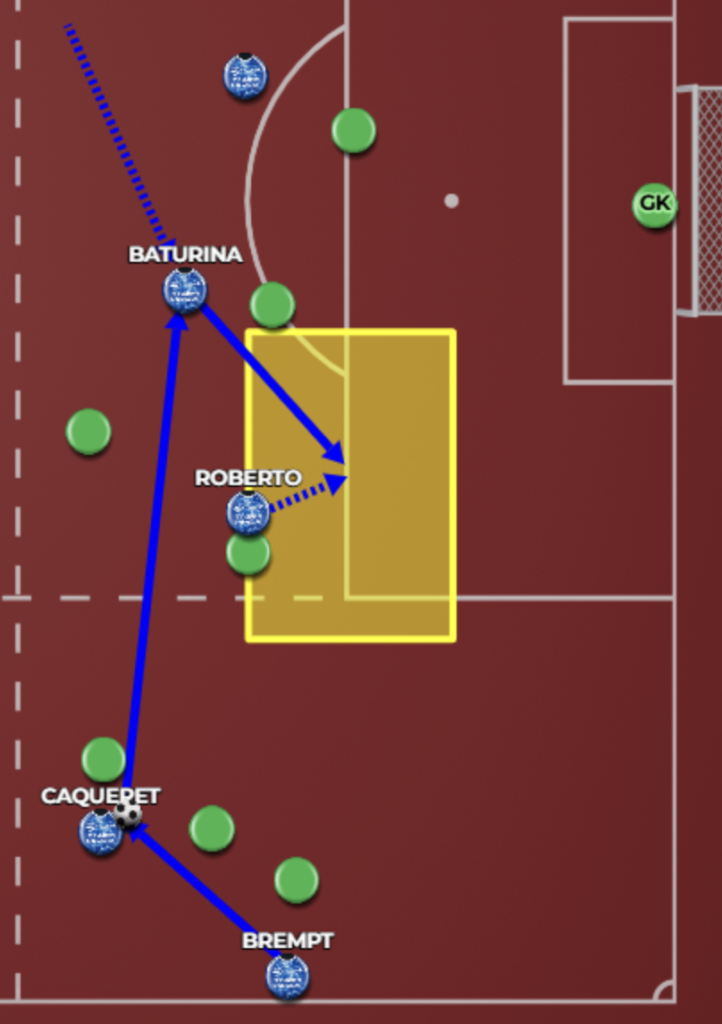
When Van der Brempt receives, Caqueret is positioned ahead of him, but there are three opposition players in front of them, so progressing through that lane is extremely difficult. For that reason, as Van der Brempt carries the ball forward, Caqueret drops off and offers a heel lay-off option. When the ball reaches him, he is in space.
At the same time, Baturina, coming in from the left side, moves toward in front of the penalty area and signals to Caqueret that he wants the ball. As the pass travels into Baturina, Sergi Roberto exploits the mismatched marking and makes a run into the box. The moment Baturina receives, he releases the ball into Roberto’s path.
4) Turn and Release
Baturina receives from Paz in midfield. He shapes as if he is going to play toward the left-back, Valle, but then turns sharply the other way.
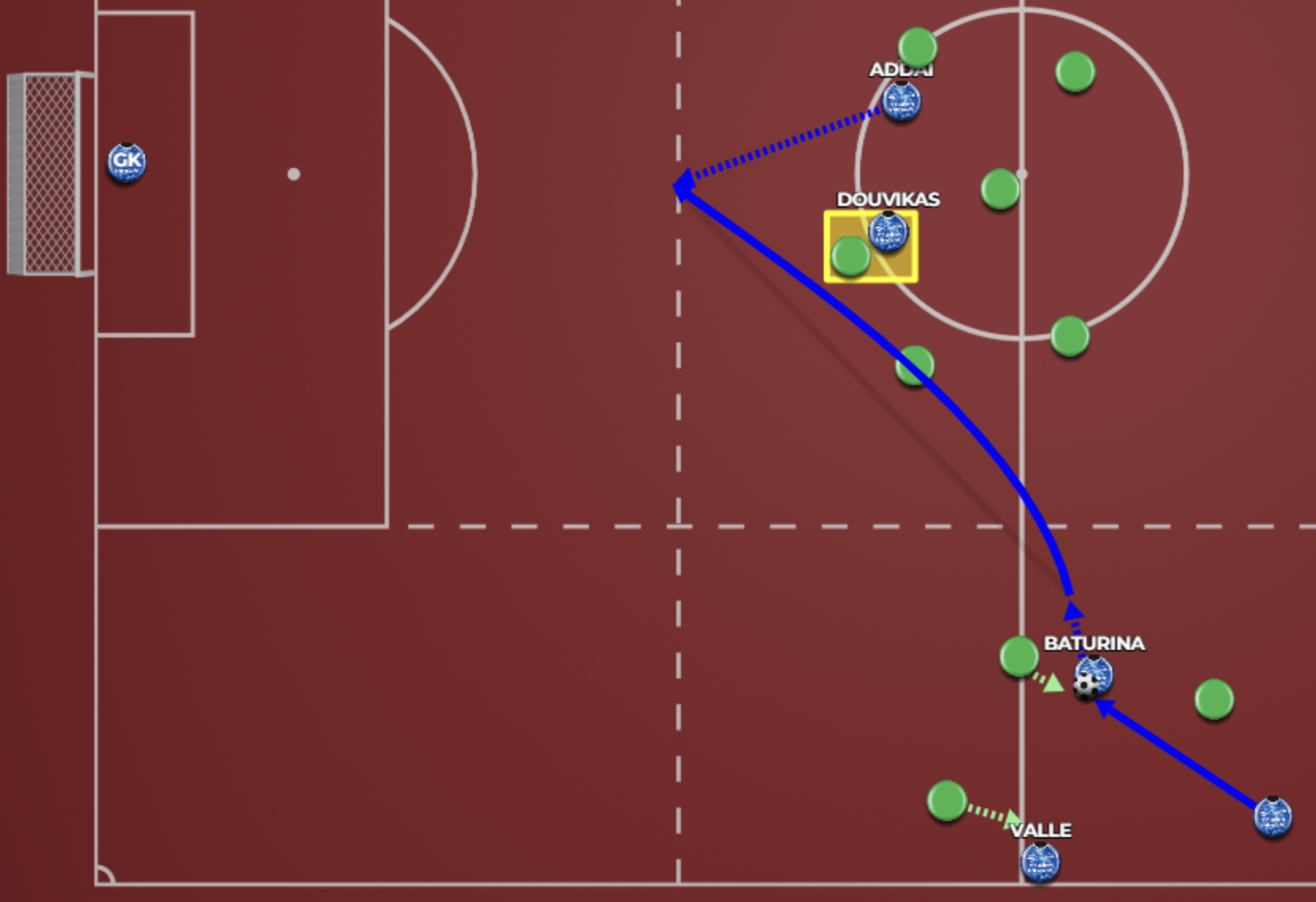
Because the 3–4 opposition players in that area expect the pass to go to Valle, they do not react quickly enough to Baturina.
As soon as he turns out, the winger, Addai, starts his run in behind the defensive line. With Douvikas occupying the central centre-back, the back line is not properly aligned. Baturina then clips a long pass into Addai’s path, and Addai goes one-on-one with the goalkeeper.
5) Press. Bait. Carry.
While Diego Carlos is in possession, Da Cunha moves inside toward the centre. Seeing this, the opposition right winger feels he can press more aggressively, because there is no longer a Como player holding the width on that flank.
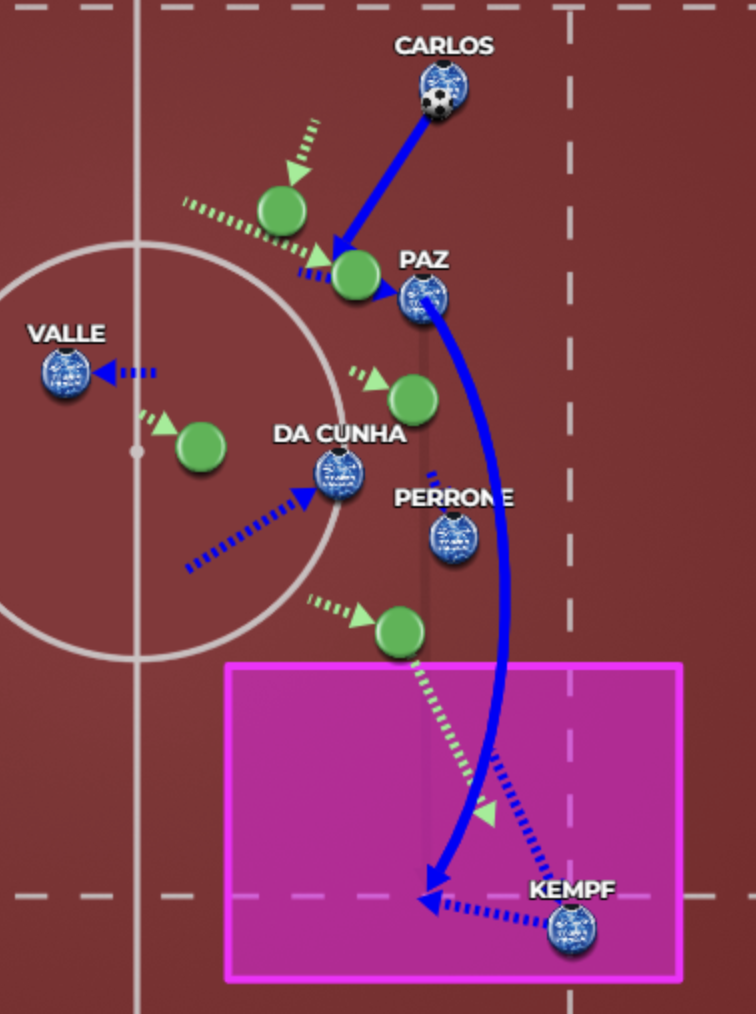
Paz receives from Carlos, and once he plays the pass into Kempf, an opposition player immediately jumps forward to win the ball. Kempf responds with a one-touch push out of his feet and then accelerates onto it. Because the opponent is arriving at speed straight toward him, he can neither reach the ball nor stop Kempf. Then he attacks the open space in front of him and carries the ball into the opposition half.
6) Zigzag Progression
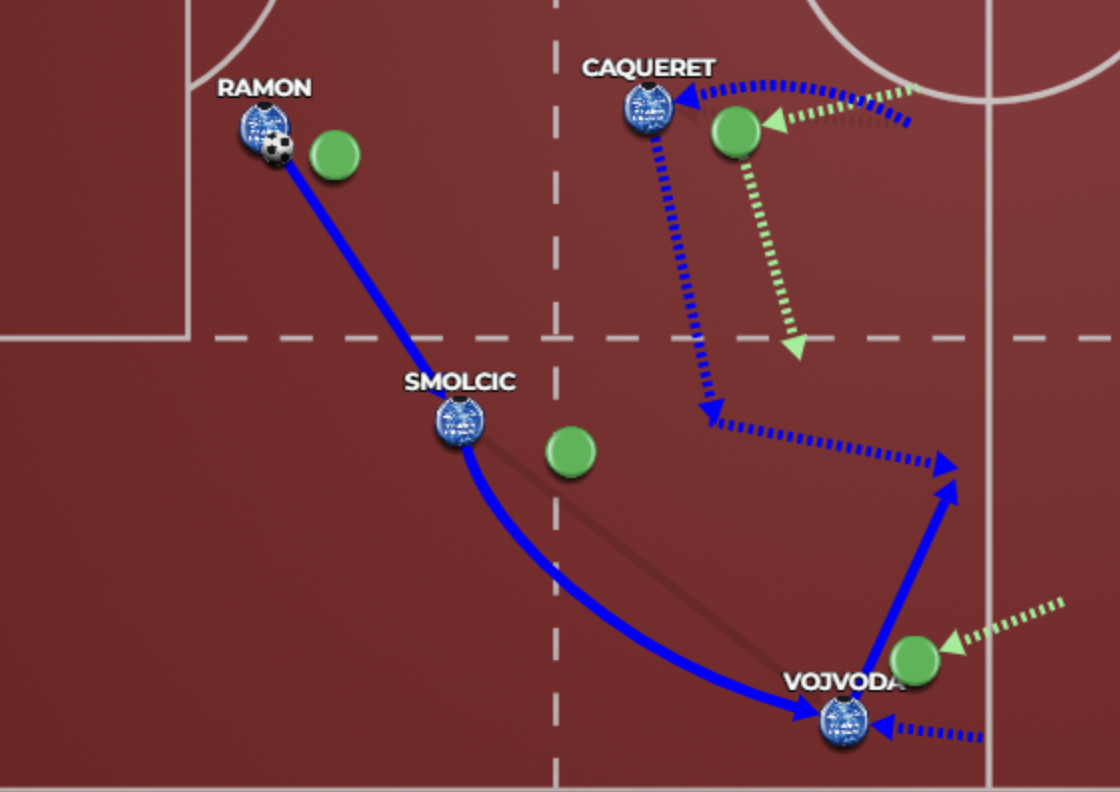
We see a zigzag passing sequence on the right side. It starts with Ramon and continues through Smolcic, Caqueret and Vojvoda.
In Como’s passing structures, either Caqueret or Nico Paz is almost always involved. Even though both are attack-minded players, they regularly drop deeper and become the key figures in moving the ball forward.
During this sequence, the players other than Caqueret operate within a relatively narrow space. Caqueret, however, not only drops to connect himself to the action, but also becomes the player who finishes the pattern.
7) Bounce and Drive
Baturina plays into the advancing Valle and receives the return pass. With no nearby support around him, he then drives diagonally inside toward the centre. The midfielder, Perrone, positions himself between three opposition players on the diagonal to provide Baturina with a passing option.
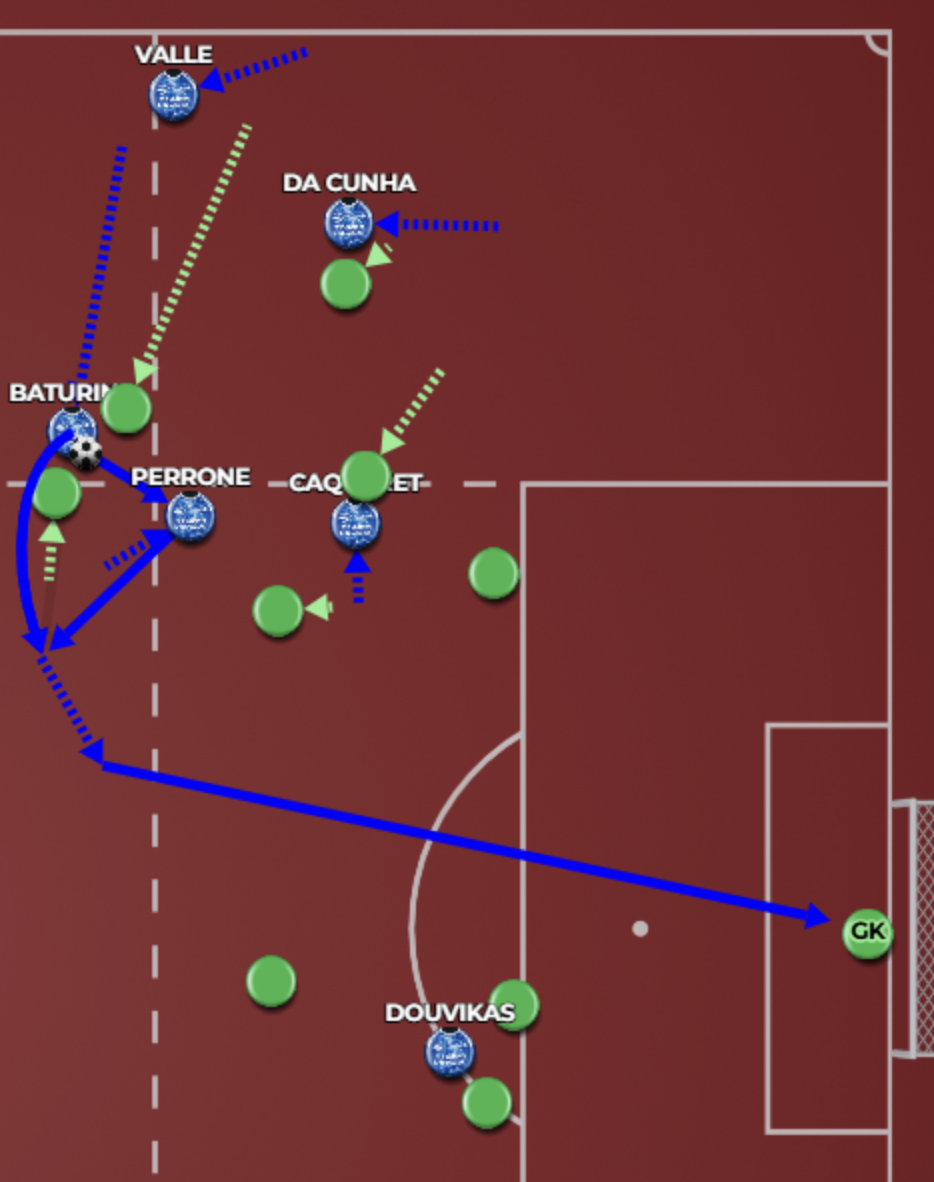
Baturina then plays a second pass and receives it back again. Exploiting the space that opens up centrally, he carries the ball forward once more and gets his shot away.
It is a highly efficient passing pattern created with only a few players. However, because Como executed it in the second phase and still far from goal, the overall effectiveness of the move drops, as the final shot comes from a less dangerous area and has limited impact.
8) Disguised Wall Pass
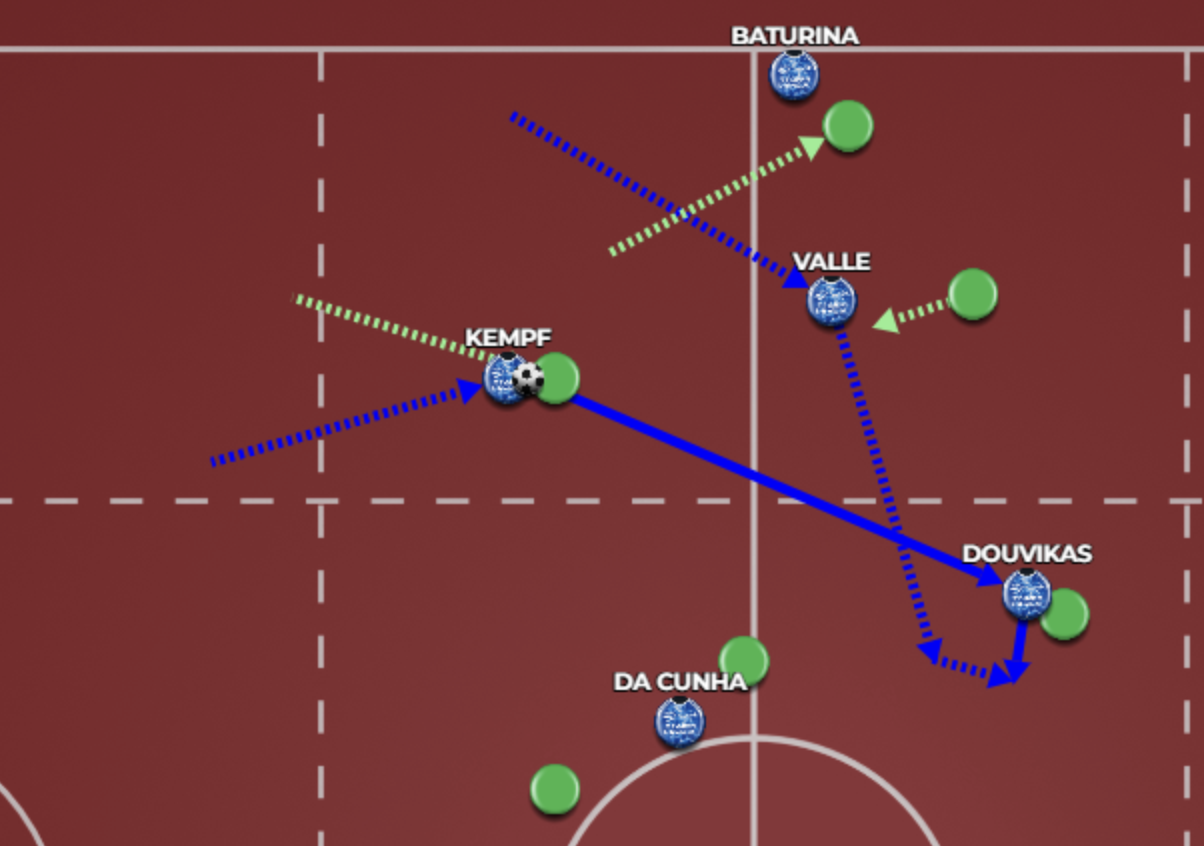
After receiving from the goalkeeper, Kempf drives forward into the space in front of him.
Valle can’t receive on the touchline because he is under direct pressure from his marker, and as long as he remains passive in that position, that situation isn’t going to change. He therefore starts to move inside.
The opposition player then leaves Valle, because he does not want to leave the Como winger, who has dropped deeper, unmarked. As Kempf shapes as if he is going to play into Valle, Douvikas reads the situation, receives the ball, and immediately sets it into the path of Valle, who is running centrally. As a result, Valle receives the ball in stride, without having to fix his attention on it beforehand, as it arrives naturally into his path.
9) Dual Long Pass Option
In moments by repeated turnovers from both sides, it becomes extremely difficult to escape a tight area through short passing alone. Como creates two different long-ball options.

Because they do not combine in the same direction repeatedly, the opposition players are unable to anticipate the pattern and win the ball. Once the ball-carrier breaks out of the congested zone, he has the option to play either vertically or horizontally. In this case, he chooses the horizontal pass.
10) Two-Pass Access
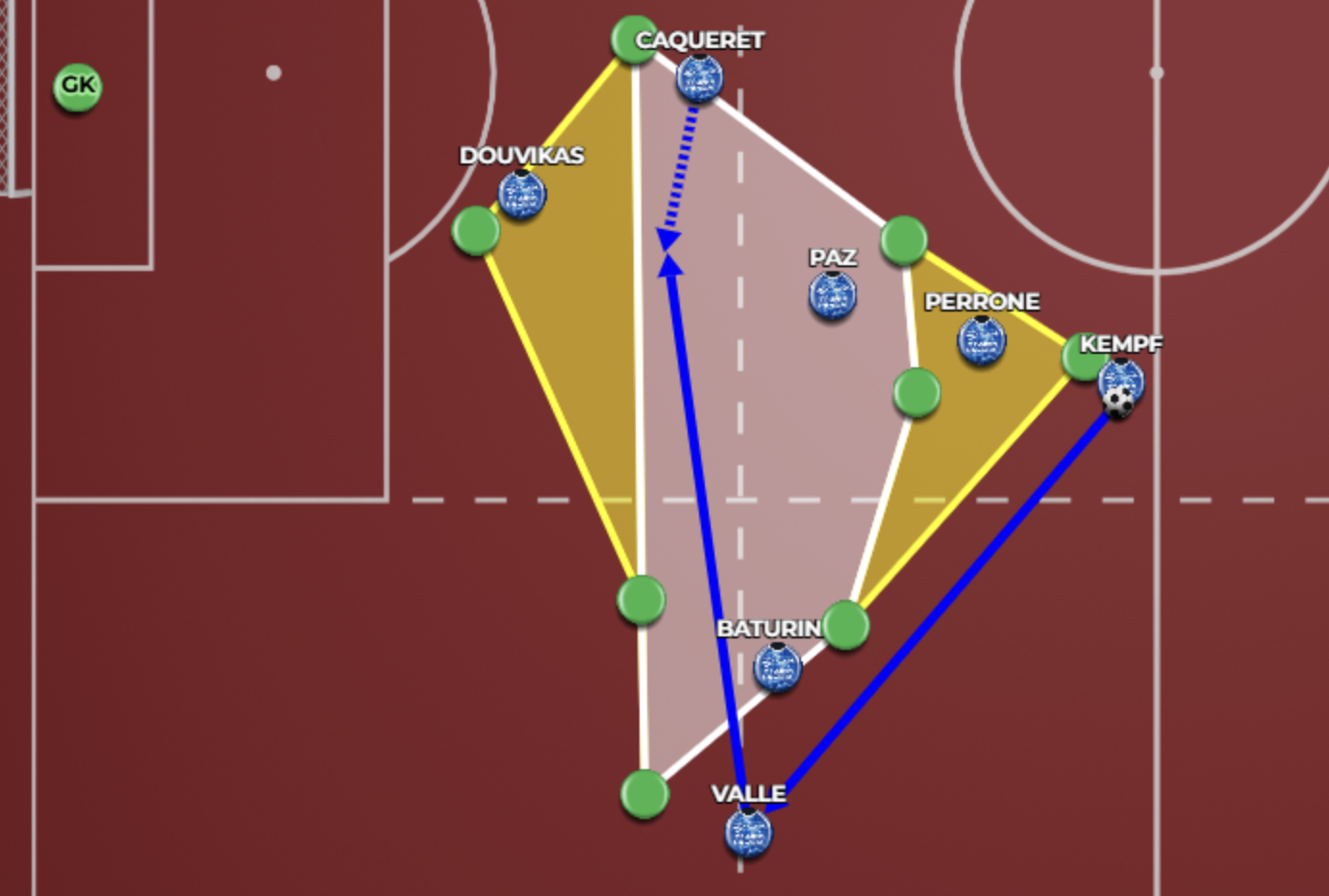
When the distance between the opposition’s lines is too large, those spaces have to be exploited well. If you can do that with a small number of low-risk passes, you can consistently generate effective attacks.
In this attacking sequence, there are only two passes, and the probability of either pass failing to reach its target is very low. The reason is that each player already knows the next action before receiving. When Kempf plays into Valle, he is fully aware of the space between the opposition’s defensive and midfield lines. Caqueret also knows where Valle is going to direct the next pass. That is why he can receive on the move, with momentum, and reach the edge of the opposition penalty area through just two safe passes.
11) Hidden Third-Man
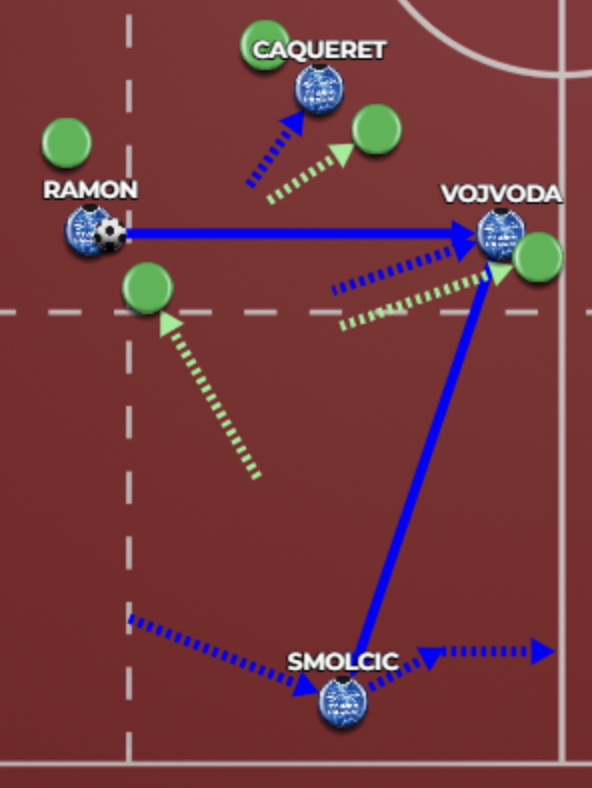
With Ramon on the ball, Smolcic is under direct pressure from his marker. Ramon first holds onto possession long enough to draw the opponent toward himself, then signals for Smolcic to push forward.
At the same time, Caqueret and Vojvoda move toward Ramon and then away from him, dragging their markers with them. As a result, no one properly registers Smolcic’s forward movement. As Vojvoda moves away from Ramon, he suddenly stops to lose his marker, and the moment he receives, he immediately plays the ball into Smolcic.
12) Rotations Around Pressure
Como’s players constantly circulate around the area where the passing exchange is taking place. The most active in this regard are Caqueret, Vojvoda and Valle.
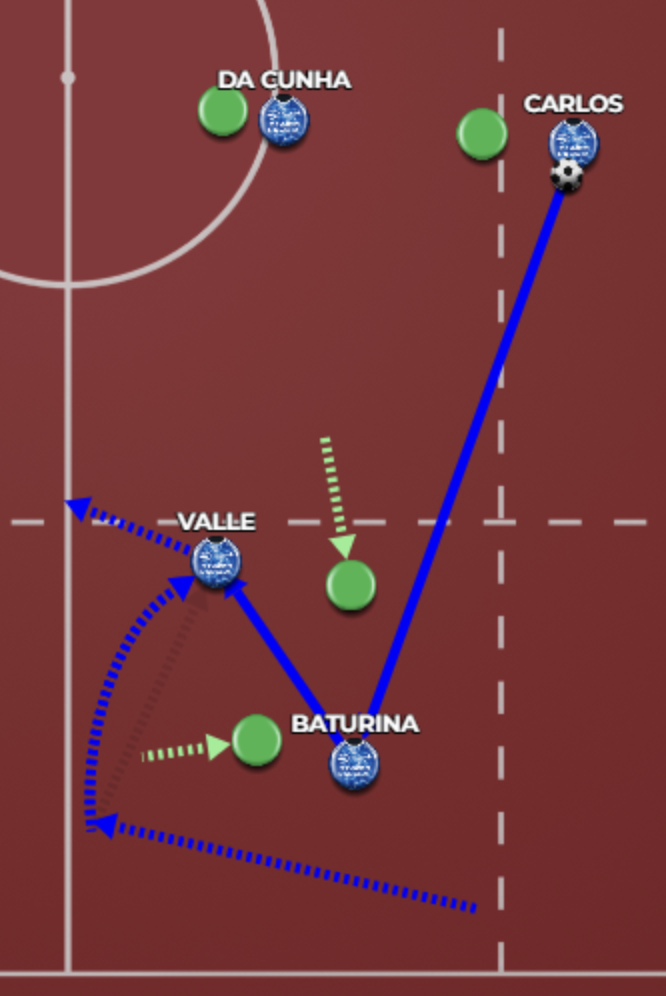
At times they move into that zone, and at other moments they loop around behind opponent players to offer a new passing angle to the teammate in possession. During these combinations, the same player can disappear from the camera frame several times. You assume he has moved further forward or dropped deeper, but a moment later he reappears and reconnects himself to the passing structure.
13) Correct Progression
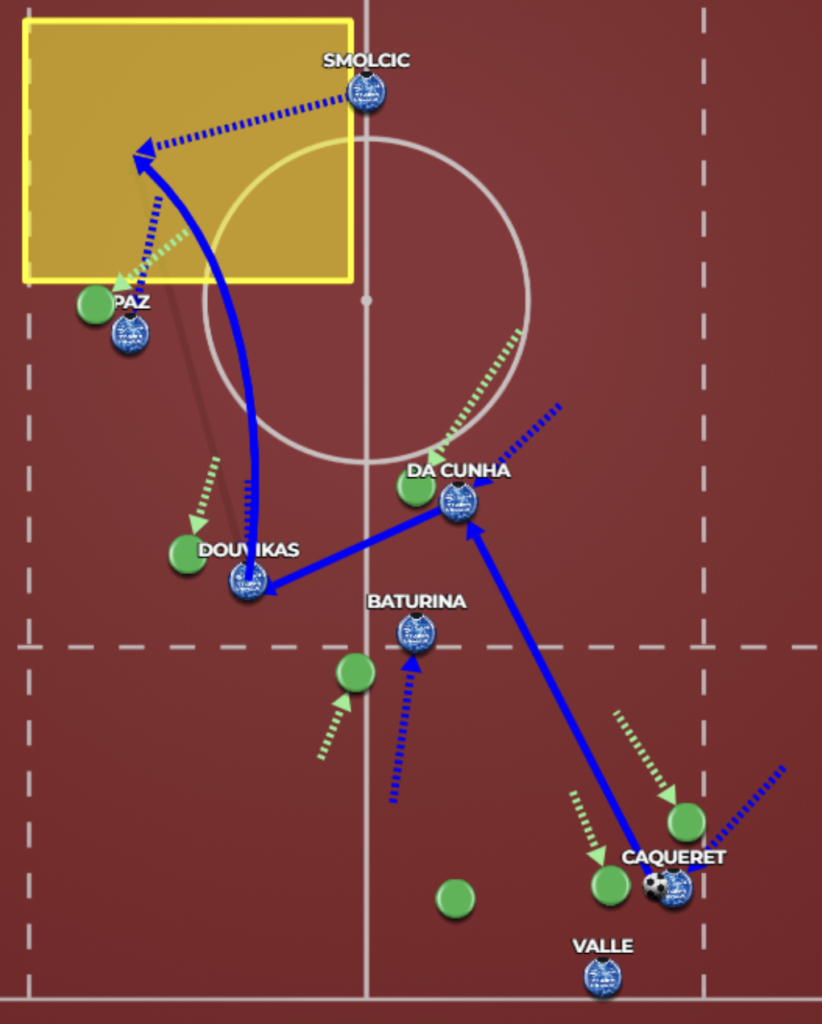
The first action in this passing pattern comes from the goalkeeper. He sees that Caqueret is free and starts the move with an excellent distribution. As the opposition jumped out to press Caqueret, they lost their superiority in the centre.
Caqueret then plays a pass that can be received by either Da Cunha or Baturina. Once Da Cunha takes the ball, Douvikas creates separation from his marker and makes himself available. He escapes the pressure with two touches and then threads a through ball into the path of Smolcic, who is overlapping down the right wing.
14) Rotating Triangle
Vojvoda, Caqueret and Perrone use a rotating passing triangle with constant positional interchange. As soon as Perrone passes, he immediately moves forward.
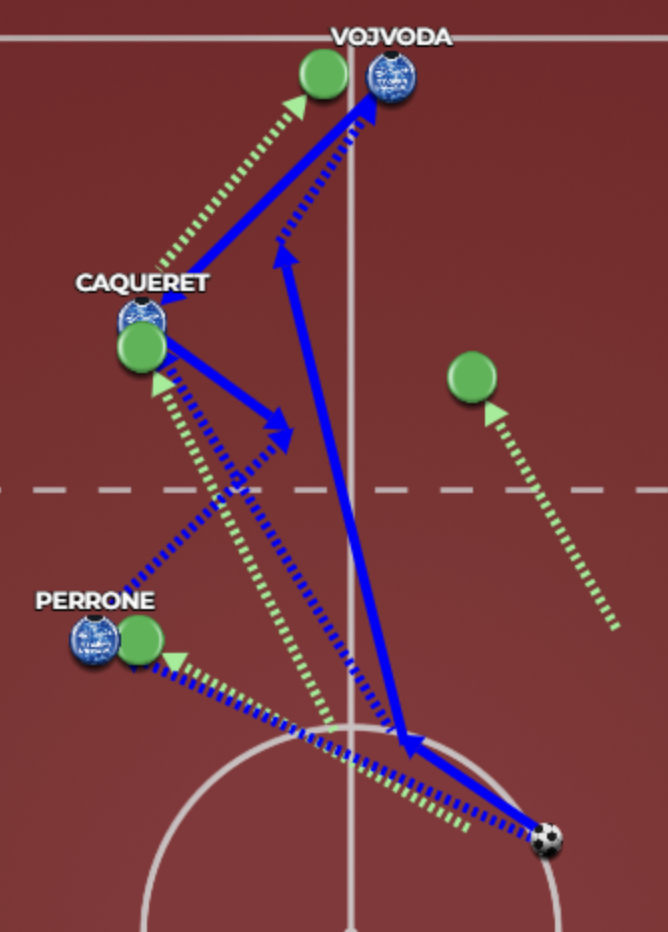
Caqueret receives and plays into Vojvoda, then makes a forward run beyond him. In other words, they shape as if they are about to break the triangle, because the diagonal structure briefly flattens into the same line.
The opposition players tracking Caqueret and Perrone cannot adjust in time when both players pause and rotate their positions just before Vojvoda releases the pass. By the time the ball comes back to Perrone, the triangle has already been re-established.
15) Reverse-Side Release
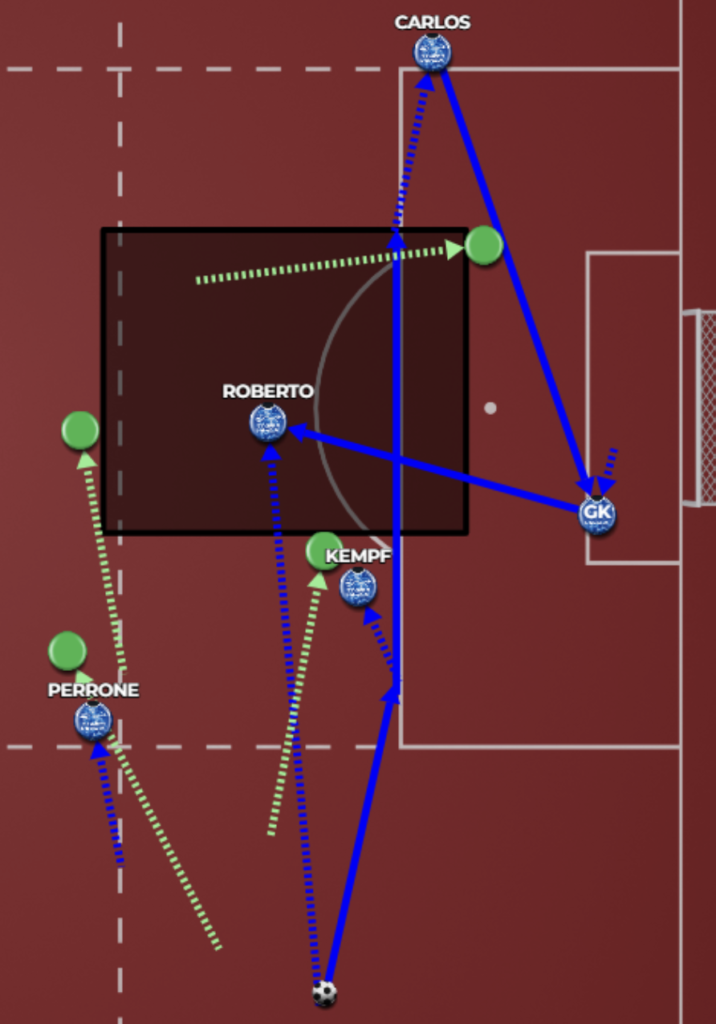
When the opposition intensifies their press in Como’s first phase, the team can escape by finding a player positioned away from the pressure who steps into the goalkeeper’s line of sight to receive. In this sequence, that player is Sergi Roberto.
Before arriving in the zone I highlighted, he was positioned between the left centre-back and the left-back. As Diego Carlos plays back into goalkeeper Butez, both Kempf and Butez shift their body orientation toward the left side. While the opposition players jump toward Butez and Kempf, Roberto moves in the opposite direction. As a result, when the ball reaches him, there is no opponent around him, and Como can break the pressure cleanly.