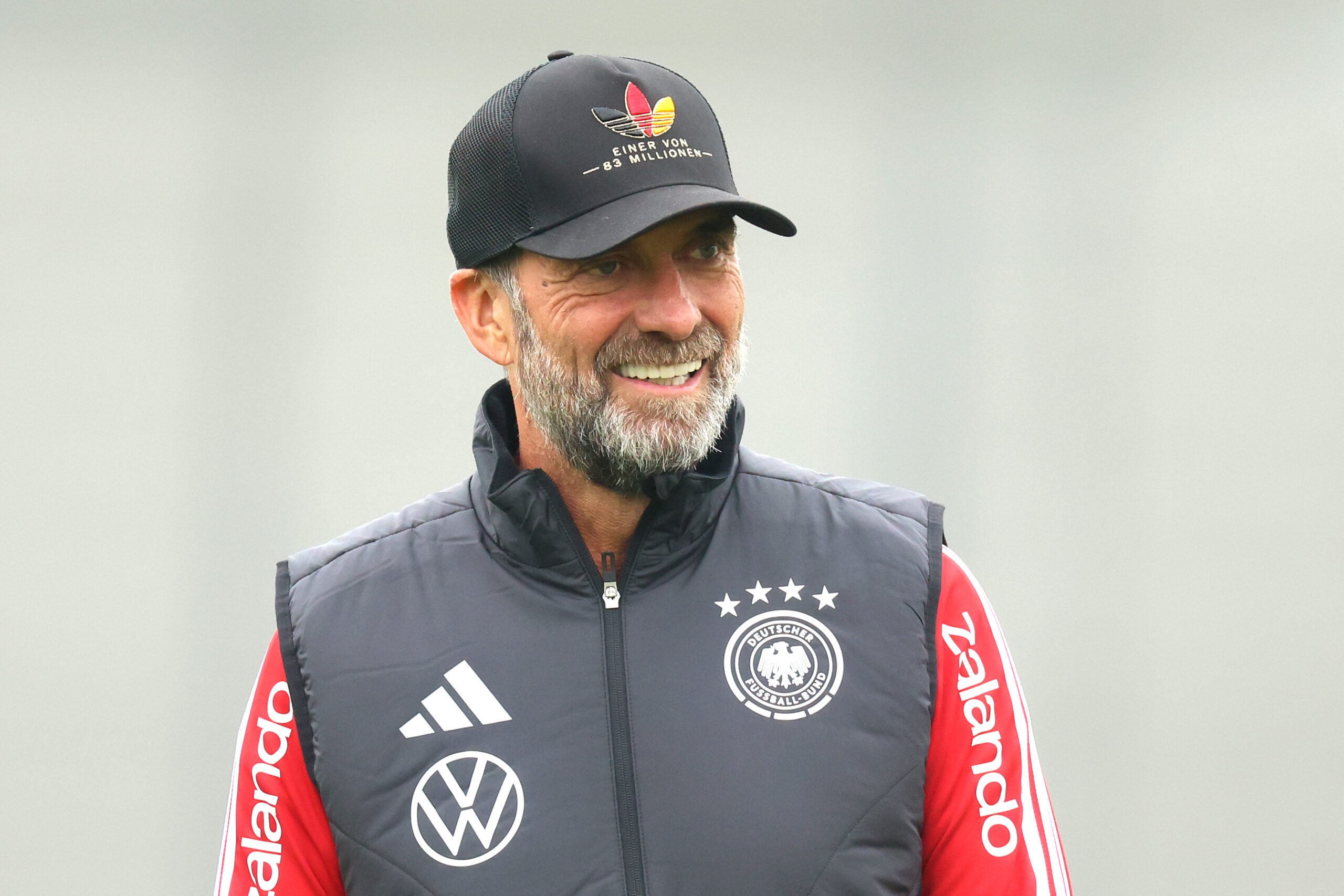

You’d be hard-pressed to find a single sport where Germany aren’t dominating. They simultaneously hold the world and European crowns in men’s basketball, having won their inaugural FIBA Basketball World Cup in 2023, whilst they are also the reigning champions in other sports like field hockey, equestrian, rowing, canoe sprint, bobsleigh and beach handball. And in just a few weeks, they will boast the #1-ranked player in men’s tennis.
Ironically, however, the one sport where Germany is failing to meet expectations is also their national pastime: football. Since winning their fourth World Cup in 2014, Germany have crashed out in back-to-back World Cup group stages before losing on penalties to Paraguay in the Round of 32 this year.
But just why are Germany falling behind on the job, and what needs to change for them to become a heavyweight in world football again under Jürgen Klopp? We spoke to two former Germany internationals in an exclusive Hooligan Soccer interview.
Early Warning Signs
Whilst Die Mannschaft had won the 1990 World Cup and 1996 Euros, Germany manager Berti Vogts had long warned that their talent pool was running dry, and he was proven correct as they finished bottom of their group in 2000. They managed to paper over the cracks by reaching the 2002 World Cup Final, but they regressed to the mean with another group stage exit in 2004.
After a humiliating group stage exit in Euro 2000, Germany hit a hard reset and commenced a cycle that has often been described as ‘Das Reboot.‘ The DFB mandated all 36 professional clubs across the top two divisions to build and run highly regulated, fully equipped youth academies, threatening them with the loss of their professional licenses if they failed to do so.
The German FA built 52 centres of excellence to house the most promising players as well as 366 regional coaching bases for 1,300 professional, full-time coaches, thus ensuring that every kid in Germany lived within 25 kilometers of elite, subsidized coaching. Lastly, they shifted away from relying on physically imposing midfield generals and instead focused on tactically flexible technicians.
These reforms helped to return Germany to the pinnacle of the game, but they also created unintended consequences. Academies increasingly prioritized technical proficiency, positional intelligence, passing and tactical discipline, with young attackers being focused on being team players rather than developing their individual creativity.
The Cure Simply Progressed the Disease
This has resulted in Germany struggling to produce specialist players and failing to transition from their recent golden generation. They still haven’t found a world-class playmaker to replace Mesut Özil, or a lethal center forward to replace Miroslav Klose, or an elite fullback to replace Philipp Lahm, or a tough-tackling holding midfielder to replace Sami Khedira.
It’s no surprise, then, that Germany have struggled to move on from their veteran players. Thomas Müller, Manuel Neuer, Mats Hummels and Toni Kroos have all retired only to return to the fold after they failed to find adequate successors. Rather than establishing a stable new core, Germany has repeatedly turned to established veterans as a temporary solution.
Germany have become far too predictable on the pitch: whilst the 2014 team combined technical quality with directness, pressing, intelligent movement and devastating counterattacks, the following teams have been plagued by superfluous possession, laggard attacking patterns, insufficient movement behind opposition backlines, and vulnerability to counterattacks.
Part of this has been due to their stagnant youth production, and part of it due to their instability at the coaching position. After leading Germany to a bronze medal in his first two World Cups and a gold medal in his third, Joachim Löw’s side received a rude awakening in Russia with their first opening-phase elimination since the 1938 World Cup.
Löw’s Departure Starts a Coaching Carosel
After exiting Euro 2020 at the Round of 16 — the first time in 17 years that they failed to reach the Euro semifinals — Löw departed his post after 15 years at the helm and was replaced by Hansi Flick. Expectations were high for Flick after winning out of a possible nine trophies during his two years at Bayern Munich, but he would last just two years before being replaced by Julian Nagelsmann.
Nagelsmann started off well, with Germany reaching the Euro 2024 quarterfinal on home soil, only to lose to eventual champion Spain in extra time. However, after suffering their first-ever penalty shootout defeat in the World Cup — as well as the first time that they went through three straight World Cups without reaching the podium — the writing was on the wall.
His replacement? None other than Jürgen Klopp. Two years after announcing his retirement, Klopp returned to management and signed a contract through 2030 as Germany’s new manager. He’s already established himself as a legend for Mainz, Borussia Dortmund, and Liverpool, but now, he faces arguably the biggest challenge of his coaching career.
Unlike those previous jobs where he had a transfer market to work with, Klopp will have to work with the players at his disposal, arguably only one of whom (Joshua Kimmich) is world-class. Other players who have flirted with world-class status in the past, like Florian Wirtz and Jamal Musiala, are a long way from reclaiming their peak form.
Thoughts from Thomas Hitzlsperger
“There are several positions where we need to bring in better talent. We are lacking in key areas: we have some really amazing talent in midfield, but a clear number 9 who’s a top goalscorer, we don’t really have that,” stated Thomas Hitzlsperger in an exclusive Hooligan Soccer interview. “Fullbacks, right back, left back, they’re good, but they’re not the best, and that’s where I think we could get better.”
“There are various elements. We have been struggling a little bit in the goalkeeping position,” noted Hitzlsperger, who made 52 caps for Germany between 2005 and 2010, winning a bronze medal in the 2005 Confederations Cup and 2006 World Cup and a silver medal in the 2008 Euros. “I know it sounds strange, because Manuel Neuer is still an incredible goalkeeper, but of course, he’s not the same level as he used to be a few years ago.”
Rough International Break
This lack of talent was on full display in Germany’s first international break, which Klopp used to experiment with 44 different players. After conceding a late equalizer in a 1-1 draw at the Netherlands, Germany lost 1-0 to Greece for the first time before bouncing back with a 2-0 win vs. Serbia. But despite boasting 70% possession and 21 shots, Germany managed just 1 big chance and 0 goals in a draw at Greece.
Germany currently sit third in Group 2 of the UEFA Nations League, five points above Serbia and three behind the Netherlands. If they are to avoid a possible relegation to League B and instead advance to the UEFA Nations League Finals, then they’ll need to claim two wins from two against Serbia and the Netherlands in November.
In contrast to their only win vs. Serbia, where they managed to sustain attacks thanks to their successful counterpressing strategy, Germany struggled to maintain their balance against the Netherlands. Their overly aggressive pressing and lack of coordinated movement left Kimmich isolated in midfield and allowed the Dutch to exploit the spaces in and around him. And against Greece, just like against Paraguay, they once again struggled to penetrate a compact defensive block.
New Blood Shows Promise
If there is a reason for optimism, however, it’s their breadth of exciting new talents. Players like Jonas Urbig (23), who is challenging Marc-André Ter Stegen for the #1 spot and proving that he can be Neuer’s long-term heir for club and country, and Tom Bischof (21) and Aleksandar Pavlović (22), who have forged a promising synergy in midfield. Players like Philipp Treu (25), who impressed at the right back position, and Malick Thiaw (25), who could very well be a shrewd replacement for the retired Antonio Rüdiger in central defense.
“I think the DFB know what they have with Klopp: he will change Germany again by giving chances to young players, like he did this past window with 44 players,” stated ex-Germany international Diego Demme to Hooligan Soccer. Demme helped RB Leipzig emerge from the 3.Liga and become Champions League mainstays, before helping Napoli win their first Scudetto in 33 years.
“There was a time when the entire media here in Germany was negative about the national team, and I think it’s clear that they need to change some players. You have to go with hungry players, and maybe in 3-4 positions, you go with old, experienced players. But I have no doubt that under Klopp, Germany can become what they were 20 years ago.”
German Soccer Might Suffer; Managers will be Fine
Failing with Germany hasn’t stopped Flick from reestablishing himself as one of the best managers in Europe with FC Barcelona, and it likely won’t stop Nagelsmann from getting a lucrative move. If Klopp is unable to bring them back to their glory days, it won’t stop him from being recognized as one of the greatest coaches that Germany has ever produced. After all, it takes more than just a big-name appointment to remedy a decade of consistently declining performances.
Ultimately, Germany’s problem is not a lack of footballing talent, but a development system that hasn’t consistently produced a balanced range of elite players who can form a cohesive unit. And whilst Klopp’s appointment offers a much-needed opportunity to look inward and address their tactical shortcomings, Germany’s deeper structural issues will require changes extending well beyond the Bundestrainer.