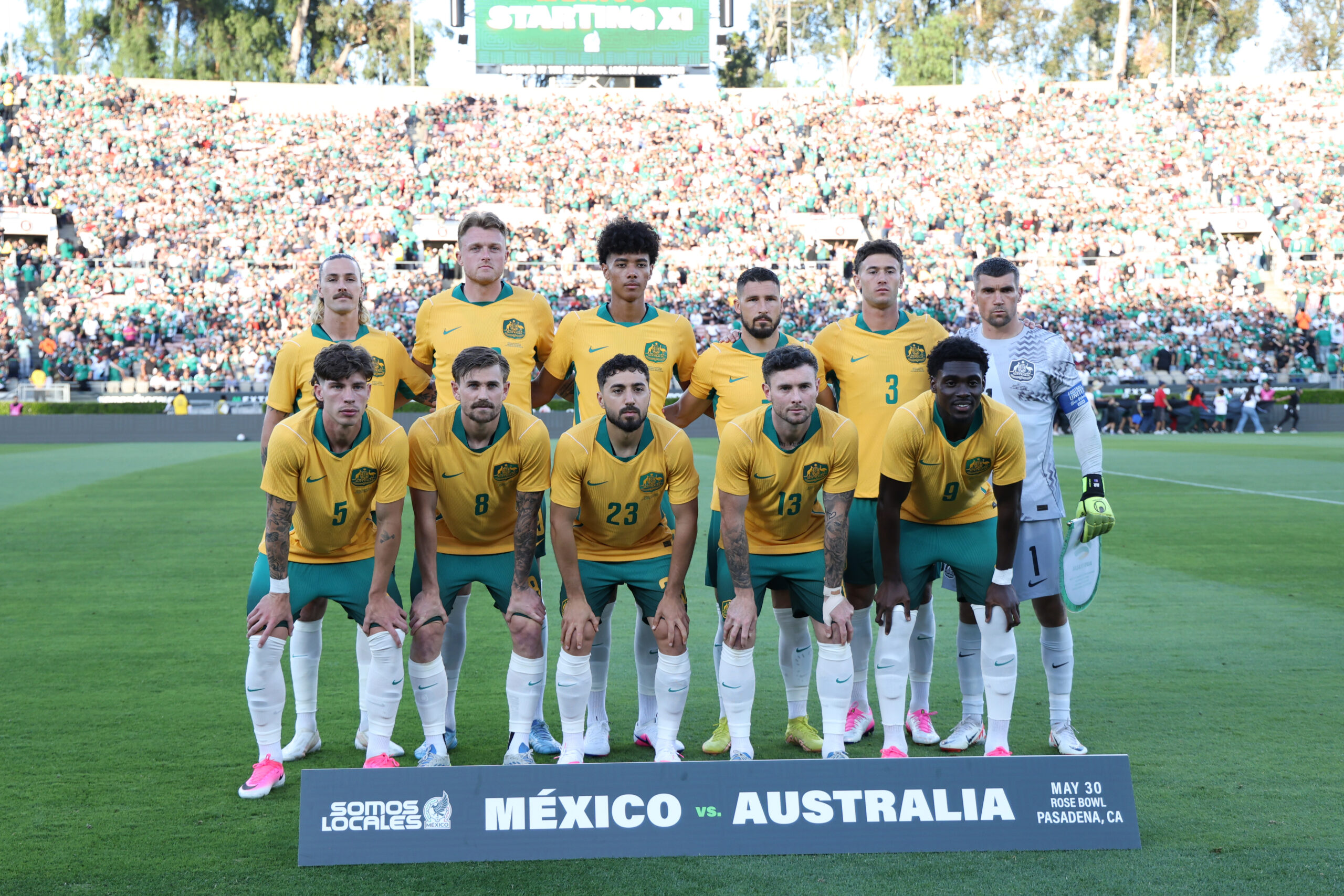

Australia were a bit of a surprise package last World Cup. Coming into a group with reigning champions France and everyone’s favorite dark horse Denmark, most people thought they’d be knocked out easily. The Aussies proved to be very difficult to break down and advanced in second place after a pair of 1-0 wins.
In the round of 16, they came up against eventual champions Argentina. Although they lost, they gave Messi and company a tough game. They only lost 2-1 in the end and had a great chance to equalize with the last kick of the match. Australia will bring the same resolute defensive style into this World Cup.
How They Qualified
As a reminder, Australia compete in AFC (Asia) despite being geographically in Oceania. Since they’re one of the best teams in the confederation, they got a bye to the second round of qualifying. They were drawn into Group I alongside Palestine, Lebanon, and Bangladesh. As expected, this group didn’t give Australia any problems. The Socceroos finished top by winning all six games, scoring 22 goals and not conceding a single one.
That put them into the third round, where they were drawn into Group C. Their opponents were Japan, Saudi Arabia, Indonesia, China, and Bahrain. The top two teams in the group automatically qualified for the World Cup. Australia proved to be hard to beat as usual but their style of football also made it difficult to score goals. They got off to the worst start possible, losing to Bahrain at home in their first match. The slow start continued as they only won once in their first six games. However, they turned it around by winning the remaining four including huge victories over Japan and Saudi Arabia. In the end, they finished second behind Japan and qualified for the World Cup.
Key Players
Jordan Bos
Usually fullbacks are an afterthought or the weak point of a team. That’s not the case for Australia. 23 year old Jordan Bos is the standout of Australia’s new up and coming generation. He got his start at Melbourne City and earned a move to Belgian Pro League club Westerlo in the summer of 2023. Two impressive seasons in Belgium led to a transfer to Eredivisie giants Feyenoord last summer. In his first season in the Netherlands, Bos led his club in assists with nine in all competitions. He also added four goals on the way to a second place finish in the league.
Bos made his debut for Australia in March 2023 at just 20 years of age. He scored his first goal for his country against India in the 2023 Asian Cup. Bos has really come alive for Australia recently. He scored against group opponents USA in their friendly loss against the Americans last October and was the best Aussie player on the day. The two time A-League champion followed that up with an impressive March window. He scored the only goal in a 1-0 win over Cameroon then registered a goal and an assist in a 5-1 win over Curaçao. Bos will be a source of attacking output from left back in Australia’s rigid five-back system.
Cristian Volpato
As has been established, Australia aren’t the most talented team in attack. However, they do have a secret weapon. Cristian Volpato officially filed his one-time switch to join Australia from Italy on May 29, just days before the World Cup roster was set in stone. He adds something that the attack lacked with experience in a top 5 league. Volpato came up through Roma’s youth academy, scoring two goals for their first team as a teenager. He moved to Sassuolo for regular game time and has become an important rotation player for them in Serie A. He scored two goals and provided four assists from the right wing.
Volpato’s switch to Australia doesn’t come without controversy. Last cycle, there was lots of interest from then-Australia manager Graham Arnold in calling up the young winger. After Australia’s 2-0 loss to Japan in qualifiers, Volpato posted on Snapchat making fun of the team. He was offered a place in their 2022 World Cup squad but ultimately turned down the opportunity. It’s fair to say that Volpato will have to make it up to Australian fans, but a strong World Cup would certainly go a long way.
Potential Breakout Player
Lucas Herrington
Australia actually have several players who could have a breakout tournament. 20 year old Watford winger Nestory Irankunda will be a popular choice. 22 year old Norwich City striker Mohamed Touré could score some goals. Ultimately, I’m going to pick 18 year old center back Lucas Herrington, the youngest defender at the World Cup. Herrington is a name that most fans won’t know but might need to learn it after this summer. He came up through the Brisbane Roar youth academy and made 29 first team appearances for the A-League side. MLS club Colorado Rapids saw the potential in Herrington and bought him for $1 million in January. He instantly slotted into the starting lineup and has been impressive in the US.
It’s crazy to think that Herrington didn’t even start for Australia in the U20 World Cup last fall. Fast forward to now and he could be starting for the senior team at the actual World Cup. Injuries to Harry Souttar and Lewis Miller meant Australia needed to bring in some new center backs, so Herrington got the call in March. He immediately started both their friendlies that window, helping to keep a clean sheet against Cameroon. Those performances were enough to earn him a spot in Australia’s World Cup roster. Herrington also started both of their final preparation friendlies against Mexico and Switzerland. He’ll be competing with veteran Cameron Burgess for a spot in the team but all signs are pointing to the youngster getting the nod.
World Cup History
Up until recently, Australia didn’t have much World Cup history to show. The only time they qualified for the tournament before the start of the 21st century was in 1974. They brought a full team of amateurs and did manage to get a draw with Chile but were knocked out in the group stage without scoring a goal. Australia qualified for their second World Cup in 2006 but that wasn’t the only big news. Before that tournament, Australia announced that they would be switching from OFC to AFC. Their reasoning was that the OFC winner always had to go through the inter-confederation playoffs to qualify and that they needed to face stronger opponents in WCQ and continental tournaments. Australia’s final World Cup as a member of Oceania saw them knocked out in the round of 16 by eventual champions Italy thanks to a 95th minute penalty from Francesco Totti.
Since switching to Asia, the Socceroos have never missed a World Cup. However, that didn’t guarantee success. They were grouped in 2010, 2014, and 2018. Across those three tournaments, Australia only won a match once. The most recent World Cup was a bit better for them. They finished second in Group D thanks to a compact defense that kept clean sheets in 1-0 wins over Tunisia and Denmark. The round of 16 saw them face the eventual champions just like they did in 2006. Just like 2006, it was a close game. The Australians frustrated Argentina but came up just short, losing 2-1. They’ll be hoping that they get an easier knockout draw if they make it out of the group this summer.
Coach Profile: Tony Popović
Australia manager Tony Popović had his World Cup dreams ended early in 2006. A mainstay in the national team for a decade, Popović earned 58 caps for the Socceroos. The highlight was qualifying for the 2006 World Cup. It was his last dance as he retired from international football after that tournament. However, it ended tragically as he suffered an injury just 40 minutes into their opening match that kept him out for the rest of the tournament. He did get a nice sendoff game against Paraguay that October where he scored a goal in his final minute of football for Australia.
If you like watching attacking football, Tony Popović is not for you. He was a center back in his playing career and it shows in his coaching philosophy. His Australia team are built around a defensive low block that is designed to be incredibly difficult to break down. They usually play a 3-4-3 but will occasionally line up in a 5-4-1 against high quality opponents. Lightning quick winger Irankunda gives them an outlet to start counterattacks that are their main source of attacking output. Australia won’t be the most exciting team to watch in the World Cup, but their solid defense commands respect and will frustrate their opponents.
Fan Culture
Australia isn’t a traditional footballing nation. The game has long been rejected by many Australians due to its British roots and the popularity of other sports. Australian rules football (AFL) and rugby are more popular than soccer; maybe cricket as well. Most original soccer fans in Australia were of European descent and that is still seen today. Manager Popović is of Croatian descent. Several Italians are in the squad including Volpato.
Despite the hesitancy to accept the sport, Australian fans are still very passionate about their national team. This has been shown by the support for the women’s national team, the Matildas. They hosted the Women’s World Cup in 2023 alongside New Zealand and made it all the way to the semifinals. Australia’s run last World Cup and fight against Argentina brought the country together and another good tournament could work wonders for the popularity of the Socceroos.
Group Stage Fixtures
- June 13, 2026
- Australia vs. Türkiye
- 12:00 AM ET (midnight) / 9:00 PM PT
- June 19, 2026
- Australia vs. USA
- 3:00 PM ET / 12:00 PM PT (noon)
- June 25, 2026
- Australia vs. Paraguay
- 10:00 PM ET / 7:00 PM PT

Braden Hines is a writer and data analyst with a passion for U.S. Soccer. Runs American Ultras Talk on YouTube and X. Works for Carolina Ascent FC and Syracuse Men’s Soccer.