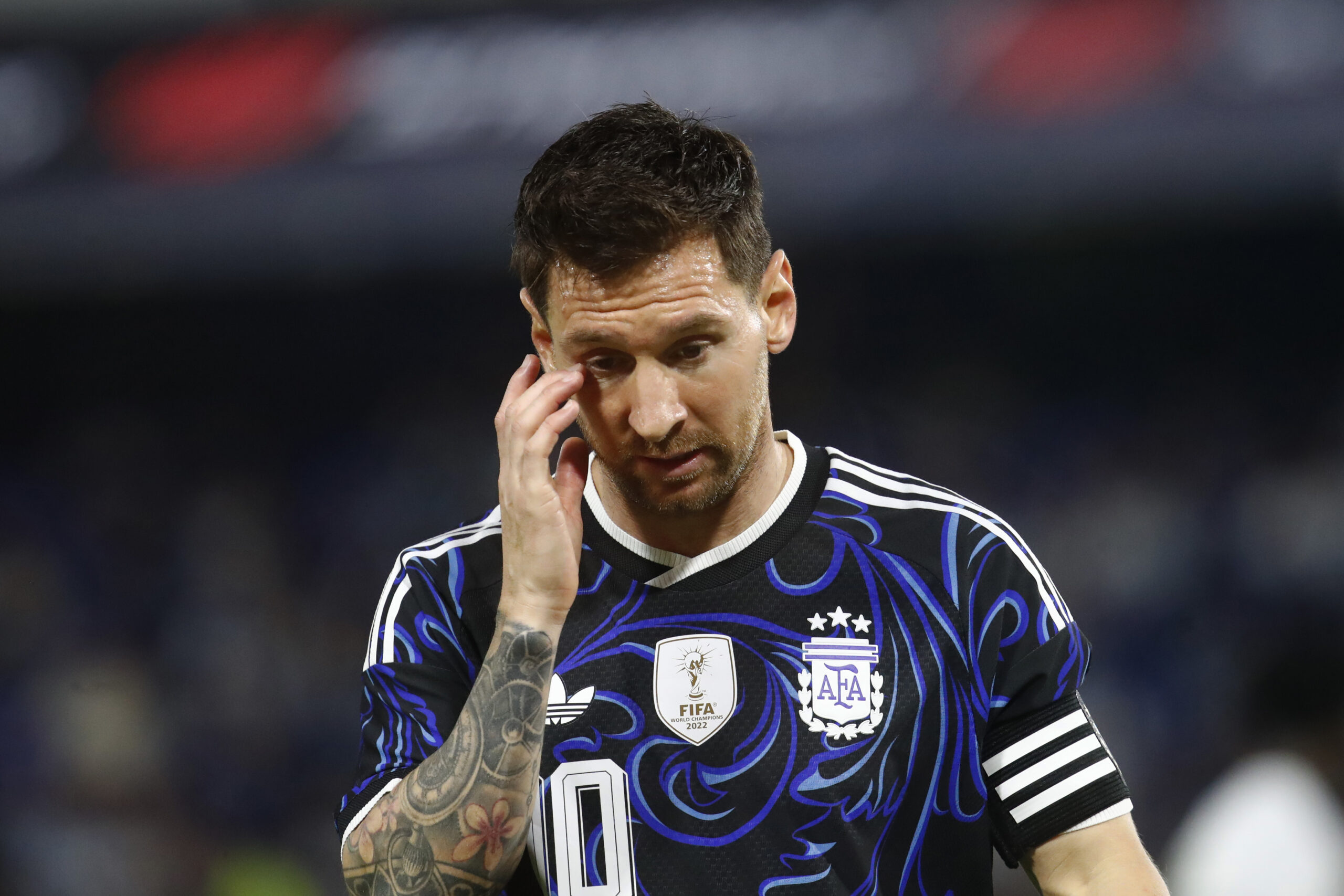
The world champions scraped past Mauritania 2–1 at La Bombonera on Friday night. Two goals in the first half, a quiet second half, a late scare, and a performance so flat that their own goalkeeper said they would have lost to Spain if the Finalissima had gone ahead as planned. If there was a more damning verdict on Argentina’s readiness to defend their World Cup title, it’s hard to imagine it coming from inside the dressing room.
“It was one of the worst games we’ve played, even for a friendly,” Emiliano Martínez said afterwards. “We lacked play and speed. We need a bit more heart. We lacked intensity, defensive solidity, and conviction when defending. Maybe it’s good we didn’t play the Finalissima if we were going to play like this.”
That is Emi Martínez — one of the best goalkeeper in the world — essentially admitting that his team, the reigning world champions, may not be ready for top-level football. That is worth sitting with for a moment.
A Game in Two Halves — Literally
To be fair to Argentina, the first half wasn’t bad. Nahuel Molina put in a dangerous cross that Enzo Fernández converted in the 17th minute, and Nicolás Paz — filling in for Messi on set pieces — curled a stunning free kick through the wall to double the lead before half-time. 2–0, comfortable, job seemingly done.
Then came the second half. Messi entered from the bench to a thunderous La Bombonera crowd. Banners reading “The Best of the Century” unfurled in the stands. And what followed was, by almost every metric, dreadful.
Argentina did not register a single shot on target after the break. Mauritania, a team ranked 137th in the world that has scored just one goal in their last five games, grew into the match, forced Dibu Martínez into several saves, and eventually pulled one back through Jordan Lefort in the dying moments after a scramble inside the box.
At least six or seven players in the second half simply didn’t care. There is no more diplomatic way to put it. They weren’t taking the opponent seriously, they weren’t pressing, they weren’t tracking runs — it felt like a kickabout, not a World Cup warm-up. Mauritania were actually the better side in the second half, and credit to them for that. But the fact that a team with a 137th world ranking outplayed the defending champions for 45 minutes, even in a friendly, should set off alarm bells.
And then there is the question of Valentín Barco, who didn’t even get off the bench. One of the most exciting young Argentine players around, and Scaloni didn’t find a single minute for him in a friendly against the 137th-ranked team in the world. That is a conversation worth having.
Scaloni’s Honesty, and a Painful Context
To his credit, Lionel Scaloni did not hide from it. “We didn’t play well in the second half, and not in the first either,” he admitted post-match. “The team wasn’t good, and it’s right to say it, we have to work and fix it.” He also noted, sombrely, that the mood had been affected by an injury to young squad member Sebastián Panichelli during training. “He was training incredibly well,” Scaloni said. “It was very sad… something really awful, I wouldn’t wish it on anyone. He’s a kid who deserves the best.”
The emotional toll of a serious injury to a young player is real, and it deserves acknowledgement. But a World Cup is 79 days away. Adversity is not going to disappear in North America — it is going to multiply. How a team responds in those moments defines champions.
Scaloni looked visibly frustrated on the touchline throughout the second half, and his words after the game carried the weight of a man who knows what he saw was not good enough. “It’s better that it happens now so we can fix it,” he said. Let’s hope that’s true.
The Real Problem: Argentina Haven’t Been Tested in Years
Friday’s performance didn’t come out of nowhere. It is the product of a preparation cycle that, when you lay it all out, is frankly alarming for a team that wants to make history by becoming back-to-back world champions.
Since lifting the trophy in Qatar in December 2022, Argentina’s friendly opponents — outside of CONMEBOL rivals in qualifying and the Copa América — have been: Curaçao (81st in the FIFA rankings), Indonesia (122nd), El Salvador (99th), Australia, Guatemala (94th), Puerto Rico (156th), Angola (89th), and now Mauritania (137th). That is an extraordinary list for the number one footballing nation on the planet.
In their last eleven friendlies before this window, Argentina won every single game, scoring 33 goals and conceding just two. That sounds impressive until you consider who they were playing.
Martínez acknowledged the problem directly: “We’d have liked to face high level opponents. Before the last World Cup we didn’t face high competition either, but we tested ourselves against Italy and saw we could hold our own. Now we don’t know if we’re actually a top 10 team in the world.”
That is a stunning admission. The goalkeeper of the world champions is saying — out loud, publicly — that he doesn’t know where his team actually stands competitively. Not because of a lack of confidence, but because of a genuine lack of information. They haven’t been tested. And there is something deeply uncomfortable about that.
Why Argentina Can’t Get a Top Opponent
It is worth being fair to the AFA and Scaloni here, because the situation is partly structural. Since UEFA introduced the Nations League in 2018/19, European teams are essentially unavailable for intercontinental friendlies during October and November international windows. They are locked into their own competition, meaning the only realistic window to face a European side is March — and this March, the Finalissima against Spain (which would have been a genuine elite test) was cancelled due to the conflict in the Middle East.
Scaloni put it plainly: “November was the only window in which we could have played against a European side. Before that, they were tied up in the Nations League, and now the suspension happened. People can say whatever they want, but that is the reality.”
He’s not wrong about the structural problem. But there is also a pattern here that predates the Finalissima cancellation, one that Argentine press have been pointing to for months. Some sections of the media at home have been blunt: since Qatar 2022, every friendly has followed the same formula — sporting irrelevance of the opponents and financial appetite. There is a commercial logic to playing in front of packed domestic stadiums against teams that will never beat you. It is just not good preparation for a World Cup.
Contrast Argentina’s approach with Brazil’s. Carlo Ancelotti, from the moment he took charge, made clear he wanted to face representatives from each of the main footballing schools they could encounter: Europe, Asia, Africa, North America. This March, Brazil face France and Croatia. Colombia face France and Croatia. Uruguay take on England. Ecuador test themselves against Morocco and the Netherlands. Argentina play Zambia on Tuesday.
The Complacency Question
Here is the uncomfortable truth that nobody in the Argentine camp wants to say directly, but that everyone watching on Friday could see: some of these players have gotten too comfortable.
This is what happens when you are the best team in the world, when you have won everything there is to win, when your opponents look up to you with reverence before a ball has even been kicked. Mauritania’s coach called it “a historic match” just to be playing Argentina. That kind of aura can be a weapon — but it can also become a sedative.
Tagliafico, one of the most experienced voices in the squad, named “complacency” as the main threat facing the defending champions ahead of the tournament. “It’s also true that it’s not easy to train at that level of intensity five days a week,” he admitted, “and sometimes you do start to relax a bit.”
This is what Friday looked like. A team that has won the World Cup, two Copa Américas, and a Finalissima — that has gone on an unbeaten run stretching years — coasting through the second half of a game against a team that couldn’t score in four of their last five matches. Not because they are bad players. Because the fire, just for one evening, wasn’t fully lit.
Hopefully — and this is the most charitable reading of Friday night — this performance serves as a genuine wake-up call. Not just for the coaching staff, but for the players themselves. Some of those so-called “guaranteed” World Cup spots might need to be looked at again. Competition for places should be fierce right now, and anyone who jogged through 45 minutes on Friday as if they were already on the plane to New York should be looking nervously over their shoulder.
79 Days to Fix It
Argentina’s next game is against Zambia on Tuesday, also at La Bombonera. After that, they are reportedly targeting friendlies against Serbia (June 9, Alabama) and Honduras (June 6, Texas) before their World Cup opener against Algeria on June 16 in Kansas City.
Serbia, ranked 39th in the world, will be the closest thing Argentina get to a meaningful test before the tournament begins. It is not Spain or France, but it will at least tell them something. And with the opener against Algeria just a week later, the timing is tight.
The squad is largely set. Messi, assuming he commits — and there is still genuine uncertainty around his participation — leads a generation that won everything together. Martínez in goal. Romero and Lisandro Martínez in defence. Mac Allister and Enzo Fernández in midfield. Álvarez up front. The talent is not in question.
The question is whether that talent will show up in July with the same hunger that defined Qatar 2022. Whether winning it all has made the destination feel less urgent than the journey once did. Whether a team that has proven itself the best in the world still has something left to prove.
Friday night did not answer that question. If anything, it made it louder.
Argentina face Zambia at La Bombonera on Tuesday, March 31.