
A question was asked about a recently published article highlighting five players who got big transfers after their World Cup performances: “Any Argentinians go up in value?”
Let’s be honest, Argentina didn’t exactly cover themselves in glory during that World Cup final. It’s entirely possible that their negative play, rough tactics and sore loser churlishness might have impacted their market valuations (individually and collectively).
So I did some digging.
It turns out that the prevailing answer is mostly NO, but with caveats. Important caveats, as we’ll explain below, because it’s complicated. It’s also worth pointing out that the window is still open, and this trend may reverse. The only constant is change.
Methodology
There are two factors we’re looking at. The first is the overall value of the Argentinian national team, as calculated by adding the market value of all its players. The second is the relative performance of Argentinian players in the summer transfer window.
All data used in these calculations came from Transfermarkt (glad to have you back!).
National Team Value
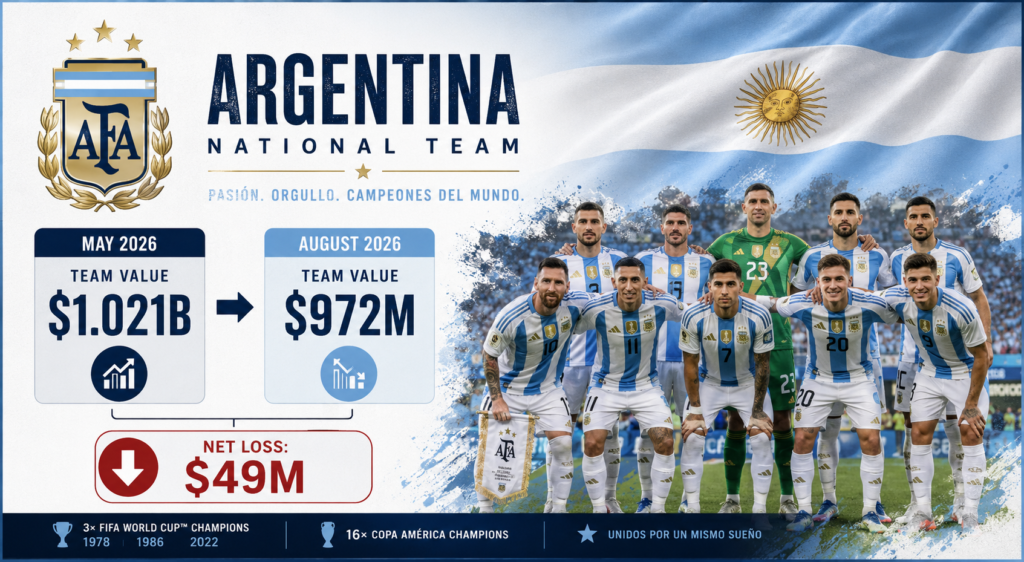
This has gone down.
Back in May I pulled data (including market value) when building my World Cup team spreadsheets. I then compared that to data pulled today. Interestingly, half the Argentine players went up in value; half of them down. But the total decline of those thirteen was much greater than the increase of the others, to the tune of a $49M loss.
In the opinion of this author it’s no surprise the team value took a hit, and deservedly so.
Argentina in the Summer Transfer Window
This one is more complex. At the time of publication, 32 Argentine players have transferred out of, or into, a Top Five league (Premier League, Bundesliga, La Liga, Serie A and Ligue 1). Seven of these were on the World Cup squad. Comparing their transfer fee against their estimated market value, we can tell if they traded for higher, lower or at the same price (within 5% of the value). Here’s how they fared:
- Higher – 6 (1 World Cup player)
- Lower – 5 (2 World Cup players)
- Same – 6 (3 World Cup players)
- Went on Loan – 9
- Left on Free – 3 (1 World Cup player)
- Released – 2
- Undisclosed Terms – 1
So that’s only 35% of player transfers with exchanged fees that went higher. Loans, frees, releases and unknowns were excluded.
Oh, and it turns out for World Cup players the percentage who increased was worse: only 17%. This is not impressive.
One World Cup player of note transferred twice in this period: Facundo Medina. His initial transfer between Lens and Marseille on July 1 was a push at $20.5M; the subsequent trade to Leverkusen on 8/11 was for $26.2M.
Nahuel Molina, who moved from Atlético Madrid to Roma, did so at $2.3M below his valuation.
Compare with England
We wanted to measure Argentina against another strong World Cup side, and England fit this bill. This summer there have been 61 Englishmen who transferred, with the following breakdown:
- Higher – 14 (3 World Cup players)
- Lower – 10 (1 World Cup player)
- Same – 1
- Went on Loan – 10
- Left on Free – 11 (2 World Cup players)
- Released – 0
- Undisclosed Terms – 15
Against the entire data set, 56% of English saw higher transfer fees compared to value. For World Cup players, that increases to 75%.
The biggest value gap belongs to Morgan Rogers, who moved to Chelsea from Aston Villa for $32M over his value.
It’s also worth noting that the player whose value dropped, Anthony Gordon, had the terms of his transfer settled between Newcastle and Barcelona BEFORE the tournament.