
Spanish soccer is currently experiencing a golden era like never seen before.
With the Spanish team lifting the FIFA U-15 World Cup on Friday, La Roja, across all levels, now hold four official FIFA titles. Not just that, they also hold five other major honors simultaneously in an unprecedented era of domination.
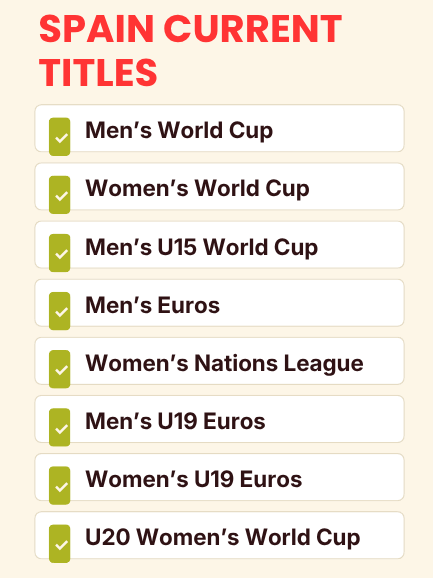
Let’s take a look at how Spanish soccer is slowly taking over the world.
The Men of Spanish Soccer
On July 19, 2026, Ferran Torres’ strike in extra time was all it took for Spain to add a second star to their name, as they won the 2026 FIFA World Cup against Argentina. For the men’s team, it was the culmination of a golden run that started when Luis de la Fuente took over from Luis Enrique following the latter’s disappointing 2022 World Cup campaign.
After a 12-year trophyless run in major tournaments, Spain put an end to that by beating England in the UEFA European Championship final in 2024. That was Luis de la Fuente’s second trophy in charge of Spain, having already won the UEFA Nations League a year prior. For Spain, it signaled the start of an era where they would destroy everything and anything in their path, as shown by their world-record streak of unbeaten games, a streak that they still maintain today. A 2-1 victory over Croatia in the UEFA Nations League in October 2026 brought the streak to 43 games, six games more than the previous record holder, Italy.
In this unbeaten run, which started all the way back in March 2024, Spain have won the UEFA Nations League, the UEFA European Championship, and the FIFA World Cup. Currently the holders of the latter two, they relinquished their Nations League title by losing to Portugal in the 2025 final on penalties. Though they look like favorites to retain it again. And with Luis de la Fuente set to remain manager at least until 2032, he has a chance to add a few more trophies under his belt, with most of his young squad now reaching their prime.
Don’t Rule Out the Women of Spanish Soccer
For a team that had to be born in secrecy under a dictatorship, La Roja Femenina haven’t looked back ever since Spain transitioned to democracy and the team was granted official status. Despite that, the early years of women’s Spanish soccer were turbulent, and it took them nearly 35 years since their inception to qualify for their first-ever FIFA World Cup.
It only took them three editions to win their first, though.
Spain ran havoc through the 2023 FIFA Women’s World Cup tournament, losing only one game in the group stage against Japan and then beating England in the final to win their first-ever FIFA World Cup. This was their first-ever official trophy, marking the start of their own era of domination. Immediately following this title, they won and then retained the UEFA Women’s Nations League in 2024 and 2025, while also reaching their first-ever Women’s European Championship final in 2025.
In a rematch of the 2023 World Cup final, Spain unfortunately lost to England on penalties in the 2025 EUROs final, with the European Championship still the one and only trophy eluding the Spanish women in this era of dominance.
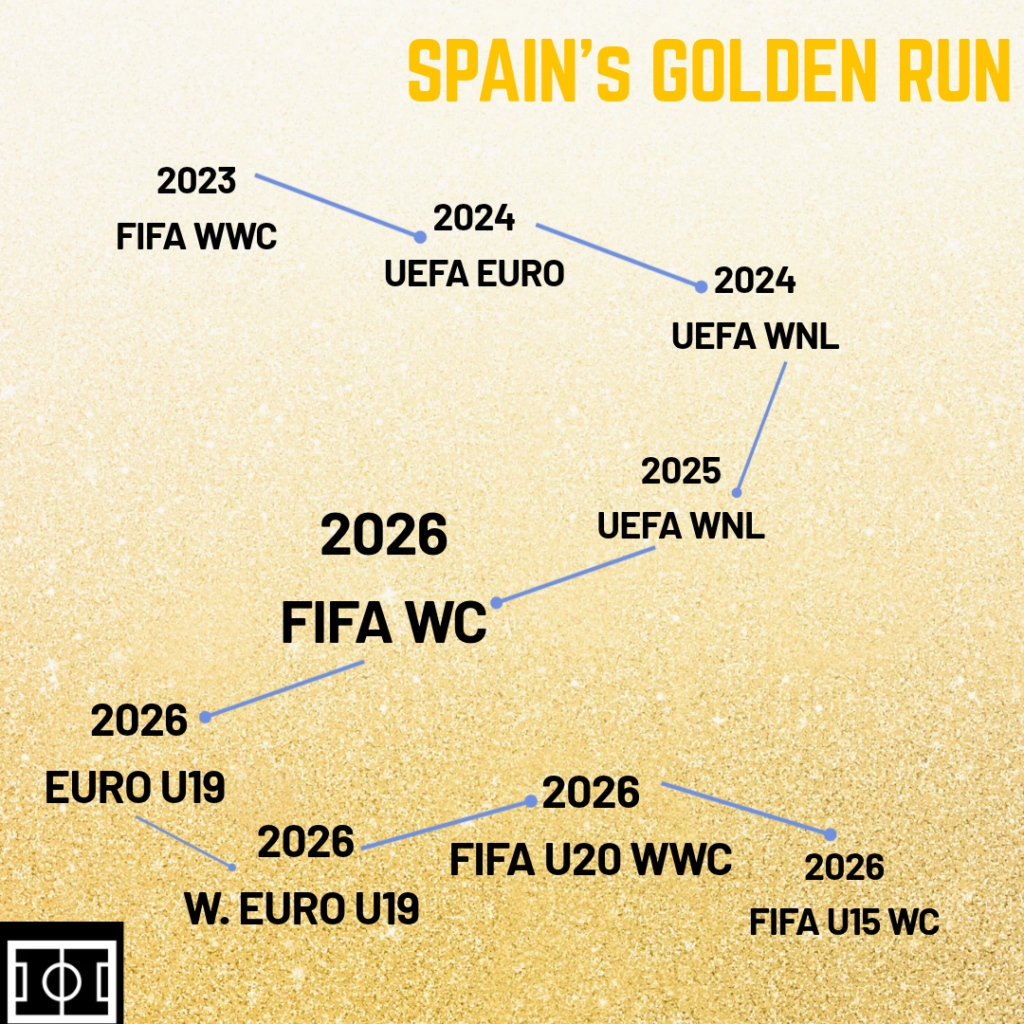
Starting Young; Starting Strong
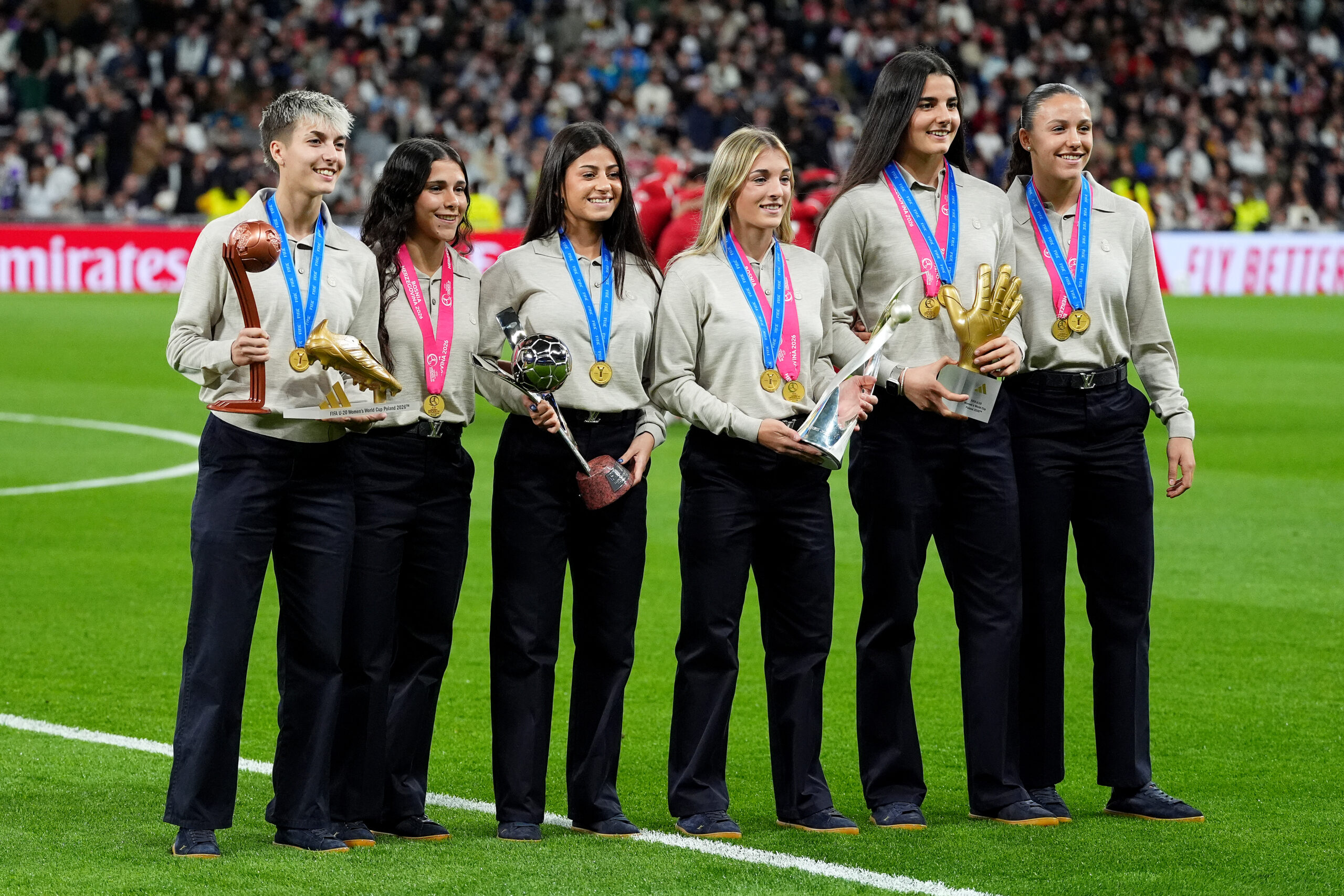
Just like in life, sometimes the first heartbreak often comes young. Spain’s under-20 women lost the 2018 World Cup final to Japan. Four years later, they took their sweet revenge by beating Japan in the 2022 World Cup final.
Four years later, in September 2026, they reached the final again, this time against defending champions DPR Korea, who won the title in 2024. The final remained goalless for 120 minutes, but Spain, who are not the best country when it comes to penalty shootouts, kept their calm and won the shootout comprehensively to lift their second U-20 World Cup title.
But how did the U-20 Spanish women’s team become so good that they won two of the last three editions, despite not winning any titles before?
When you look at the U-19 teams, it all makes sense.
After all, the U-19 Spanish women’s team has only won seven out of the last eight UEFA European Championships. No big deal.
Except for 2019, Spain have won every single U-19 European Championship since 2017, setting a record for the most titles in tournament history with eight. This resurgence is recent and aligns with the rise of Spanish soccer in the modern age. Spain had only won the tournament once, back in 2004, didn’t make any finals until 2012, then made four out of five finals ending up as runners up before embarking on their winning run from 2017.
But what about the boys?
Well, both the Spanish girls (eight) and boys (13) hold the record for the most U-19 European Championship titles.
The 2026 tournament was the U-19 boys’ most dominant of their 13 title wins. They won every single game they played, scored 19 goals, and conceded ZERO in five games. The 2026 final was the third in a row that they played, after winning the title in 2024 and finishing as runners-up in 2025. Only three times have they failed to win a European Championship after qualifying for the tournament, and even then, they were twice semifinalists and once runners-up.
The Newest Crown in Spanish Soccer: The U-15 FIFA World Cup
The first-ever FIFA U-15 World Cup and Festival brought 189 countries together as part of a soccer festival to promote youth soccer and crown the youngest FIFA world champions ever. The boys from Spain once again showed up and went through the tournament unbeaten to win the tournament and become world champions. In 10 matches, they won nine games, drew one, and scored 42 goals to clinch the title.
That means Spain have now won titles across the men’s, women’s, U-20 women’s, U-19 women’s, U-19 men’s, and U-15 men’s levels. Plus, an Olympic gold.
That is domination on a level rarely seen before. When the current crop of senior men’s and women’s teams reach their peak and start to slow down, the next generation will already be ready to take over the mantle. And then the cycle will repeat…
Abhik Deb is an accomplished sports journalist and content creator, renowned for his innovative approach to digital storytelling within the football world. With a Master’s degree in Sports Journalism and Communications from Universidad Europea de Madrid, Abhik brings a sophisticated understanding of both traditional journalistic tenets and contemporary digital media strategies to his work. His professional journey includes a significant tenure as a multimedia journalist at Real Madrid C.F., where his contributions spanned video editing, scriptwriting, and on-camera presenting. Notably, Abhik made history as the first Indian to record a live stand-up from the hallowed Santiago Bernabéu pitch for Real Madrid TV, underscoring his pioneering spirit and influential presence. A specialist in La Liga and Spanish football, Abhik excels at captivating audiences through viral football content and insightful documentary-style videos. His natural ability to blend rigorous journalism with creative digital storytelling is evident in his independent fan channel, ‘LaLigaVic,’ where he cultivates a growing audience through engaging, original coverage of Spanish football culture. Abhik’s proficiency extends to social media strategy and audience engagement, crucial skills in today’s digital landscape. You can explore more of Abhik’s work on Hooligan Soccer and Muckrack. Connect with Abhik on Instagram, LinkedIn, and YouTube to follow his continuous dedication to delivering high-quality, authoritative sports content.