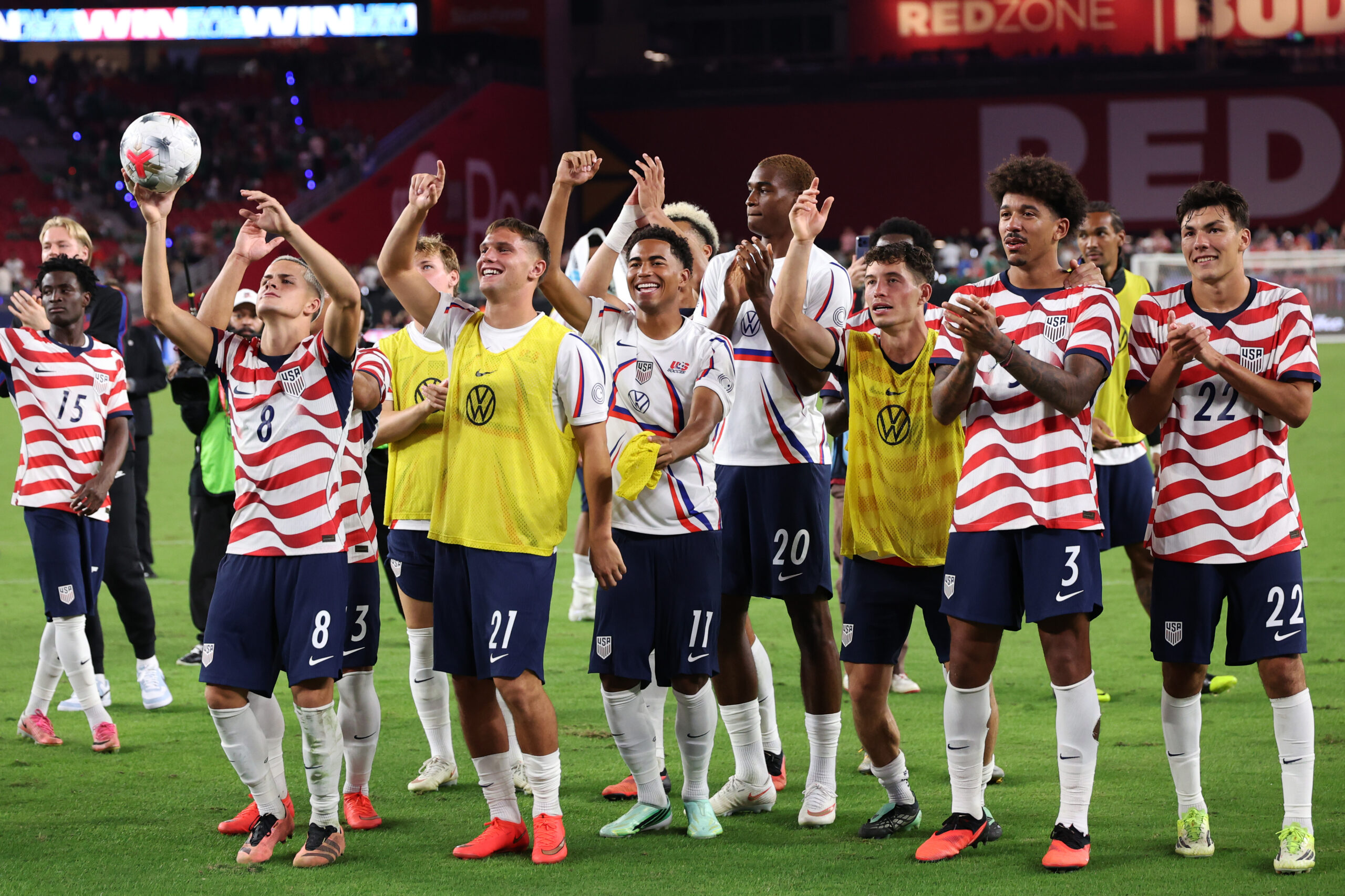

The U.S. men’s national team just wrapped up their first camp since the World Cup. It’s the dawn of a new cycle that will feature the 2028 Copa America, the 2028 Olympics, and culminate in the 2030 World Cup in four years’ time. To say this camp was a success would be an understatement. The USMNT won all four of their matches including shutout victories over Concacaf rivals Mexico and Canada, all while integrating several exciting names into the fold. Here are the top five things we learned about the USMNT during this international break.
1. The Kids Are Alright
Let’s start with the biggest and most obvious takeaway – the kids are alright. The next generation of American talent was given their chance to prove themselves. This window featured 13 debutants for the USMNT. All but one of those players are U21 and eight of them are still teenagers. This is the first youth movement the national team has had since the so-called “golden generation” started breaking through post-Couva. Not only did these kids get the call up, they showed that they belonged.
The USA scored 12 goals this camp. Nine of those directly involved one of the young debutants. Seven goals, one assist, and one drawn penalty that was converted. Julian Hall became the youngest player since the great Pelé to score in each of his first three international appearances. Mathis Albert became the youngest ever goalscorer for the USMNT. That record was broken four days later by Cavan Sullivan. Justin Ellis scored in both of his starts. These players have been hyped up for the last few years, but this level of output in their first taste of senior international football shattered all the expectations.
It’s not just the attacking talent shining through either. 20 year old goalkeeper Diego Kochen kept a clean sheet against Mexico. Peyton Miller, Neil Pierre, and Frankie Westfield all got starts in the back line. Brooklyn Raines and Adri Mehmeti contributed at the base of midfield. Although the big names up front will rightly garner most of the headlines, there is an abundance of talent breaking into the team in every position. After this camp, it’s hard to not be excited about the future of all these young stars.
2. Matt Freese is no longer GK1
Goalkeeper has always been the position that the USA produces the best. The likes of Tim Howard, Brad Friedel, Kasey Keller, Tony Meola, and Brad Guzan had great careers abroad and for the national team. For whatever reason, that production line has taken a hiatus this generation. Several options have been tried with little success and Matt Freese ultimately won the job in 2025. We all know how that ended.
The good news is, the American goalkeeper factory might be back in business. Two new options made their debut this window. Freese was part of this camp as was World Cup GK3 Chris Brady, but it was the new boys who showed out. Each of the four keepers were given 45 minutes across the first two friendlies to earn a starting spot in the more important games against Mexico and Canada. Freese and Brady both were shaky, but Kochen and fellow debutant Brian Schwake fared better.
As mentioned previously, Kochen kept a clean sheet against bitter rivals Mexico. He also didn’t concede in his 45 minutes off the bench against Peru. Although Kochen was only forced to make one save, it was a good one. He reacted quickly to Roberto Alvarado’s volley and tipped it over the bar. Schwake had a similar performance against Canada. He also kept a clean sheet and his best save was also tipping a shot up, this time onto the crossbar.
Both shot stoppers have a key advantage over the other. For Schwake it’s his experience as a 25 year old, for Kochen it’s his ability with the ball at his feet. As expected for a La Masia product, Kochen’s distribution is the best of any goalkeeper in the pool by far. Although it’s still unclear which of the two is currently ahead, one thing that is certain is that it’s not Matt Freese anymore.
3. The depth will be way better this cycle
One of the most encouraging things about the results this window is that they came without several key players. Christian Pulisic, Weston McKennie, and Folarin Balogun were all absent this time around. That’s arguably the three best players in the entire player pool. Other big names like Atletico Madrid’s Johnny Cardoso and PSV’s Ricardo Pepi also missed camp.
Looking back at the World Cup, the USMNT’s depth was a glaring weakness. The starting lineup played well for most of the tournament, but very few bench pieces inspired confidence. Only Sebastian Berhalter and Auston Trusty can really say they belonged out there. Those two earned bigger roles in this window as a result.
Now looking ahead to this upcoming cycle, it doesn’t look like depth will be a problem anymore. In fact, it might even be a strength. If Sergiño Dest isn’t cutting it at right wing, in comes Cavan Sullivan. Folarin Balogun is having an off game? Julian Hall and Justin Ellis are ready to change the game. Christian Pulisic is forced off with an injury? Mathis Albert can be a spark plug off the bench. In the midfield, there’s the likes of Cardoso, Raines, Mehmeti, Aidan Morris, and Tanner Tessmann who weren’t on the World Cup roster but will have aspirations of making it in 2030. It’s looking likely that some quality players who could potentially make a difference will end up missing out on the squad in four years, which is a great problem to have.
4. The USA are a real gold medal contender in 2028
Before we get to the 2030 World Cup, the summer of 2028 has two huge competitions for the USMNT. It’s being reported that the USA will likely host Copa America once again, meaning they have a shot at redemption after the embarrassment of 2024. However, that might not be the highest priority. U.S. Soccer has made it clear that they have lofty ambitions for the Olympics, which will also be held in the United States.
Put simply, winning the gold medal is the goal. Mauricio Pochettino helped pick the manager Steve Cherundolo and the two have been working closely. One of the main reasons so many young talents were part of this camp was to get a better look at the key pillars of the Olympic roster in two years. All of the debutants besides Schwake are age-eligible for the Olympics, which is a U23 tournament on the men’s side.
It may seem like a pipe dream, but winning gold in 2028 isn’t as unrealistic as one may think. Consider that most of the top young stars in the world will likely be playing at either the Euros or Copa America that summer and as a result won’t be released for their clubs. Several of the USA’s prospects could very well be good enough for the Copa America roster, but don’t be surprised if some are held back so they can play in the Olympics instead. The core of that team is looking extremely promising right now, just imagine where they’ll be in two years.
5. Several veteran spots are at risk
The final takeaway goes hand in hand with the point about depth. These talented young players bursting onto the scene have to take roster spots from somebody. Due in part to some lackluster performances in the World Cup and the positions of the upcoming players, some guys that have been USMNT mainstays for years are now suddenly looking over their shoulders nervously. Let’s start with the defense. Kochen and Schwake’s emergence means the two Matts, Turner and Freese, could be in danger of losing their place. Frankie Westfield and Peyton Miller could threaten Joe Scally and Max Arfsten at fullback. Neil Pierre is arguably already better than Miles Robinson and certainly has a much higher ceiling.
Now let’s look at the midfield. This is easily the deepest area of the pitch for the USA. The following players have a reasonable claim for a roster spot right now:
- Tyler Adams, Bournemouth
- Malik Tillman, Bayer Leverkusen
- Weston McKennie, Juventus
- Gio Reyna, Strasbourg
- Sebastian Berhalter, Middlesbrough
- Johnny Cardoso, Atletico Madrid
- Yunus Musah, AC Milan
- Tanner Tessmann, Lyon
- Aidan Morris, Middlesbrough
- Santiago Castañeda, Paderborn
- Brooklyn Raines, New England Revolution
- Adri Mehmeti, Red Bull New York
That’s 12 players for about seven roster spots, without even getting into guys like Gianluca Busio, Jack McGlynn, or Niko Tsakiris. There will be several very good midfielders that get cut from the squad in 2030, most of whom will have a legitimate reason to be upset. It’s unfortunate for those players but a good problem to have for Mauricio Pochettino, especially considering the midfield depth this past summer was Berhalter and Cristian Roldan.
Finally, let’s focus on the final third. Revisiting the first takeaway, the young attackers had a fantastic camp. Sullivan, Albert, Hall, and Ellis all look like they will be key contributors for years to come. Zavier Gozo and Cole Campbell didn’t get to play as much but are still 19-20 year old wingers with bright futures, already plying their trade in Europe. Due to all these future stars, the likes of Timothy Weah, Brenden Aaronson, and Alejandro Zendejas are the veterans most at risk. None of them impressed at the World Cup and appear to have reached their ceiling. At the striker position, guys like Haji Wright and Patrick Agyemang may have already been passed by Hall and Ellis. Even Pepi could be in danger if Pochettino decides to only bring three strikers to the World Cup.
Next Up: Nations League
All of these takeaways will be proven right or wrong in due time, but for now the USMNT turn their attention to their first competitive matches of the new cycle. Pochettino’s men will face Haiti in the quarterfinals of Concacaf Nations League in November. It will be fascinating to see which of this camp’s debutants did enough to keep their spot and which veterans return to the squad. One thing’s for sure – the future of the U.S. men’s national team is exciting.

Braden Hines is a writer and data analyst with a passion for U.S. Soccer. Runs American Ultras Talk on YouTube and X. Works for Carolina Ascent FC and Syracuse Men’s Soccer.