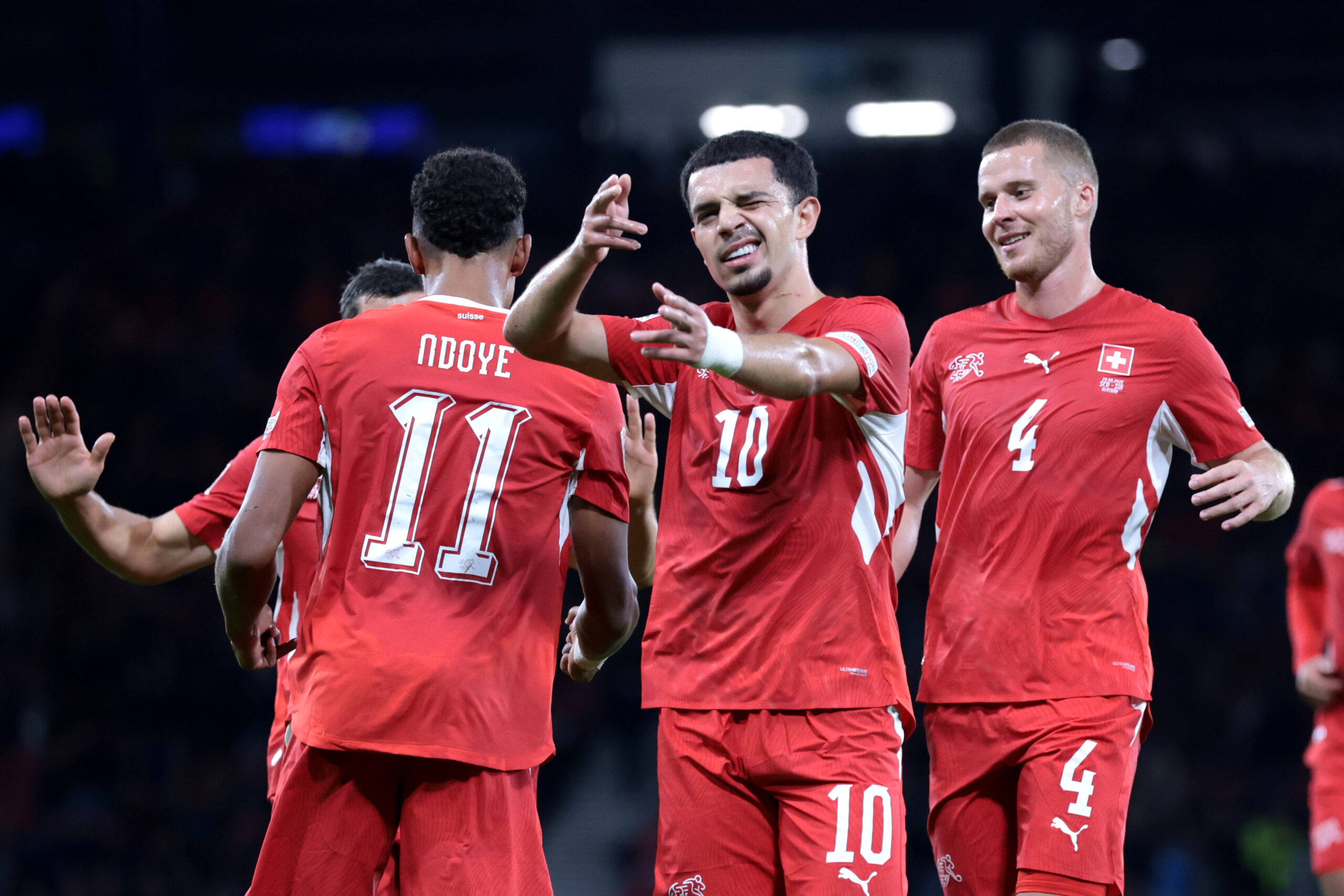

From a bird’s-eye view, it’s all going swimmingly for the Switzerland national team. Switzerland kicked off their UEFA Nations League campaign with a 3-0 thrashing of North Macedonia, with Zeki Amdouni setting up Remo Freuler’s opener in Skopje before producing a brace himself.
It was more of the same on Tuesday, with goals from Ricardo Rodriguez, Nico Elvedi and Amdouni seeing them demolish Scotland 3-0 in Glasgow. However, scratch beneath the surface, and you’ll find a cobweb of controversy that threatened to derail their international break.
Switzerland’s Resurgence
After struggling through the second half of the 20th century, Switzerland started to find its footing in the mid-90s, reaching their first World Cup in 28 years in 1994 as well as their maiden European Championship in 1996. But it wasn’t for another decade that Switzerland started to become a perennial force in European football.
The Nati returned to a major tournament eight years later, exiting the group stage in Euro 2004 and Euro 2008 and the 2010 World Cup, as well as reaching the Round of 16 in the 2006 World Cup. After missing out on Euro 2012, Switzerland enjoyed an impressive showing in the 2014 World Cup thanks to a number of promising young stars like Granit Xhaka, Ricardo Rodriguez, Fabian Schär and Haris Seferović, all of whom would feature prominently in the coming decade.
Despite only having a population of 9 million, Switzerland have managed to punch above their weight in major tournaments and enjoyed their greatest period of sustained success in the post-WWII era. Apart from their 6-1 demolition against Portugal in the 2022 World Cup, you’d have to go all the way back to 1994 for the last time that Switzerland suffered a lopsided elimination in a knockout match.
Switzerland have consistently challenged the biggest teams in the world up until the final whistle. That was the case in 2014, when they held on for 118 minutes against eventual finalists Argentina before eventually conceding to Ángel Di María. It was the case in 2021, when they defeated world champions France before losing to Spain on penalties, and in 2024, when they defeated cup holders Italy before losing to England on penalties.
World Cup 2026
This summer, Switzerland achieved their greatest-ever World Cup performance, finishing atop Group B after beating Bosnia & Herzegovina and co-hosts Canada, before taking care of business with a 2-0 win vs. Algeria. And despite missing breakout sensation Johan Manzambi with a knee injury, they managed to come away with a penalty shootout win vs. Colombia, bucking the trend of 2006, 2016, 2021 and 2024 in the process.
After reaching their first World Cup quarterfinal in 1954, Switzerland looked headed for a comprehensive defeat to Argentina, who broke the deadlock via Alexis Mac Allister after 10 minutes. But they didn’t buckle; instead, they started to dominate proceedings and eventually found a well-deserved equalizer via Dan Ndoye. Suddenly, Argentina’s dreams of becoming the first men’s international team to win four straight major trophies were very much at risk.
And yet, just five minutes after equalizing, Switzerland suffered a self-inflicted wound as striker Breel Embolo received a second yellow for simulation. Without their two biggest attacking threats in Embolo and Manzambi, Switzerland failed to trouble the Albiceleste’s backline, and while they did well to hold on for 40 minutes, they failed to stop Julián Álvarez and Lautaro Martínez from scoring two late goals.
I was there in the post-game mixed zone, and to nobody’s surprise, Embolo was the first to exit the tunnel, trudging past a sea of journalists and photographers like an embarrassed schoolboy who had just been requested to come to the principal’s office. And maybe, just maybe, he knew that it wouldn’t be the last time that he’d be making headlines for the wrong reasons in Switzerland.
Post-Tournament Fallout
Since that last-gasp elimination in Kansas City, a handful of players have called it quits. Right back Silvan Widmer (33) retired after 5 goals in 65 caps in order to give his body more time to recover and concentrate on his Mainz career. Christian Fassnacht (32) also retired after 5 goals in 24 caps in order to finish on a high and make room for younger wingers.
However, the biggest surprise is undoubtedly Noah Okafor, who has “retired” from international football at the ripe age of 26. After making his Switzerland debut in 2019, Okafor played twice in 2021 before playing 9 and 7 times in 2022 and 2023 for Switzerland, but he fell out of favor with manager Murat Yakin the following year and was an unused substitute throughout Euro 2024.
Okafor finally returned to the fold in June 2026, coming off the bench in a friendly vs. Australia for his first appearance in 19 months. However, apart from a 19-minute cameo vs. Algeria, he failed to play a single minute in North America, in stark contrast to 2022, when he played three out of four matches in Qatar, missing one due to a muscular injury.
The Leeds United winger announced on September 10 that he will not return to the national team as long as Yakin is in charge, stating: “My decision has nothing to do with my playing time. Things happened that hurt me deeply.”
“Trust was broken. Commitments were not kept. And when I was allowed to play against Algeria, people reacted to minor mistakes far away from our goal in a way that hurt me deeply. In the weeks that followed, I thought a lot and decided for myself that I no longer want to play for the national team under the current manager.”
Recent Controversies
Things have gone from bad to worse. Switzerland’s captain and all-time appearance maker Xhaka was forced to withdraw from the squad on September 21 after admitting that he obtained a falsified COVID-19 vaccination certificate in 2022.
“At the time, I was deeply unsettled and had serious reservations regarding the Covid-19 vaccination,” lamented Xhaka. “I harboured a deep mistrust of the vaccine and was gripped by fear and uncertainty. In that state of emotional turmoil, I obtained a vaccination certificate instead of addressing my unresolved questions through the proper channels.”
“Today, I clearly see that this was the wrong course of action. It was a mistake. I am sorry. I accept responsibility for this decision, am facing the process of addressing the situation, and am cooperating fully with the relevant authorities.”
Et tu, Embolo?
Four days later, it was revealed that Embolo also lied about receiving the vaccine. The Atlanta United striker ordered two fraudulent COVID travel/test certificates via WhatsApp — one for himself and one for a female acquaintance — in 2021. Embolo was charged with multiple counts of incitement to document forgery and accepted a suspended financial penalty of 20 daily units of 3,000 Swiss francs in November 2025.
Embolo only told the Swiss Football Association just as the details were becoming public on the verge of the international break. The ASF-SFV ultimately decided to keep him out in order in order to avoid an unwanted distraction. Unlike Xhaka, however, his investigation has been closed.
Injuries & Impacts
Switzerland are missing a plethora of other players who were involved in their World Cup squad like Rubén Vargas, Miro Muheim, and Luca Jaquez, with the likes of Aurèle Amenda and Denis Zakaria missing out due to injury. As it has turned out, though, these obstacles might very well end up being a blessing in disguise for Yakin.
With Embolo (29) and Xhaka (34) missing out, Amdouni (25) and Ardon Jashari (24) have been allowed the space to flourish and demonstrate why they could be reliable starters in the future. Moreover, Zachary Athekame (21) has impressed in Widmer’s void and proven why he could be the present and future for Switzerland’s right back position.
Switzerland will now head home to Luzern, where they will host Slovenia and North Macedonia. They wrap up the Nations League campaign traveling to Slovenia and hosting Scotland next month. Currently atop Group 1 with 6 points from a possible 6, Switzerland are more than capable of earning promotion to League A of the UEFA Nations League… even if they don’t have their full A-team at their disposal.