
Over the past month, we’ve seen quite a few shocks to the system in the 2026 FIFA World Cup. We’ve seen Germany lose in back-to-back matches to Ecuador and Paraguay. Debutantes Cape Verde held Spain to a goalless draw, and forced Argentina into extra time. Unfancied sides like Ghana and DR Congo held European giants like England and Portugal to stalemates.
However, there’s absolutely zero doubt that if Switzerland can beat Argentina on Saturday, they will effectively supplant all of those others and solidify the biggest upset of the tournament.
Switzerland’s Steady Improvement
Over the past two decades, Switzerland have gone from unheralded minnows to a consistently disciplined side that punches above their weight. After exiting the group stage in their maiden European Championship in 1996, their second and third participations would see them suffer early exits in 2004 and 2008. And in 2006, their first World Cup in 12 years, they topped their group only to lose on penalties to Ukraine in the Round of 16.
Since then, however, Switzerland have begun to consolidate their presence in the biggest tournaments in the world. After exiting the group stage in 2010 and failing to qualify in 2012, Switzerland would beat Ecuador and Honduras to secure their status in the Round of 16. But just when it seemed that they were headed for a penalty shootout in Brazil, Lionel Messi set up Ángel Di María for Argentina’s 118th-minute winner, with the Albiceleste going on to reach the final.
After narrow losses to Poland and Sweden, Switzerland would finally bare their teeth in 2021, knocking out world champions France on penalties before losing to Spain on penalties in the quarterfinal. They were bounced out of Qatar with a humiliating 6-1 defeat to Portugal, but they would respond in style by knocking out European champions Italy and narrowly losing on penalties to England in the quarterfinal.
Team in Transition
Now in their third major tournament under Murat Yakin, Switzerland have a promising mix of youth and experience that is taking them far in North America. Longtime goalkeeper Yann Sommer retired after Euro 2024, as did attacking talisman Xherdan Shaqiri and defensive bedrock Fabian Schär, with the trio combining for 300+ caps.
But whilst plenty of the veteran leaders are no longer here, there are still a couple of elder statesmen who are holding their own for Switzerland. There’s Remo Freuler (34), Silvan Widmer (33), Ricardo Rodriguez (33), Yvon Mvogo (32), and Manuel Akanji (30). And there’s captain Granit Xhaka (33), who helped lay the foundations for Switzerland’s ascent by winning the 2009 U-17 World Cup as well as reaching the 2011 U-21 Euros.
It might have seemed that Switzerland would go through a transitional period under Yakin after losing so many national team icons, but instead, they’ve only built on their momentum. And it’s why, despite failing to beat Argentina in their seven attempts (including two losses in the World Cup), Switzerland can cause some serious issues to Argentina.
Switzerland may not have a world-class attacker like Lionel Messi, Kylian Mbappé, Erling Haaland or Harry Kane, but they do have a team that is defensively sound and that is more than capable of bending without breaking. They haven’t trailed at any point in the World Cup, including the qualifiers, and they aren’t going to be anywhere near as prone to schoolboy errors.
Switzerland’s World Cup progress
Similar to former champions Argentina and Spain, Switzerland started their tournament by slipping on a banana peel. Despite having the bulk of possession and chances, Switzerland failed to put away the game and ended up conceding a last-second equalizer to Qatar in Santa Clara.
This necessitated a couple of changes, with Yakin preferring Widmer to Denis Zakaria at the right back position, as well as switching from a 4-3-3 to a 4-3-1-2, with Fabian Rieder filling in for Ruben Vargas in attack. They were on level pegging in Inglewood against Bosnia & Herzegovina until the 71st minute, when Yakin made a fateful switch. He brought on Vargas, Djibril Sow, and Johan Manzambi for Michel Aebischer, Rieder, and Dan Ndoye. Just like that, the floodgates opened up, with Manzambi and Vargas working their magic against a fatigued Bosnian backline en route to a 4-1 win.
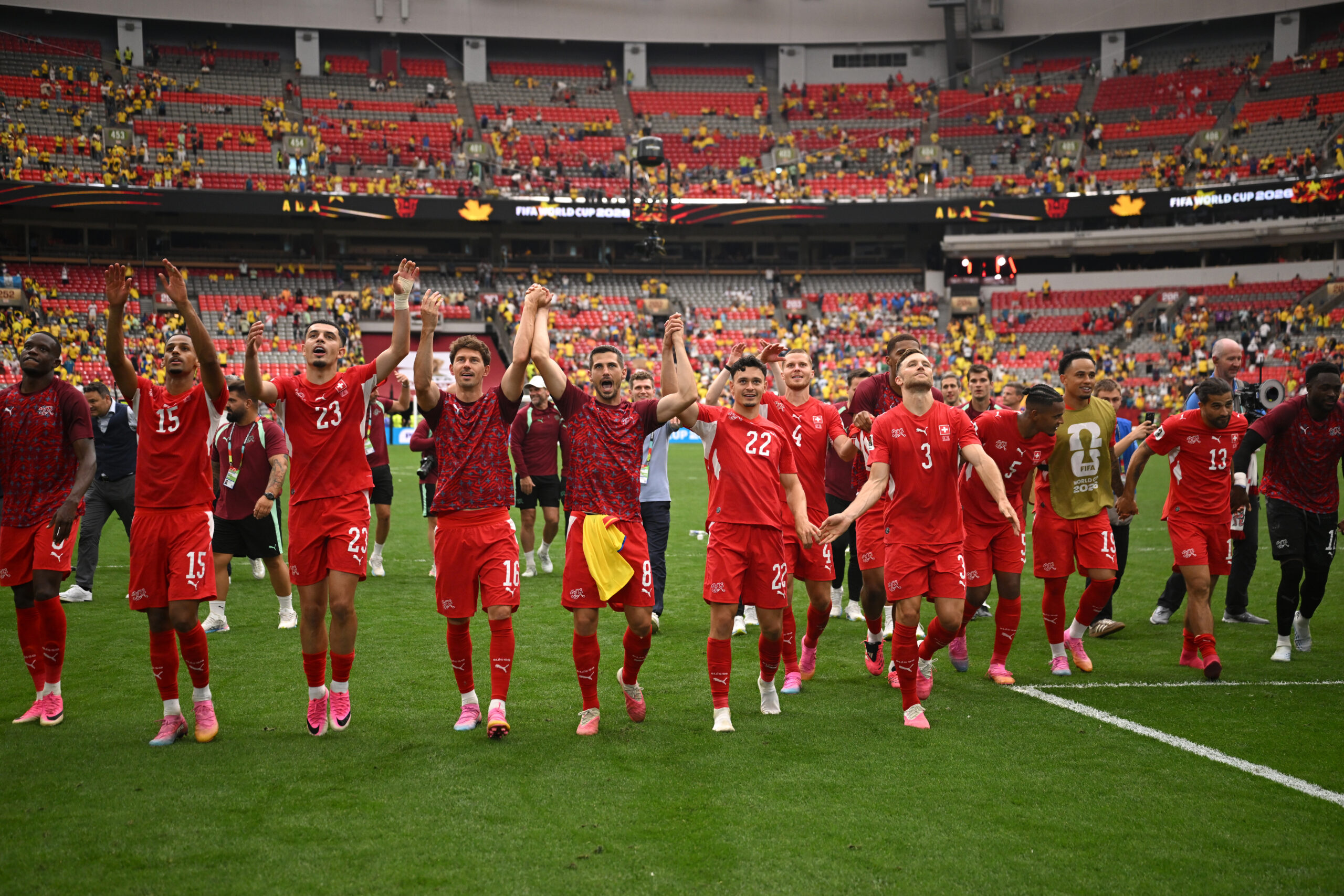
Yakin stuck to that script, replacing Widmer, Aebischer, Rieder and Ndoye for Luca Jaquez, Sow, Manzambi, and Vargas against Canada. Manzambi and Vargas rewarded his trust, scoring in a must-win match vs. Canada to secure the top spot.
Switzerland in the knockouts
The Nati continued their momentum in the Round of 32, with Manzambi shredding Algeria’s defensive block like Swiss cheese and finding Breel Embolo, who made it five straight matches with a goal contribution. And immediately after the restart, Ndoye — who replaced Sow in the XI — doubled the lead to secure Switzerland’s spot in the Round of 16.
This time, they were the underdogs as opposed to the favorites, going up against a Colombia side that had just reached the Copa América Final. If they were going to beat Colombia, they were going to have to do so without Manzambi, who suffered an injury in training. Sow and Vargas also got hurt during training, but they came off the bench.
Switzerland were outgunned by Colombia’s audacious attacking setup, counting on the shot-stopping heroics of Gregor Kobel and the defensive pairing of Nico Elvedi and Manuel Akanji to nullify the opposing danger. The match went to penalties, where Switzerland prevailed 4-3 to return to their first quarterfinal since 1954.
How it should play
After three straight matches in Vancouver, Switzerland will now head to Kansas City to face off against Argentina. Whilst Argentina have been made to sweat in their first two knockout clashes vs. Cape Verde and Egypt, they nevertheless boast a fully fit squad. Switzerland, meanwhile, are still waiting to see whether Manzambi will recover in time from the knee injury that kept him out vs. Colombia.
This match will be won and lost in midfield, with Xhaka and Freuler seeking to cut off passing avenues in the middle and working the ball to the speedy wingers Ndoye and Vargas, who can then combine with Embolo in transition. Argentina’s midfield has come under scrutiny this tournament, with many fans demanding to see Nico Paz and Valentín Barco over Rodrigo de Paul and Alexis Mac Allister, and that might be the one area where Switzerland can come out on top.
The odds are not exactly in their favor. After all, Argentina have won their last three major tournaments, they’ve scored two or more goals in 11 straight World Cup matches, and they’ve outscored Switzerland 15-3 throughout their meetings. And with Messi showing no signs of slowing down, that trend is bound to continue.
But if there’s one thing that Switzerland have proven, it’s that they won’t go down without a fight. After a string of heartbreaking quarterfinal eliminations, can Switzerland put an end to the Albiceleste’s dominance and reach their first-ever major semifinal?