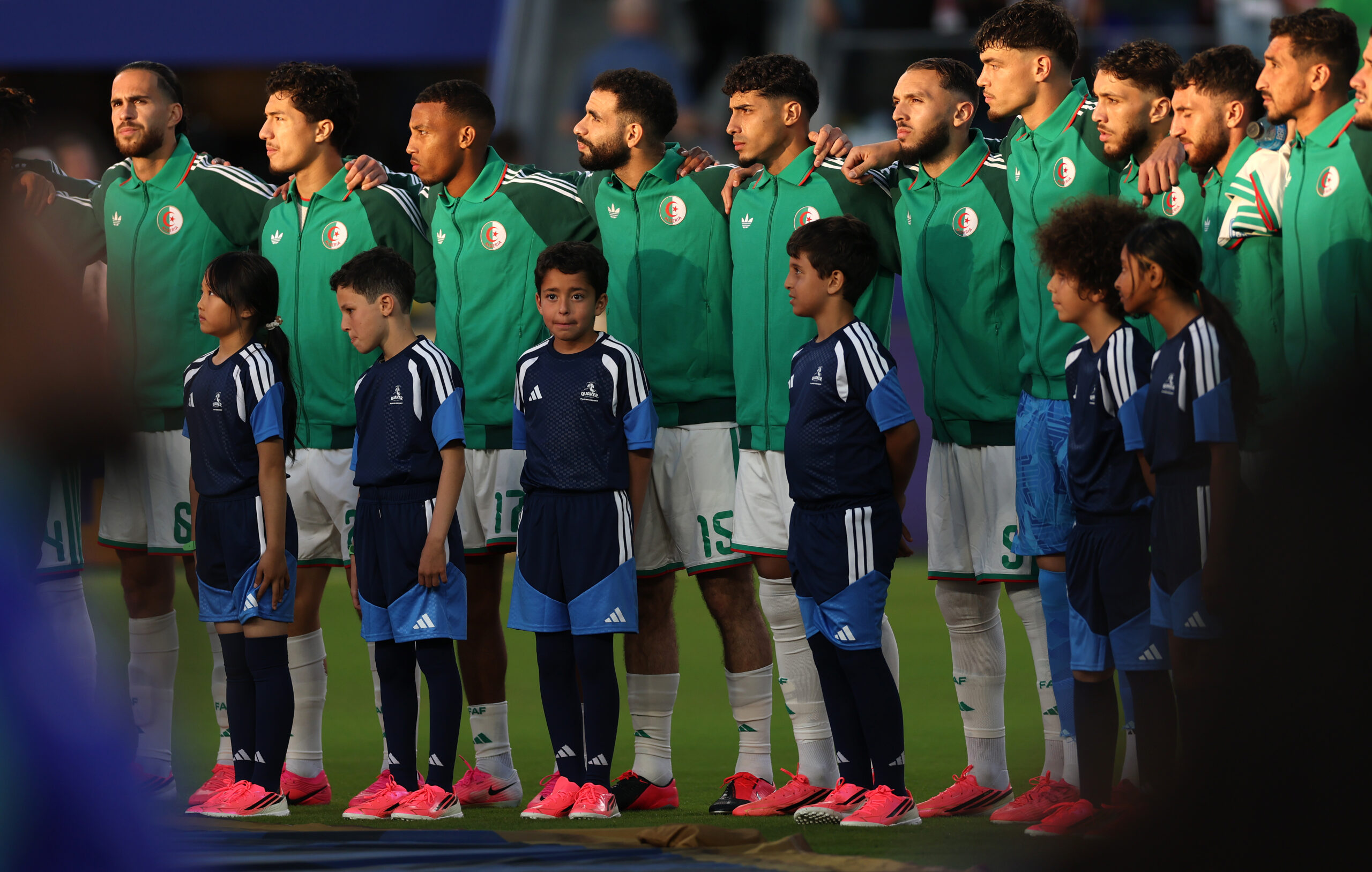

Put mildly, this is the battle of Group J’s less popular “A” teams. Both were soundly defeated by Argentina, though in reality they all fell before the global sensation that is Lionel Messi, responsible for all five of the goals.
But this is somewhat unfair, as each side also earned a victory over the group’s hapless “J” team: Jordan. So they find themselves in Kansas City this Saturday night level on three points, knowing a victory propels them into the Round of 32.
Algeria
They are the “home” team, and this moniker applies in more ways than you think. The national team home training facilities are in Lawrence, Kansas, only 50 miles west of the Kansas City Stadium (which is in the state of Missouri). The local population adopted the team as their own, sporting scarves and kits from the Desert Foxes. The Jayhawks college marching band even learned the Algerian national anthem Qasaram and played it for them as they exited training.
So expect more than your usual ex-pats and Algerian-descended supporters in the stands.
In their opener, Algeria was soundly dismantled by Argentina as a whole, and Lionel Messi specifically. The almost-39-year-old scored his first World Cup hat-trick, assisted in no small part by some questionable goalkeeping by Luca Zidane. Their offense also failed to show up, registering zero shots on frame to make life quite comfortable for the Albiceleste’s backline.
It was a different story against Jordan. Algeria dominated tempo with 72% possession, and doubled the Jordanians in the critical attacking stats like shots (17 to 8), shots on frame (8 to 4) and touches in the opposition box (31 to 14). Critically, they also doubled on the scoreline, winning 2-1. Both goals came from set pieces, with ex-Manchester City star Riyad Mahrez contributing on the game winner.
Algeria’s clean play record (they have only one yellow card), gives manager Vladimir Petkovic the chance to stick with the same starting XI he’s fielded in every game. His one question is who starts up front. Amine Gouiri has a goal and two starts already; Nadhir Benbouali came on to score the winner at halftime, and might get another call.
Possible Starting XI
L. Zidane
R. Aït-Nouri, R. Bensebaini, A. Mandi, R. Belghali
N. Bentaleb, H. Boudaoui
I. Maza, F. Chaïbi, R. Mahrez
A. Gouiri
Austria
I’m fairly sure this Austrian team has flown under most people’s radar, which is a shame. Despite losing 2-0 to Argentina, courtesy of a Messi brace, they weren’t quite as outclassed as Algeria was against that same foe.
Their opener against Jordan also showcased their offensive capabilities. Romano Schmid opened Austria’s account with a lovely curling effort into the upper right corner. Continued pressure forced defender Yazan Al Arab to inadvertently head the ball into his own net in the second half. A late stoppage time penalty converted by 36 year-old Marko Arnautovic, his 48th goal in his 135th cap, gave them a third.
There are questions around their defensive rigor. This is something that manager Ralf Rangnick will no doubt obsess over prior to this match, particularly since his two wingbacks Stefan Posch and Konrad Laimer are both sitting on yellows.
Possible Starting XI
A. Schlager
K. Laimer, K. Danso, D. Alaba, M. Friedl
X. Schlager, N. Seiwald
M. Sabitzer, P. Wanner, R. Schmid
M. Arnautovic
The Ghost of Gijón
Soccer historians will no doubt recall one of the more shameful incidents from the 1982 World Cup, commonly referred to as “The Shame of Gijón.” Algeria had qualified for their first World Cup, registering wins over West Germany and Chile, but losing to Austria. Unlike later competitions, final group matches were not held simultaneously. Crucially, West Germany and Austria played knowing that an Austrian loss by one or two goals would result in both teams advancing.
To nobody’s surprise, West Germany won 1-0. Horst Hrubesch got that goal in the 10th minute. Then both sides appeared to simply stop trying, as if content. In the second half, only three shots were taken, zero on frame. Both sides completed 90% of their passes.
Algeria’s protests fell on deaf ears at FIFA. The German and Austrian camps both issued vociferous, mendacious and outright racist denials of collusion. What did change, however, is that in all future competitions, final group stage ties would be scheduled to minimize collusion and match-fixing.
The Hooligan Take
Forty-four years is a long time to hold a grudge, but I have relatives who’ve held them longer. In terms of this 2026 match, I think it will be heated and passionate. A draw here would advance both, with second and third tumbling down the cascade of FIFA implemented tiebreaker criteria.
Maybe that’s for the best.

The Qooligan is an alias of Hooligan Soccer founder Q Williams. Q is a 20+ year veteran of numerous technology and media companies, including MTV, Gracenote, Watchwith and Crunchyroll. He has a master’s degree in European History from Columbia University. Q is also a respected Sports Journalist with extensive experience in Soccer, particularly the Premier League, Champions League, MLS and USL. The Qooligan provides analysis and valuable insights based on years of professional practice. Connect with The Qooligan on X and Bluesky. He is committed to delivering accurate, trustworthy content that reflects expertise, experience and no shortage of attitude.