
The FA Cup is often decried as losing its magic, but this weekend showed it could be a fertile ground for tactical experimentation. Whereas the Premier League has become rigid, with teams competing for every point, managers avoiding risks, and goals per game at one of their lowest levels in years… the FA Cup feels different. Managers seem willing to take risks, not just in selection but in tactics too.
Could the competition be the key to rescuing domestic football’s entertainment value? Potentially, provided it doesn’t just manufacture entertainment via ridiculous officiating. Without further ado, here’s what we noticed.
Villa vs Newcastle: Chaos, Cards and VAR Lessons
Did this match make hypocrites of us all when it comes to VAR?
Because what it laid bare is just how essential VAR has become. The future of elite officiating cannot realistically exist without it. Anyone still clinging to the idea of scrapping VAR was made to look naïve here. The takeaway is not to remove VAR – it’s to improve it. That feels non-negotiable after this.
Villa made seven changes, yet Morgan Rogers who has featured in every match this season – started again, underlining his importance. Newcastle, meanwhile, arrived weakened. Bruno Guimarães is out for eight weeks with a hamstring injury and Jacob Ramsey was deployed in a double pivot alongside Sandro Tonali – a fresh structural tweak – and did so back at his former club, which added an extra layer of intrigue.
Tactics Quickly Became Secondary
Villa opened the scoring through a brilliantly choreographed set piece. Rogers shaped to shoot from distance – playing into Villa’s reputation for defying xG with long-range efforts … only to step over it. Douglas Luiz clipped a clever ball over the top for Tammy Abraham, who was clearly offside. With no VAR in operation until the fifth round, the goal unbelievably stood.
The officiating errors piled up. Harvey Barnes was brought down in the box – no penalty. Lucas Digne launched into a dangerously high challenge on Murphy – no red card. Then chaos ensued.
Goalkeeper Marco Bizot raced far from his goal near the end of the first half, fouled a Villa player, and was sent off. Leon Bailey was sacrificed, and Emiliano Martínez entered the fray. The game had lost any sense of rhythm.
And still the curious decisions kept coming. Digne handled inside the area from a Kieran Trippier cross, yet the referee bizarrely awarded a free kick outside the box. From that free kick, Tonali struck from range. A deflection carried it beyond Martínez. With Villa down to ten men, momentum swung decisively.
Newcastle Sensed the Swing
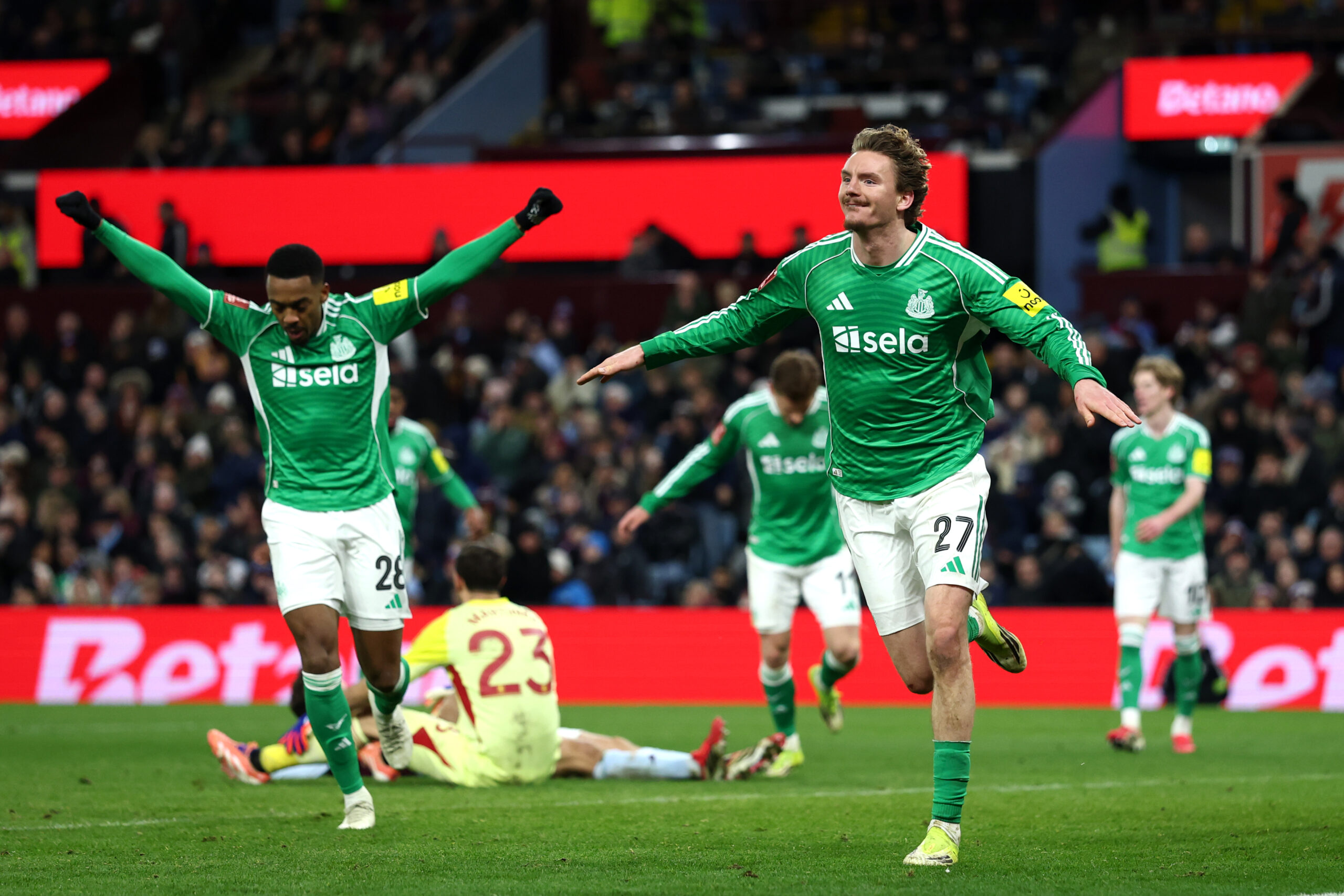
Anthony Gordon hit the post. Tonali then scored again from the edge of the D — this time a clean, authoritative strike. Ironically, Villa – a side known for outperforming their xG through speculative long-range shooting – were undone by the very same tactic. Newcastle outdid them at their own game.
Whilst the scoreline suggests a thriller, in truth both sides finished with under 1.0 xG – a reminder that this wasn’t a chance-heavy thriller but a game defined by moments and errors. A match that told us as much about refereeing infrastructure as it did about football. A case study in why modern football cannot function without technological support.
Arteta RELEASES The Handbrake
Arsenal experimented against Wigan Athletic, with Eberechi Eze playing deeper and delivering precise through balls to the likes of Madueke. By playing more as a regista, he was able to have more space in which to play his balls into – whereas closer he is to goal, he faces more roadblocks. In a strange way, this mirrored the zones he occupied whilst at Palace where by playing a compact block, he could initiate attacks from deeper on the pitch knowing the opposition left space in their own third for him to drive or play passes into.
Another drastic Arteta invention was Bukayo Saka excelling in the number 10 role. He drifted into central zones or right half space zones to dribble past defenders and create space, completing 25 of 26 passes (96%) and delivering a key pass. With no Ødegaard occupying that zone, and Madueke to the outside of him – Saka played with no restriction and could escape the excessive marking he faces in wide areas.
Within half an hour, Arsenal were 4–0 up. However, the underlying numbers show caution: the team generated just 1.44 xG, almost entirely in the first half, and created only one big chance in the second. The tactical tweaks were effective initially, but the drop-off demonstrates that positional experimentation must be executed with intensity throughout to remain a genuine threat.
Liverpool’s Midfield Sparks and Salah Revival
Next up, Liverpool’s ‘feel good’ win against the Seagulls which featured some standout performances.
Kerkez was the butt of jokes at the start of the season but has had a recent upturn in form and put in a really enterprising performance going forward, providing the assist for Curtis Jones’s goal. Aggressive, dynamic – he’s beginning to show signs of the left-back Bournemouth developed.
Mohamed Salah, once again hugging the touchline, looked tactically more cohesive than we’ve seen this season. Even if he isn’t the exact footballer of old, he’s still impactful. From a tactical cohesion perspective, this was one of Salah’s best performances of the season. He won a penalty, which he then converted, summing up an overall brilliant showing.
One player who also deserves a mention but hasn’t been short of praise this season was Dominik Szoboszlai. With Curtis Jones handed the right back berth, Szoboszlai strode like a colossus in midfield alongside McAllister. The Hungarian’s goal which involved running onto Salah’s assist, highlighted his box-to-box ability and growing prowess as a goal scorer. He’s beginning to show glimpses of the Leipzig Szobo – trademark excellent ball striking and a real threat in attack.
Burnley’s Self-Inflicted Collapse
Scott Parker’s job at Burnley F.C. now looks under serious scrutiny. Against Mansfield Town F.C., Burnley dominated large stretches – 64% possession, 2.82 xG to 0.63 but ultimately lost 2–1.
Fiorentino Luís was neat but occasionally sloppy, and Laurent summed the performance up and their season so far: hero to zero. Brilliant goal followed by a lackadaisical defensive moment at the far post.
Burnley’s concentration lapses and giveaways allowed Mansfield to capitalise. Despite loyalty from the chairman, failure to beat a mid-table third-tier side compounded by a dwindling fan support and no winter transfer backing suggests Parkers days are increasingly numbered.
The Pythagoras Perspective
Ultimately this weekend’s FA Cup action offered a reminder of why the competition still matters. From Burnley’s collapse to Villa–Newcastle’s chaos, Liverpool’s tactical sparks, and Arsenal’s positional experiments, the Cup continues to be a platform for managers to experiment, for players to shine, and for football narratives to unfold in ways the Premier League rarely allows. The magic may not be gone – it may just be evolving.